
Official statement
Other statements from this video 20 ▾
- □ Pourquoi Google ne peut-il jamais garantir que vos utilisateurs atterriront sur la bonne version linguistique de votre site ?
- □ Faut-il bannir les redirections automatiques pour les sites multilingues ?
- □ Faut-il bloquer l'exécution JavaScript pour les SPA avec SSR ?
- □ Faut-il baliser les mots étrangers avec l'attribut lang pour le SEO ?
- □ Le contenu dupliqué entraîne-t-il vraiment une pénalité Google ?
- □ Le rel=canonical est-il vraiment pris en compte par Google ou juste une suggestion ignorée ?
- □ Les FAQ dans les articles de blog sont-elles vraiment utiles pour le SEO ?
- □ Hreflang est-il vraiment obligatoire pour gérer un site international ?
- □ Le cache Google a-t-il un impact sur votre référencement ?
- □ Les résultats de recherche localisés : comment Google adapte-t-il vraiment son algorithme selon les pays et les langues ?
- □ Le noindex est-il vraiment inutile pour gérer le budget de crawl ?
- □ Faut-il vraiment se limiter à une seule thématique sur son site pour bien ranker ?
- □ Combien de liens peut-on vraiment mettre sur une page sans pénalité Google ?
- □ L'URL référente dans Search Console impacte-t-elle vraiment votre classement ?
- □ Le nombre de mots est-il vraiment inutile pour le référencement ?
- □ Faut-il s'inquiéter de réutiliser les mêmes blocs de texte sur plusieurs pages ?
- □ Les URLs bloquées par robots.txt mais indexées posent-elles vraiment problème ?
- □ Faut-il vraiment dupliquer le schema Organisation sur toutes les pages du site ?
- □ Les avis auto-hébergés peuvent-ils afficher des étoiles dans les résultats de recherche Google ?
- □ Pourquoi les fusions de sites Web génèrent-elles des résultats imprévisibles aux yeux de Google ?
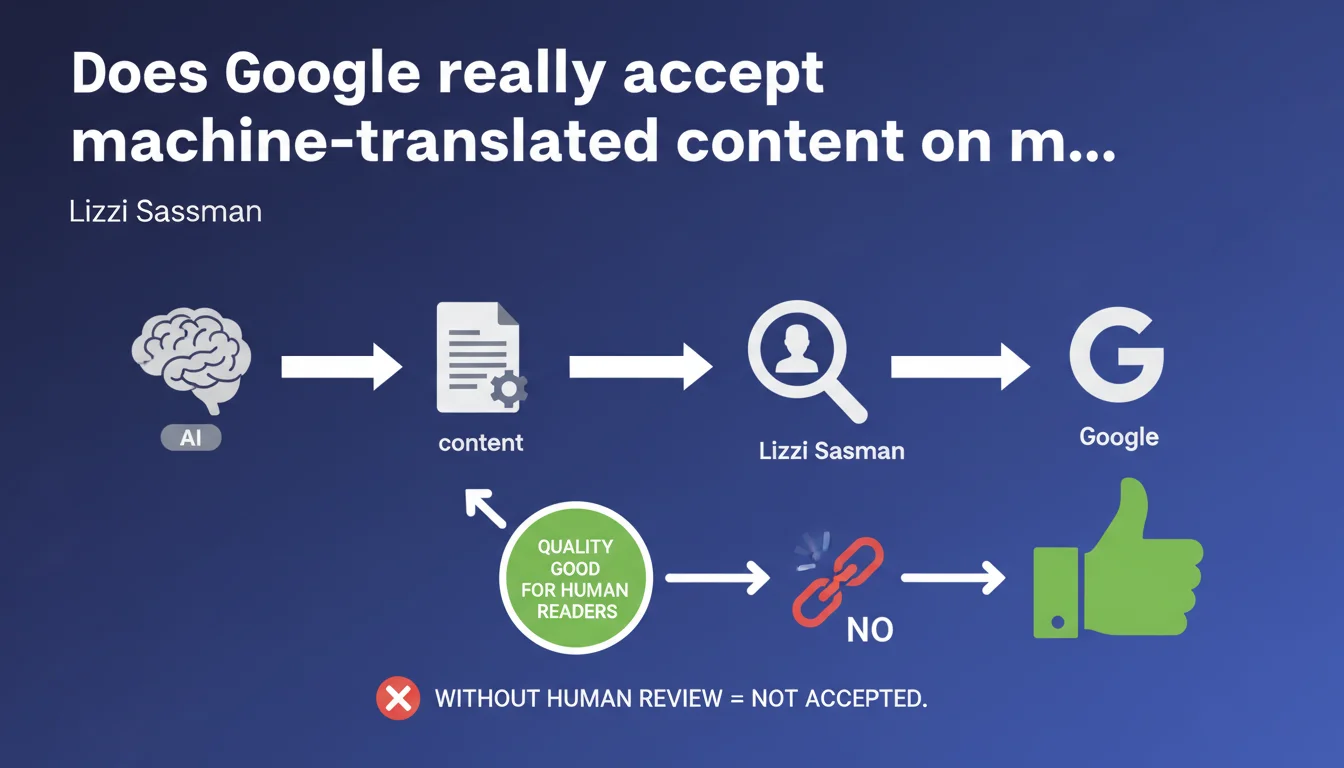
Google accepts automatically translated content as long as a human reviews and validates the final quality. The algorithm does not penalize machine translation in itself, but the quality perceived by the user remains the determining criterion. In practical terms: translate what you want using DeepL or similar tools, but review seriously before publication.
What you need to understand
The position of Lizzi Sassman clarifies a gray area that has been lingering since the emergence of high-quality automatic translation tools like DeepL, Google Translate, or multilingual LLMs. For years, the consensus in the SEO community was that you either had to translate manually or accept mediocre content with ranking consequences.
This official statement formalizes what some practitioners were already observing: Google does not detect — or does not penalize — automatic translation as such. What matters is the final result for the user.
What does Google mean by "human validation"?
The term remains intentionally vague. You could imagine it's a continuum: from a simple review to catch gross mistranslations to in-depth revision by a native speaker. Google does not set a quantifiable standard, which leaves considerable room for interpretation.
What's essential for the algorithm is that the final content does not generate negative signals: abnormal bounce rate on the translated version, lack of engagement, ridiculously low session duration. If your behavioral metrics are consistent across language versions, you're probably in the clear.
Why this tolerance now?
Two factors converge. First, the quality of automatic translation has made a spectacular leap forward with neural models — some closely related languages (English-French, Spanish-Italian) achieve near-human quality on factual content. Second, Google understands that the alternative to validated machine translation is often... no translation at all, hence zero content for certain geographic areas.
Allowing this hybrid approach enables Google to index more multilingual content of acceptable quality, which serves its users and its advertising business model.
- Automatic translation alone is not penalized by a specific filter
- Quality perceived by the end user remains the decisive criterion
- Human validation can be minimal as long as the result is consistent
- Google implicitly encourages multilingual expansion rather than inaction
SEO Expert opinion
Is this statement consistent with observed practices?
Honestly, yes. Over the past two years, we've seen e-commerce sites translate their product sheets automatically with light review and maintain decent positions in local SERPs. Conversely, sites with 100% manual translation but poor or outdated content struggle. This confirms that Google measures overall user satisfaction, not the production method.
The real red flag is when automatic translation produces gibberish that drives users away in three seconds. There, Core Web Vitals and engagement metrics collapse, and the site drops — but that's an indirect consequence, not an anti-translation penalty.
What nuances should be noted?
Watch out for languages with distant structures. Translating English to Japanese or Arabic with superficial validation is playing with fire. Cultural misunderstandings, inappropriate phrasing, or register errors often go unnoticed by non-natives. [To verify]: we lack data on algorithmic rejection rates by language pair.
Another critical point: YMYL content (Your Money Your Life). Automatically translating medical, financial, or legal information, even with review, carries enormous reputational risk. Google could apply stricter quality thresholds on these verticals, even if not explicitly stated.
In what cases does this rule not apply?
If you translate automatically generated content in bulk without any human intervention, you fall into the "automated spam" category. Google doesn't mince words on this, especially if the translated content itself comes from scraping or AI paraphrasing with no added value.
Similarly, if automatic translation is used to create doorway pages — nearly identical language versions just to capture long-tail traffic without intent to serve the user — it's non-compliant with guidelines. The context of use matters as much as the method.
Practical impact and recommendations
What should you do concretely to stay compliant?
Define a minimal validation workflow based on content criticality. For strategic evergreen content (pillar pages, landing pages), review by a native speaker remains essential. For secondary informational content (blog, product FAQ), a quick pass to correct glaring errors may suffice.
Test your automatic translations with real users of the target language. If no one blinks, it's probably good enough. If feedback mentions "weird" or "robotic" phrasing, you're in the red zone. Translation tools provide a confidence score — use it to prioritize segments for review.
What errors must you avoid at all costs?
Never translate technical SEO elements (title tags, meta descriptions, URLs, internal link anchors) without validation. A word-for-word translated title may be grammatically correct but target a completely different intent. Keywords don't translate linearly — "meilleur avocat Paris" doesn't become "best lawyer Paris" in English, but "top attorney in Paris."
Also avoid automatically translating customer testimonials or reviews. Nothing looks more suspicious than a review that sounds like Google Translate. If you must translate this type of content, rephrase entirely while preserving meaning, or request permission from the customer to publish a professionally translated version.
How do you verify your implementation is compliant?
Analyze your metrics by language version in Google Analytics 4. If a language shows abnormally high bounce rate or ridiculously low session duration, that's a signal the translation isn't holding up. Compare performance between languages at equivalent traffic volume.
Use Google Search Console to verify that your translated pages are properly indexed and not generating language-specific crawl errors. If you notice low indexation rates on certain languages while content is published, it may be that Google judges quality insufficient.
- Implement a human review process, even light, for each language
- Prioritize review based on commercial criticality and YMYL of content
- Test automatic translations with native speakers before mass deployment
- Adapt keywords and SEO metadata rather than translating them literally
- Monitor engagement metrics by language to detect warning signals
- Never automate without validation on sensitive content (finance, health, legal)
- Document your validation process to adjust based on real-world feedback
Validated automatic translation is now a legitimate strategy for deploying multilingual content at scale. Google doesn't seek to detect the production method, but to measure end-user satisfaction. The challenge is therefore no longer technical — the tools are mature — but organizational and qualitative.
For many organizations, defining the right validation level by content type, orchestrating workflows between automatic translation and human review, and closely monitoring performance by language represents a structural challenge. If your organization lacks internal resources to manage this hybrid approach, engaging an SEO agency specialized in internationalization may prove worthwhile to avoid missteps and maximize your multilingual expansion ROI.
❓ Frequently Asked Questions
Peut-on utiliser DeepL ou Google Translate directement sans aucune relecture ?
La validation humaine doit-elle être faite par un traducteur professionnel ?
Google peut-il détecter qu'un contenu a été traduit automatiquement ?
Faut-il traduire les URL et les balises hreflang automatiquement ?
Combien de langues peut-on déployer simultanément avec cette approche ?
🎥 From the same video 20
Other SEO insights extracted from this same Google Search Central video · published on 21/10/2022
🎥 Watch the full video on YouTube →
💬 Comments (0)
Be the first to comment.