
Official statement
Other statements from this video 20 ▾
- □ Pourquoi Google ne peut-il jamais garantir que vos utilisateurs atterriront sur la bonne version linguistique de votre site ?
- □ Faut-il bloquer l'exécution JavaScript pour les SPA avec SSR ?
- □ Faut-il baliser les mots étrangers avec l'attribut lang pour le SEO ?
- □ Le contenu dupliqué entraîne-t-il vraiment une pénalité Google ?
- □ Le rel=canonical est-il vraiment pris en compte par Google ou juste une suggestion ignorée ?
- □ Les FAQ dans les articles de blog sont-elles vraiment utiles pour le SEO ?
- □ Hreflang est-il vraiment obligatoire pour gérer un site international ?
- □ Le cache Google a-t-il un impact sur votre référencement ?
- □ Les résultats de recherche localisés : comment Google adapte-t-il vraiment son algorithme selon les pays et les langues ?
- □ Le noindex est-il vraiment inutile pour gérer le budget de crawl ?
- □ Faut-il vraiment se limiter à une seule thématique sur son site pour bien ranker ?
- □ Combien de liens peut-on vraiment mettre sur une page sans pénalité Google ?
- □ L'URL référente dans Search Console impacte-t-elle vraiment votre classement ?
- □ Le nombre de mots est-il vraiment inutile pour le référencement ?
- □ Faut-il s'inquiéter de réutiliser les mêmes blocs de texte sur plusieurs pages ?
- □ Google valide-t-il vraiment la traduction automatique sur les sites multilingues ?
- □ Les URLs bloquées par robots.txt mais indexées posent-elles vraiment problème ?
- □ Faut-il vraiment dupliquer le schema Organisation sur toutes les pages du site ?
- □ Les avis auto-hébergés peuvent-ils afficher des étoiles dans les résultats de recherche Google ?
- □ Pourquoi les fusions de sites Web génèrent-elles des résultats imprévisibles aux yeux de Google ?
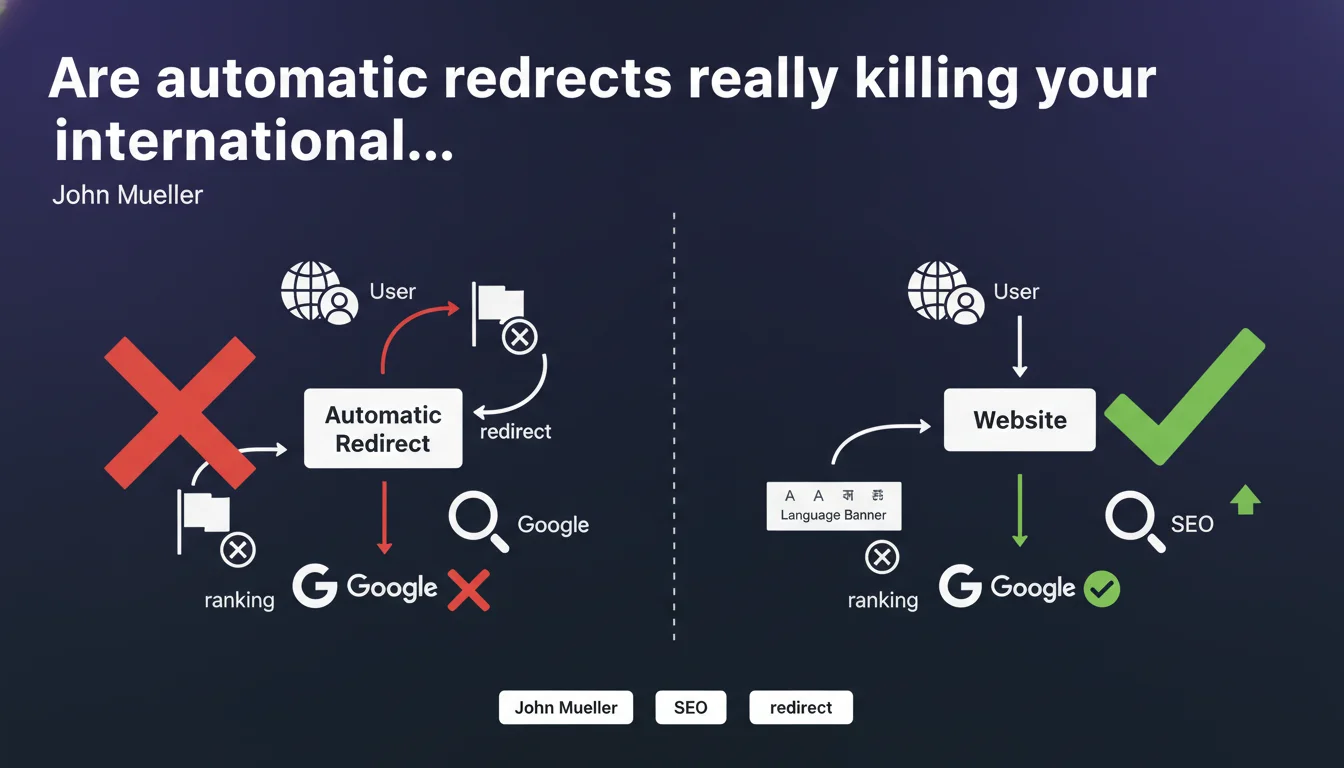
Google recommends using language selection banners rather than automatic redirects on international websites. Geolocation-based redirects prevent search engines from discovering all language versions and rely on localization assumptions that are never 100% reliable. Instead, display a banner that lets users choose their preferred language.
What you need to understand
John Mueller's statement touches on a crucial aspect of international SEO architecture: the conflict between user experience and discoverability. Many sites automatically redirect visitors based on their IP address or the browser's Accept-Language headers, thinking they're doing the right thing.
The problem? Googlebot gets trapped in a single language version, unable to explore alternatives. And this isn't just a theoretical issue.
Why do automatic redirects cause crawling problems?
When you redirect a French user to /fr/ as soon as they land on your homepage, Googlebot undergoes the same treatment. The bot crawls from different datacenters with varying IP addresses, but it consistently gets funneled toward a single version.
Result: other language versions remain invisible or extremely difficult to discover. Hreflang tags become useless if Google can't even access the URLs they reference.
- Googlebot only sees one version of the site—whichever one it gets redirected to
- Hreflang signals lose their effectiveness because alternative URLs remain uncrawled
- IP-based geolocation is imprecise (VPNs, proxies, geolocation errors)
- Accept-Language reflects browser preferences, not necessarily the user's desired language
- Traveling users or expats end up with incorrect language versions
What does Google recommend instead?
The recommended approach is straightforward: display a language selection banner or dropdown without forcing a redirect. Users see content in the default language (usually en-US or your main version), then choose their preference.
This method keeps all URLs accessible to Googlebot. Hreflang tags can then function correctly and guide the search engine toward the right version based on the query and user's location.
What's the difference with a properly configured multilingual site?
Simply removing redirects isn't enough. An international site must implement proper hreflang architecture, with each page declaring its language and regional alternatives.
The banner complements this technical setup by giving users manual control. It's the compromise between technical autonomy (SEO) and user autonomy (UX).
SEO Expert opinion
Is this statement consistent with real-world observations?
Absolutely. I've seen dozens of multilingual sites lose rankings because Google only indexed a fraction of their versions. Automatic redirects create a maze where the crawler gets lost or gives up.
What's trickier is that many developers confuse UX with SEO. They think automatically directing users improves experience—and sometimes it does in the short term. But if Google can't find your /de/ or /es/ pages, you lose all organic traffic from those markets.
What nuances should be added to this recommendation?
A banner isn't a magic solution. It works if your hreflang implementation is flawless, your URLs are consistent, and you have unique content per language (not hastily machine-translated content).
Another point: Mueller says you can never be 100% certain of proper localization. That's factually correct, but it doesn't mean intelligent detection has zero value. [To be verified]: some sites use a hybrid approach—no redirects, but context-aware banners displayed with varying urgency depending on the language probability. This kind of nuance isn't covered in the statement.
In what cases might this rule not apply strictly?
There are situations where partial redirects can be justified—for example, redirecting only deep subdirectories after detection while keeping the homepage accessible to everyone. Or using a 302 temporary redirect with client-side JavaScript detection for Googlebot (but this is risky and complex).
Let's be honest: most sites don't need these workarounds. Mueller's recommendation is pragmatic and applies to 95% of cases. If you think you're in the remaining 5%, you'd better test rigorously and monitor index coverage for each language version.
Practical impact and recommendations
What should you do concretely on an international site?
First, disable all automatic redirects based on IP or Accept-Language that prevent direct access to different language versions. Verify that each URL (/en/, /fr/, /de/, etc.) is freely accessible.
Next, implement a language selection banner or dropdown visible on all pages. It should be discrete but accessible, ideally at the top of the page or in the header. Store the user's choice in a cookie or localStorage so you don't bother them on every visit.
- Remove automatic 301/302 redirects based on geolocation
- Verify that all language versions are crawlable (test with curl or Fetch as Google)
- Implement hreflang tags on each page, pointing to all alternatives
- Add a visible and functional language selection banner or dropdown
- Test behavior for different User-Agents (Googlebot, real users)
- Monitor index coverage for each version in Search Console
- Check server logs to confirm Googlebot accesses all languages
What errors should you avoid during implementation?
The classic mistake: keeping a JavaScript redirect on the client side thinking Googlebot won't see it. Google executes JavaScript, so you recreate the same problem.
Another pitfall: implementing hreflang without consistency. Each page must declare all its alternatives, including itself (self-referencing). URLs must be canonical, absolute, and free of unnecessary parameters.
Finally, don't overlook XML sitemaps. Declare all your language versions in them, with hreflang annotations if possible (Google supports xhtml:link in sitemaps).
How do you verify the configuration is correct?
Use Search Console for each language property (or your domain property if you're on a single domain). Check index coverage, hreflang errors, and discovered but unindexed pages.
Test manually with tools like Screaming Frog or Oncrawl to simulate a full crawl. Look for whether all versions are discovered and whether hreflang annotations are consistent.
Migrating from an architecture with automatic redirects to a banner-based system requires fine technical coordination: disabling server-side redirects, implementing rigorous hreflang, cross-browser testing, and monitoring indexation. If your team lacks resources or expertise in these areas, working with an international SEO agency can help you avoid costly mistakes and accelerate compliance.
❓ Frequently Asked Questions
Peut-on utiliser une redirection 302 au lieu d'une bannière ?
Les balises hreflang suffisent-elles sans bannière utilisateur ?
Comment gérer les utilisateurs qui ne parlent aucune des langues proposées ?
Est-ce que Google pénalise les sites avec redirections automatiques ?
Faut-il dupliquer le contenu ou traduire entièrement chaque version ?
🎥 From the same video 20
Other SEO insights extracted from this same Google Search Central video · published on 21/10/2022
🎥 Watch the full video on YouTube →
💬 Comments (0)
Be the first to comment.