
Official statement
What you need to understand
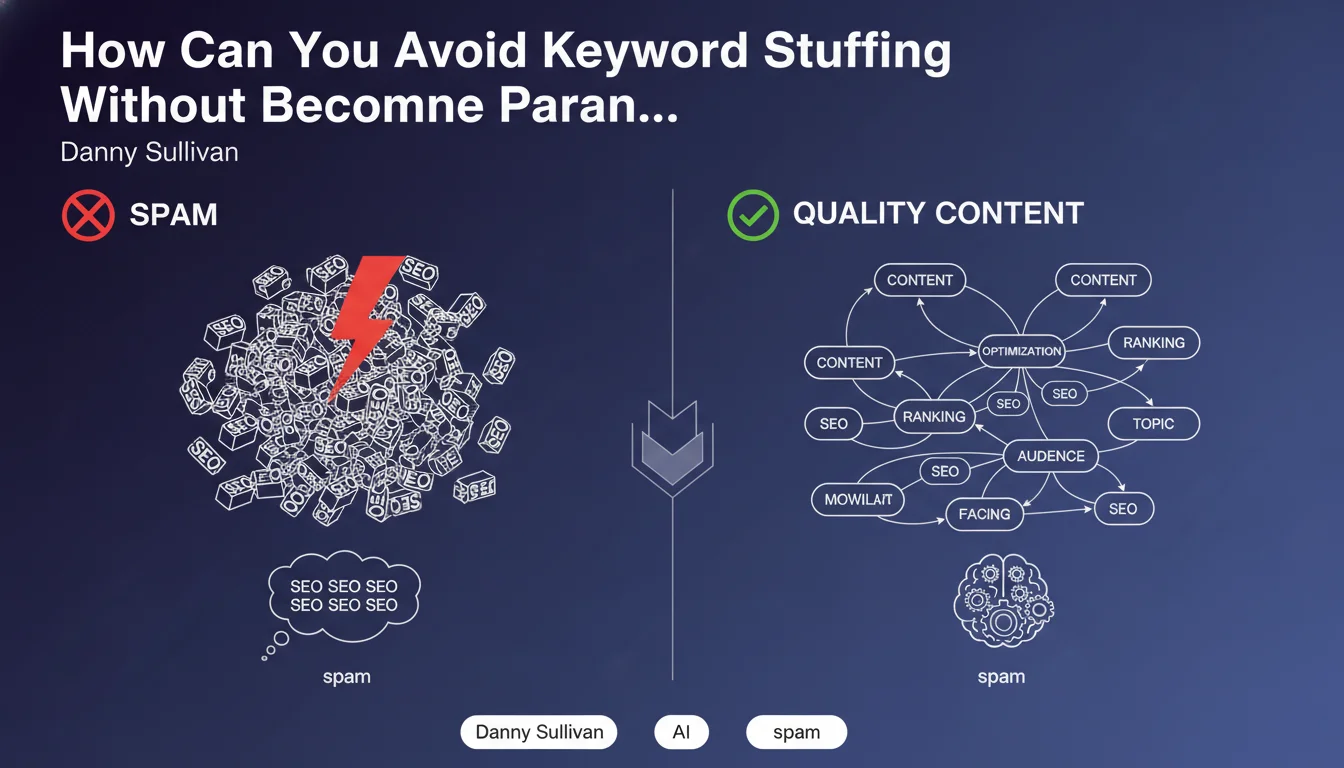
Google clarifies its position on keyword stuffing, which remains one of the most misunderstood practices in SEO. According to Danny Sullivan, the problem is not mathematical but contextual.
Keyword stuffing is not defined by a precise number of repetitions, but by the way these repetitions are integrated into the content. Natural repetition is not penalizing, even if it is frequent.
What characterizes genuine spam is senseless and artificial repetition that doesn't correspond to natural writing. Google now has sophisticated algorithms capable of understanding meaning and concepts without needing excessive repetitions.
- Keyword stuffing is a matter of writing quality, not word counting
- Google understands concepts and synonyms thanks to its natural language processing algorithms
- Writing for humans remains the best strategy for aligning with Google's expectations
- Paranoia around the number of repetitions is unfounded if the writing remains natural
SEO Expert opinion
This statement confirms what experienced SEOs have been observing for several years: Google has become remarkably competent in semantic analysis. Algorithms based on BERT, MUM and now generative AI enable deep contextual understanding.
Nevertheless, a nuance is necessary for highly technical or niche queries. In certain specialized fields (medical, legal, technical), the repetition of precise terms may be necessary for clarity and accuracy, without constituting spam.
The recommended approach remains testing and observation: if your content reads naturally when spoken aloud and provides value, you're probably in the clear, regardless of the frequency of the main keyword.
Practical impact and recommendations
- Abandon keyword density tools as your primary optimization metric
- Read your content aloud: if repetitions seem forced or artificial, rephrase
- Enrich your semantic field with synonyms, related terms and natural variations
- Use pronouns, rephrasing and equivalent expressions to vary your writing
- Prioritize structure and clarity: explicit headings, short paragraphs, logical progression
- Test the readability of your content with non-SEO people to verify its natural character
- Focus on search intent rather than repeating an exact term
- For existing content, audit those that present obvious mechanical repetitions and rephrase them
- Train your writers to write naturally while integrating SEO concepts fluidly
Implementing this qualitative approach often requires a comprehensive semantic audit and structured editorial overhaul. These optimizations, while conceptually simple, demand sharp expertise to balance editorial naturalness and SEO performance. Support from a specialized SEO agency can prove particularly relevant for establishing a coherent content strategy, training your teams in editorial best practices and effectively auditing your existing corpus without compromising your acquired rankings.
💬 Comments (0)
Be the first to comment.