
Official statement
Other statements from this video 14 ▾
- □ Can you really use a single subdirectory to manage multiple international markets with hreflang?
- □ Why doesn't Google index every single URL on your site?
- □ Can you use third-party reviews to power product rich results on Google?
- □ Is Google really penalizing your site, or is it just an algorithm update?
- □ Should you really abandon NALT thesaurus URIs to boost your SEO rankings?
- □ Why are robots.txt unreachable errors always your own fault?
- □ Should you really redirect all your 404 errors to your homepage?
- □ Should you really maintain redirects when migrating to a new domain?
- □ Should you really worry about millions of unindexed URLs on your website?
- □ Is deliberately serving different HTTP status codes to Googlebot really that risky for your site?
- □ Does Google really treat 308 and 301 redirects the exact same way?
- □ Does content quality really impact how fast Google indexes your pages?
- □ Does Google really distinguish between WiFi and Wi-Fi for SEO purposes?
- □ Why do some migrated sites appear in Google within minutes while others take months to show up?
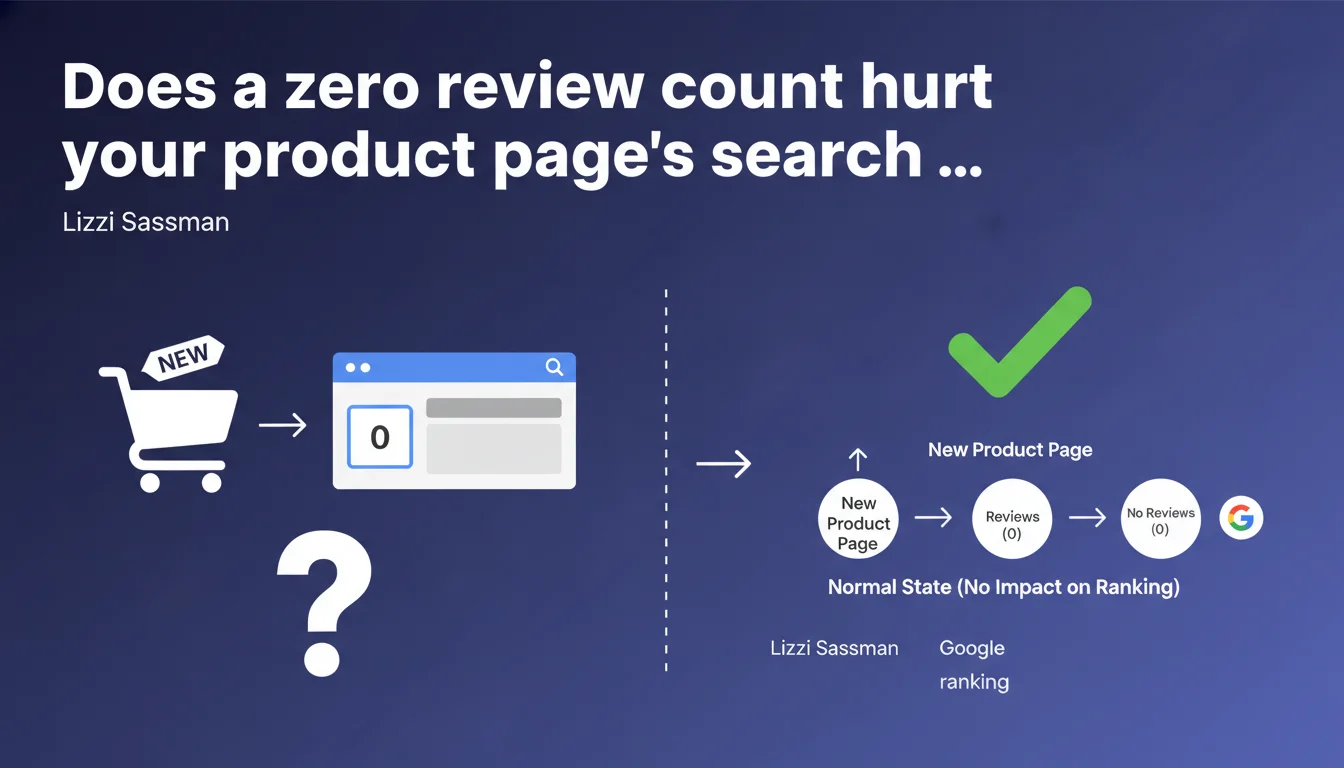
Google confirms that a review counter at zero has no negative impact on SEO. The absence of reviews simply prevents star ratings from displaying in rich results, without harming the page's ranking. This is a normal situation for any new product.
What you need to understand
Why is Google making this clarification now?
This statement addresses a persistent belief in the SEO community: the idea that a page without reviews would be penalized by the algorithm. Some practitioners even avoid implementing schema.org Product markup when the counter is at zero, for fear of sending a negative signal.
Lizzi Sassman sets the record straight—and it's consistent with the very logic of structured data. Markup serves to inform Google about what exists on the page, not to invent content. An aggregateRating with reviewCount at zero simply tells the truth: no reviews have been posted yet.
What's the difference between SEO and rich snippet display?
The confusion stems from mixing two distinct things. The organic ranking of a page doesn't depend on the number of reviews—Google won't demote you because no one has rated your product yet.
However, the display of stars in the SERPs requires a valid rating. Without a rating, no stars. That makes sense. But this doesn't prevent the page from ranking normally, nor does it prevent the rest of the Product markup from being leveraged (price, availability, etc.).
Should I still implement the markup if I have no reviews?
Yes, and it's actually recommended. The Product schema contains many other useful properties beyond reviews: name, description, image, price, availability, SKU, brand. Google can use this data to better understand your page.
Declaring reviewCount at 0 (or not including aggregateRating at all) is perfectly acceptable. As soon as your first review comes in, you update the markup. Simple.
- A review count of zero has no impact on ranking in organic search results
- The absence of stars in the SERPs is a logical consequence of no rating, not a penalty
- Product markup remains useful even without reviews thanks to other properties (price, availability, etc.)
- Implementing the schema from the start makes it easy to display stars as soon as you receive your first review
SEO Expert opinion
Does this statement match what we observe in practice?
Yes, and that's reassuring. Tests show that a well-optimized product page can rank perfectly without any reviews, even against competitors displaying stars. Click-through rate may be lower (stars catch the eye), but ranking isn't affected.
What matters for ranking are the classic factors: content relevance, backlinks, engagement signals, page quality. Reviews can have an indirect influence through UX and conversion rate, but they're not a direct ranking criterion.
Are there any nuances to consider?
The statement is clear on one specific point: zero review count. But it doesn't address the reverse question: does having many positive reviews improve SEO? Google remains evasive on this subject.
We know that reviews can influence CTR (stars attract clicks), and good CTR can reinforce the perceived relevance of a page. There's also the E-E-A-T dimension: real user testimonials contribute to credibility. But it's hard to quantify the direct impact. [To verify]
What situations require caution?
Be careful not to confuse this statement with permission to neglect reviews. If you have reviews but don't mark them up (or mark them up incorrectly), you're missing an opportunity to display rich snippets ahead of the competition.
Another pitfall: some sites implement the schema with fictional values (reviewCount="25" when there are no visible reviews). Google can consider this markup spam and ignore your structured data, or even apply manual action.
Practical impact and recommendations
What should you actually do for a new product page?
Implement the schema.org Product markup from launch, even without reviews. Fill in the essential properties: name, image, description, offers (with price and availability). For aggregateRating, you have two valid options: either omit it entirely, or include reviewCount="0".
As soon as your first review arrives, add aggregateRating with ratingValue and reviewCount updated. Automate this process if possible—a script that dynamically generates JSON-LD based on actual reviews in your database.
What mistakes should you absolutely avoid?
Don't cheat with numbers. If your page displays "No reviews" but your JSON-LD declares 50 reviews with a 4.8 rating, Google will detect the inconsistency. Result: loss of rich snippet eligibility, sometimes across your entire site.
Another common mistake: failing to update the markup as reviews evolve. A product with 12 new reviews but schema still showing reviewCount="3" sends a signal of poorly maintained content.
How do you verify everything is correct?
Use Google's Rich Results Test to validate your markup. Check that required properties are present and values match visible content. Check Search Console under Enhancements > Products to spot any errors or warnings.
Also test actual display in the SERPs. Search for your products and observe whether stars appear (when you have reviews) or if other rich elements are present (price, availability).
- Implement Product schema on all product pages, including those without reviews
- Fill in essential properties: name, image, offers (price, availability)
- For new products: either omit aggregateRating or set reviewCount="0"
- Automate markup updates as soon as a review is published
- Never declare reviews that don't exist in visible content
- Regularly validate with Rich Results Test and Search Console
- Monitor rich snippet display in SERPs for your key products
❓ Frequently Asked Questions
Dois-je retirer le balisage Product si je n'ai encore aucun avis ?
Est-ce que les avis clients améliorent directement le classement dans Google ?
Puis-je afficher des étoiles sans avis réels sur la page ?
Combien d'avis faut-il pour que les étoiles s'affichent dans les SERP ?
Comment gérer le balisage pour un produit qui a des avis sur plusieurs variantes ?
🎥 From the same video 14
Other SEO insights extracted from this same Google Search Central video · published on 12/04/2023
🎥 Watch the full video on YouTube →
💬 Comments (0)
Be the first to comment.