
Official statement
Other statements from this video 16 ▾
- □ Should Local Business markup really be limited to just one city?
- □ Should you really do a 1:1 migration without changing anything during a domain switch?
- □ Does Google really ignore most of your structured data markup?
- □ Does adding descriptive text around your images really boost their rankings in Google Images?
- □ Do you really need to publish every day to improve your Google SEO?
- □ Does word count really matter for SEO rankings?
- □ Do keywords in URLs still have an impact on SEO?
- □ Do images really consume your crawl budget at the expense of your strategic pages?
- □ Can you really launch two nearly identical websites without risking a Google penalty?
- □ Why must your JavaScript links absolutely use A tags with valid href attributes?
- □ Does audio content on a page actually influence your Google ranking?
- □ Should you really avoid modifying meta tags with JavaScript?
- □ Why does Google only communicate about a fraction of its algorithm updates?
- □ Do structured data really improve your Google rankings?
- □ Is it really a mistake to combine noindex and canonical on the same page?
- □ Are structured video data really just about getting your content indexed?
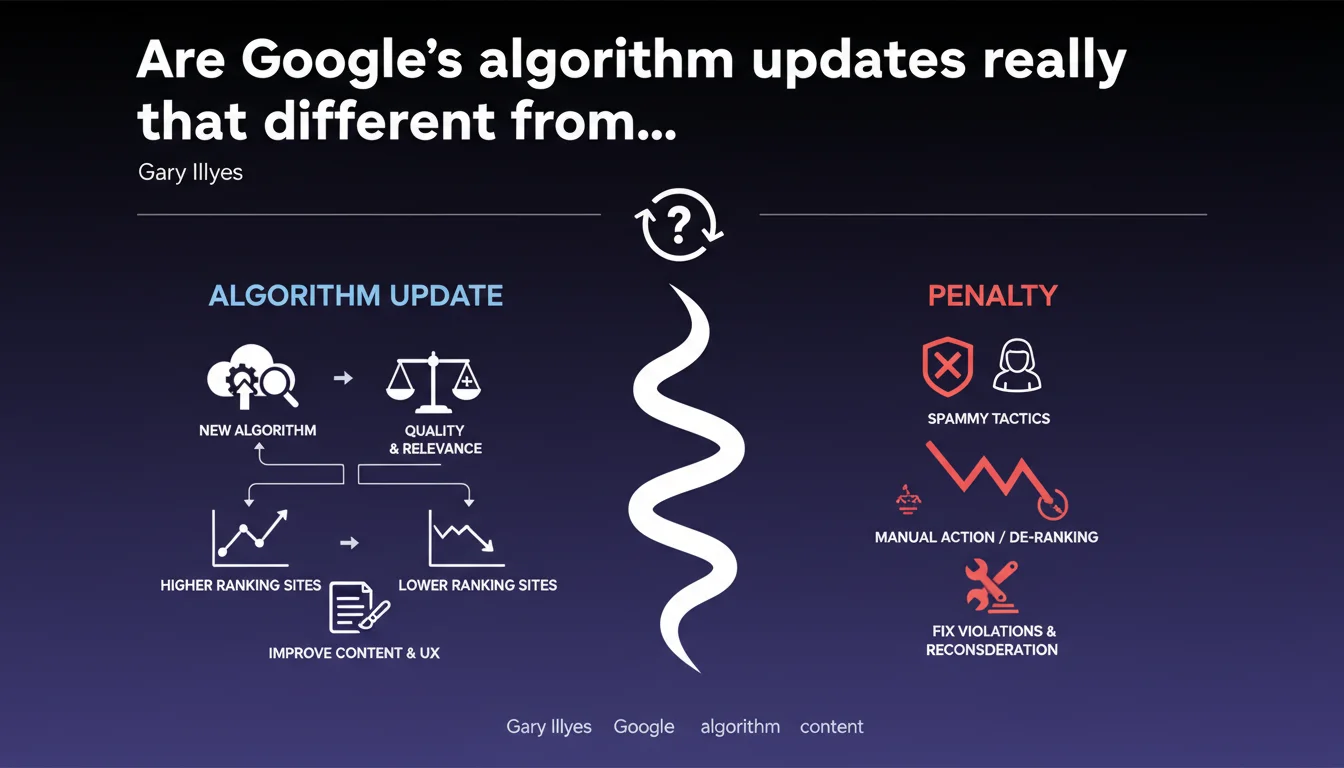
Google claims that named updates are not penalties, but adjustments to improve the quality of search results. If your site drops after an update, it signals that your content no longer meets current relevance standards — not that you've broken a rule.
What you need to understand
What's the real difference between an update and a penalty?
A penalty sanctions a rule violation (spam, duplicate content, artificial links). It results in a manual action visible in Search Console or a targeted degradation via an algorithmic filter. You're notified, and once fixed, the penalty can be lifted.
An algorithm update, according to Gary Illyes, recalibrates quality and relevance criteria. Your site didn't violate anything — it simply became less competitive against new standards. The algorithm evolves, not you getting punished.
Why does Google insist on making this distinction?
The nuance is strategic. By avoiding the word "penalty," Google sidesteps accusations of arbitrary sanctions. The message: if you lose traffic, it's because others perform better, not because you're being punished.
It shifts responsibility. Rather than fixing a mistake, you must improve your overall quality and user experience. Practically speaking, no magic checklist guarantees a comeback.
What changes for a site that drops in rankings?
In both cases — penalty or update — your traffic declines. But the recovery method differs radically.
With a penalty, you identify the violation, fix it, request a reconsideration. With an update, you must rethink your quality positioning against competitors. It's no longer a fix — it's strategic optimization.
- An update never appears in Search Console as a manual action
- No guaranteed timeline for recovery — return depends on your ability to meet new criteria
- General content guidelines become your only compass
- Recovery may require several successive updates to materialize
SEO Expert opinion
Does this statement match real-world observations?
Yes and no. Technically, Gary Illyes is right: a named update (Helpful Content, Core Update) doesn't function like a historical Penguin or Panda filter. It doesn't "penalize" in the strict sense.
But for a site losing 60% of its traffic overnight, the semantic difference is academic. The impact is identical to a penalty. Users don't understand why their unchanged content suddenly becomes invisible.
What nuances should we add to this official position?
Google plays with words. An update can massively devalue certain content types (thin affiliate, aggregators, generic AI-generated sites) without calling them spam. It's a de facto penalty without the label.
The term "adjustment" downplays the impact. Some updates have destroyed entire businesses — not just "adjusted" their rankings. [To verify]: Google claims following guidelines is enough, but no public data shows the actual recovery rate after a post-update crash.
Let's be honest: if you can't precisely identify what changed, and Google deliberately stays vague about criteria, how can you improve in a targeted way? The directive "do better" is insufficient for practitioners.
In what cases does this distinction become meaningless?
When your traffic collapses, terminology hardly matters. What counts: quickly identifying whether it's technical (crawl, indexation), qualitative (content became obsolete), or competitive (others progressed faster).
The real question isn't "am I penalized?" but "why doesn't my site meet the current algorithm's expectations?" And there, Google's general guidelines fall short — you need detailed competitive analysis of what works now in your industry.
Practical impact and recommendations
What should you do concretely after a post-update drop?
First, confirm it's actually tied to a named update. Cross-reference your drop date with the official update calendar on Search Central. If it aligns, you're in an "algorithm recalibration" scenario.
Next, analyze which page types dropped: product pages, blog posts, landing pages? Identify patterns. If it's uniform across your site, the problem is structural. If it's targeted, dig into common characteristics.
Compare your content with sites that gained rankings. What signals are they sending that you're not? Content depth, freshness, multimedia, mobile experience, E-E-A-T signals?
What mistakes should you avoid in this context?
Don't mass-delete content without analysis. Google confirmed that removing truly weak content can help, but it must be surgical, not panic.
Avoid making dozens of micro-changes daily. Algorithm updates roll out over weeks. Give your modifications time to take effect before overhaul everything again.
Don't fixate on one metric (speed, keywords, backlinks). Modern updates assess overall quality. A holistic approach is essential.
How do you verify your site meets new standards?
Use the Quality Raters Guidelines as your reading framework. They reflect Google's quality expectations, even if not directly baked into the algorithm.
Test your content with real users. Ask them if they find your pages useful, comprehensive, trustworthy. If feedback is mixed, the algorithm will detect it too.
Monitor competitors who gained rankings. Use position tracking tools to spot sector-wide movements and adjust your strategy accordingly.
- Check Search Console to rule out a manual action
- Cross-reference your drop date with official updates
- Analyze impacted pages: type, content, performance
- Compare your content with now-better-ranking pages
- Audit user experience: navigation, mobile, load time
- Strengthen E-E-A-T signals: expertise, authority, transparency
- Refresh outdated content with recent data
- Avoid impulsive changes — test, measure, adjust progressively
❓ Frequently Asked Questions
Comment savoir si ma baisse de trafic est due à une mise à jour ou à une pénalité ?
Combien de temps faut-il pour récupérer après une mise à jour ?
Dois-je supprimer du contenu après une chute post-mise à jour ?
Les directives de contenu de Google suffisent-elles à récupérer ?
Peut-on anticiper une mise à jour pour éviter une chute ?
🎥 From the same video 16
Other SEO insights extracted from this same Google Search Central video · published on 07/09/2022
🎥 Watch the full video on YouTube →
💬 Comments (0)
Be the first to comment.