
Official statement
Other statements from this video 16 ▾
- □ Le balisage Local Business doit-il vraiment se limiter à une seule ville ?
- □ Faut-il vraiment migrer 1:1 sans rien changer lors d'un changement de domaine ?
- □ Schema.org : pourquoi Google ignore-t-il une partie de vos balises structurées ?
- □ Faut-il vraiment rédiger du texte descriptif autour de vos illustrations pour ranker dans Google Images ?
- □ Faut-il publier tous les jours pour améliorer son référencement Google ?
- □ Le nombre de mots est-il vraiment sans importance pour le référencement ?
- □ Les mots-clés dans les URLs ont-ils encore un impact en SEO ?
- □ Les images consomment-elles vraiment du budget de crawl au détriment de vos pages stratégiques ?
- □ Peut-on vraiment lancer deux sites quasi-identiques sans risquer de pénalité Google ?
- □ Pourquoi vos liens JavaScript doivent absolument utiliser des balises A avec href valide ?
- □ L'audio sur une page influence-t-il réellement le classement Google ?
- □ Faut-il vraiment éviter de modifier les balises meta avec JavaScript ?
- □ Les mises à jour algorithmiques de Google sont-elles vraiment différentes des pénalités ?
- □ Pourquoi Google ne communique-t-il que sur une fraction de ses mises à jour d'algorithme ?
- □ Faut-il vraiment éviter d'utiliser noindex et canonical sur la même page ?
- □ Les données structurées vidéo servent-elles uniquement à l'indexation ?
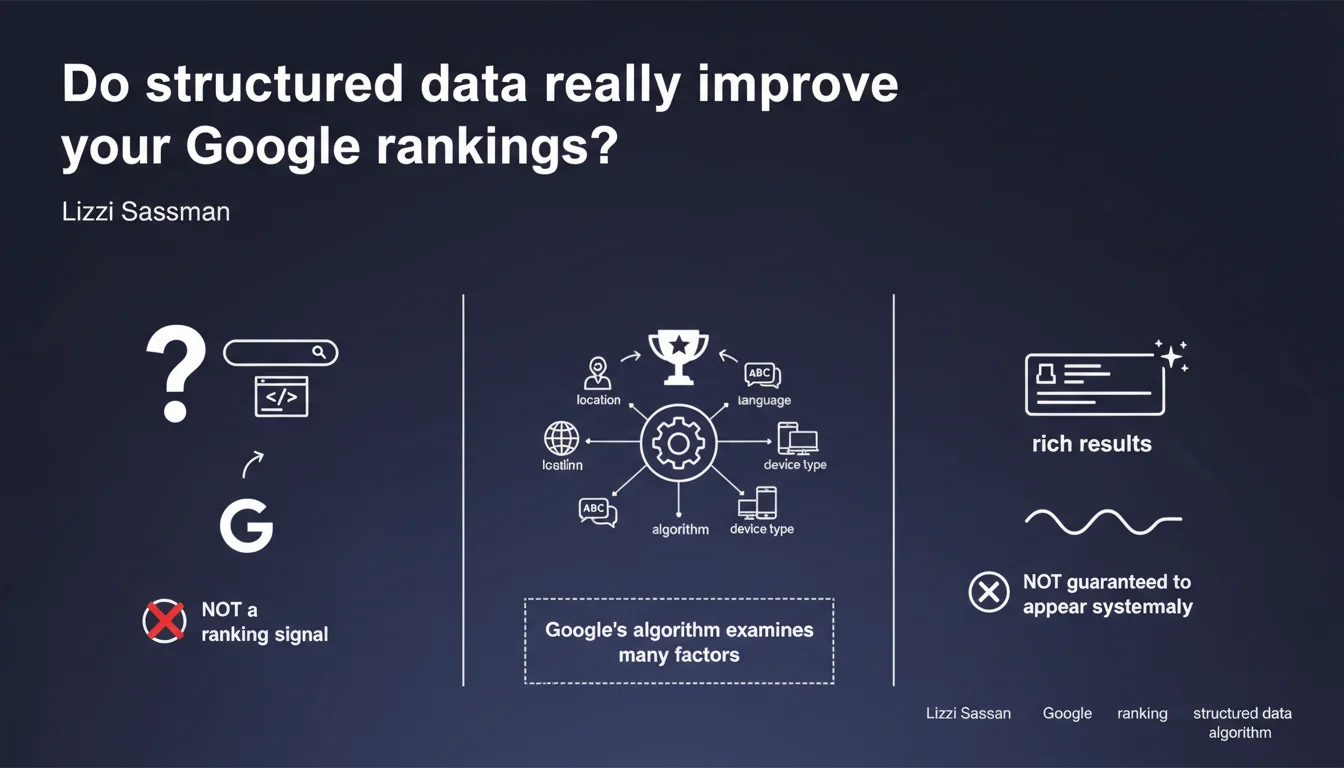
Google states that structured data is not a direct ranking signal. Their presence does not guarantee improved positioning or systematic display of rich results. The algorithm prioritizes other factors based on search context.
What you need to understand
What exactly does "not a ranking signal" mean?
When Google states that structured data is not a ranking signal, it means that adding Schema.org to your pages won't directly improve their position in the SERPs. The markup isn't weighted the way backlinks, content, or domain authority are.
But — and this is where it gets interesting — structured data can influence indirectly your performance. A rich result attracts more clicks, which can send positive behavioral signals. Except Google doesn't even guarantee the display of these rich snippets.
Why doesn't Google systematically display rich results?
The algorithm examines the context: location, language, device, search intent. The same page with perfectly implemented structured data can generate rich snippets on desktop but not on mobile, or for certain queries but not others.
Google prioritizes "the best search experience" — a vague formula that mainly means it reserves the right to display nothing if it doesn't serve its objectives. Markup quality isn't enough.
So what are the real benefits of structured data?
- CTR improvement when rich results actually display (stars, prices, FAQs)
- Better understanding of your content by crawlers — even without visible rich snippets
- Eligibility for specific features: Knowledge Graph, Google Shopping, news
- Zero guaranteed impact on pure ranking — that's not why we implement them
SEO Expert opinion
Is this statement consistent with what we observe in the field?
Yes and no. Tests show that adding Schema.org doesn't cause a jump in rankings. No direct correlation between markup and ranking.
But here's the problem: nobody correctly measures indirect impact. A click-through rate jumping from 3% to 7% thanks to stars produces more traffic, more engagement, potentially more conversions. Do these behavioral signals count? [To verify] — Google remains vague on this.
In what cases doesn't this rule really apply?
Certain types of content require structured data to be eligible for specific placements. Recipes without Recipe schema never appear in the carousel. Job postings without JobPosting schema are invisible in Google for Jobs.
Here, we're no longer talking about a "ranking signal" but about a mandatory entry ticket. No markup = no eligibility. That's different from a classic ranking factor.
What nuance should we add to Google's statement?
Saying "it's not a ranking signal" can push some to completely neglect structured data. Mistake.
It's not a direct ranking factor, but it's an essential optimization lever for visibility and CTR. In an environment where every percentage point of clicks counts, ignoring Schema.org because "it doesn't rank" amounts to leaving traffic on the table.
Practical impact and recommendations
Should you still implement structured data on your site?
Absolutely. Even if they don't directly boost your position, the indirect benefits justify the investment. A rich result captures attention, increases CTR, improves quality perception.
Focus on the types of markup with the most impact for your industry: Product for e-commerce, Article for media, LocalBusiness for local SEO, FAQ to occupy more SERP space.
What mistakes should you avoid when implementing Schema.org?
The temptation is great to artificially "inflate": add reviews that don't exist, invent prices, manipulate dates. Google detects these practices and can remove your rich snippets — or worse.
Another pitfall: implementing markup on invisible or irrelevant content. Structured data must faithfully reflect what the user sees on the page. Otherwise, it's considered spam.
- Validate your markup with Google's Rich Results Test
- Check consistency between Schema.org and visible content
- Monitor Search Console for structured data errors
- Don't invent data absent from the page
- Test actual display in SERPs (preview tool)
- Prioritize markup types with proven CTR impact
How do you measure the real impact of structured data?
Track click-through rate by result type in Search Console. Compare performance before/after implementation on comparable pages. Be careful of bias: a CTR boost can come from other simultaneous factors.
Also monitor impressions for high-intent queries. Certain markups can make you visible on queries where you were absent (carousels, Knowledge Graph).
❓ Frequently Asked Questions
Si les données structurées ne sont pas un signal de classement, pourquoi Google recommande-t-il de les utiliser ?
Est-ce que tous les sites avec des données structurées obtiennent des résultats enrichis ?
Les données structurées peuvent-elles nuire au référencement si mal implémentées ?
Quels types de Schema.org ont le plus d'impact sur le CTR ?
Faut-il implémenter tous les types de données structurées possibles sur une page ?
🎥 From the same video 16
Other SEO insights extracted from this same Google Search Central video · published on 07/09/2022
🎥 Watch the full video on YouTube →
💬 Comments (0)
Be the first to comment.