
Official statement
Other statements from this video 16 ▾
- □ Le balisage Local Business doit-il vraiment se limiter à une seule ville ?
- □ Faut-il vraiment migrer 1:1 sans rien changer lors d'un changement de domaine ?
- □ Schema.org : pourquoi Google ignore-t-il une partie de vos balises structurées ?
- □ Faut-il vraiment rédiger du texte descriptif autour de vos illustrations pour ranker dans Google Images ?
- □ Faut-il publier tous les jours pour améliorer son référencement Google ?
- □ Le nombre de mots est-il vraiment sans importance pour le référencement ?
- □ Les mots-clés dans les URLs ont-ils encore un impact en SEO ?
- □ Les images consomment-elles vraiment du budget de crawl au détriment de vos pages stratégiques ?
- □ Peut-on vraiment lancer deux sites quasi-identiques sans risquer de pénalité Google ?
- □ Pourquoi vos liens JavaScript doivent absolument utiliser des balises A avec href valide ?
- □ Faut-il vraiment éviter de modifier les balises meta avec JavaScript ?
- □ Les mises à jour algorithmiques de Google sont-elles vraiment différentes des pénalités ?
- □ Pourquoi Google ne communique-t-il que sur une fraction de ses mises à jour d'algorithme ?
- □ Les données structurées améliorent-elles vraiment votre classement dans Google ?
- □ Faut-il vraiment éviter d'utiliser noindex et canonical sur la même page ?
- □ Les données structurées vidéo servent-elles uniquement à l'indexation ?
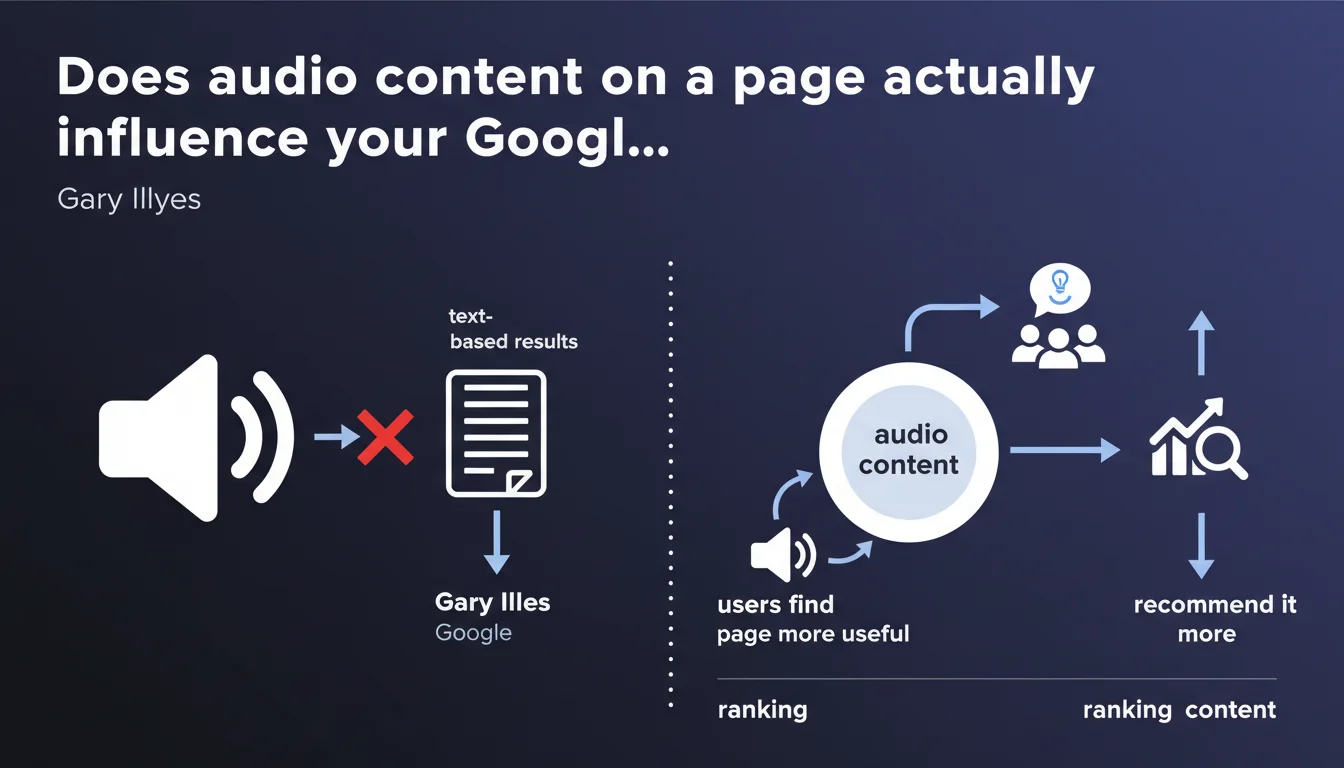
Audio content alone has no direct impact on ranking in Google's text-based search results. Potential benefits remain indirect: if audio improves user experience, it can generate more recommendations and positive signals.
What you need to understand
Why does Google make this distinction between audio and text?
Google operates primarily on crawlable text content. Ranking algorithms analyze words, phrases, semantic structures — not raw audio files.
Audio is simply not treated as a relevance signal in text SERPs. This is consistent with the engine's historical functioning: what cannot be crawled and analyzed textually does not directly influence ranking.
What do we mean by "indirect effects"?
If a podcast or audio content truly enriches the user experience, visitors may stay longer, share the page, create natural backlinks, or return. These behavioral signals can influence ranking.
But be careful: it's not the audio itself that matters, it's the user reaction to this content. This distinction is crucial.
Does this mean we should ignore audio in SEO?
Not at all. Audio can serve to enrich a page, extend visit duration, create engagement. But it never replaces well-structured text content.
If you publish a podcast without transcription, Google won't know what you're talking about. If you add a complete transcript, then you're playing both angles: audio for UX, text for crawling.
- Audio alone is not indexable as a text relevance signal
- Positive effects come through user behaviors (sharing, links, engagement)
- A text transcript remains essential for Google to understand the content
- Audio can improve UX but never compensates for mediocre text content
SEO Expert opinion
Is this statement consistent with what we observe in the field?
Completely. We've never observed pages ranking solely because they contain audio content. Sites that perform well with podcasts or audio interviews always have indexable text as support.
Podcasts that rank well generally have detailed show notes, partial or complete transcripts, and editorial content around them. Audio alone is never enough — and that makes sense.
What gray areas does this statement leave?
Gary mentions "indirect effects" but remains deliberately vague about what Google measures exactly. Is it visit duration? Bounce rate? Social signals? [To verify] — Google never gives precise details on the weight of these metrics.
Furthermore, this statement only covers text results. What about rich results (audio featured snippets, Google Podcasts)? The distinction is important: in certain contexts, audio can be indexed and displayed differently.
Should you adapt your content strategy accordingly?
If you're investing heavily in audio, make sure each episode is accompanied by solid text support. Otherwise, you're working for engagement but not for SEO.
Audio remains an excellent lever for indirect acquisition: word-of-mouth, loyalty, authority. But in terms of pure organic ranking, it's not a determining factor.
Practical impact and recommendations
What should you concretely do with audio content?
First rule: always accompany audio with a transcript. Complete if possible, at minimum a detailed summary with key points covered.
Then, structure this transcript with titles, subtitles, lists — in short, everything that helps Google understand the information hierarchy. Audio serves UX, text serves crawling.
What mistakes should you avoid?
Never publish a podcast or interview without any indexable text content. That's production time wasted in terms of organic visibility.
Another common mistake: thinking that an embedded audio player with a title is enough. Google understands nothing about what the file contains. You need descriptive text, keywords, context.
How do you verify that your audio content is properly optimized for SEO?
Ask yourself these questions: if I remove the audio from the page, is there enough text left for Google to understand the topic? If the answer is no, you have a problem.
Use tools like Screaming Frog or Google Search Console to verify that your pages with audio have indexable content and structured tags (schema.org AudioObject if relevant).
- Add a complete transcript or detailed summary for each audio content
- Structure the text with H2, H3, lists to facilitate crawling
- Never publish audio without indexable text context
- Use Schema.org tags (AudioObject, Podcast) to enrich metadata
- Verify that audio pages have unique and sufficiently dense content to rank
- Measure engagement (visit duration, shares) to evaluate indirect effects
❓ Frequently Asked Questions
L'audio peut-il améliorer mon classement Google indirectement ?
Dois-je transcrire tous mes podcasts pour le SEO ?
Les balises Schema.org pour l'audio ont-elles un impact SEO ?
Google peut-il analyser automatiquement le contenu audio ?
Faut-il privilégier la vidéo plutôt que l'audio pour le SEO ?
🎥 From the same video 16
Other SEO insights extracted from this same Google Search Central video · published on 07/09/2022
🎥 Watch the full video on YouTube →
💬 Comments (0)
Be the first to comment.