
Official statement
Other statements from this video 16 ▾
- □ Le balisage Local Business doit-il vraiment se limiter à une seule ville ?
- □ Faut-il vraiment migrer 1:1 sans rien changer lors d'un changement de domaine ?
- □ Schema.org : pourquoi Google ignore-t-il une partie de vos balises structurées ?
- □ Faut-il vraiment rédiger du texte descriptif autour de vos illustrations pour ranker dans Google Images ?
- □ Faut-il publier tous les jours pour améliorer son référencement Google ?
- □ Le nombre de mots est-il vraiment sans importance pour le référencement ?
- □ Les mots-clés dans les URLs ont-ils encore un impact en SEO ?
- □ Les images consomment-elles vraiment du budget de crawl au détriment de vos pages stratégiques ?
- □ Peut-on vraiment lancer deux sites quasi-identiques sans risquer de pénalité Google ?
- □ Pourquoi vos liens JavaScript doivent absolument utiliser des balises A avec href valide ?
- □ L'audio sur une page influence-t-il réellement le classement Google ?
- □ Faut-il vraiment éviter de modifier les balises meta avec JavaScript ?
- □ Les mises à jour algorithmiques de Google sont-elles vraiment différentes des pénalités ?
- □ Les données structurées améliorent-elles vraiment votre classement dans Google ?
- □ Faut-il vraiment éviter d'utiliser noindex et canonical sur la même page ?
- □ Les données structurées vidéo servent-elles uniquement à l'indexation ?
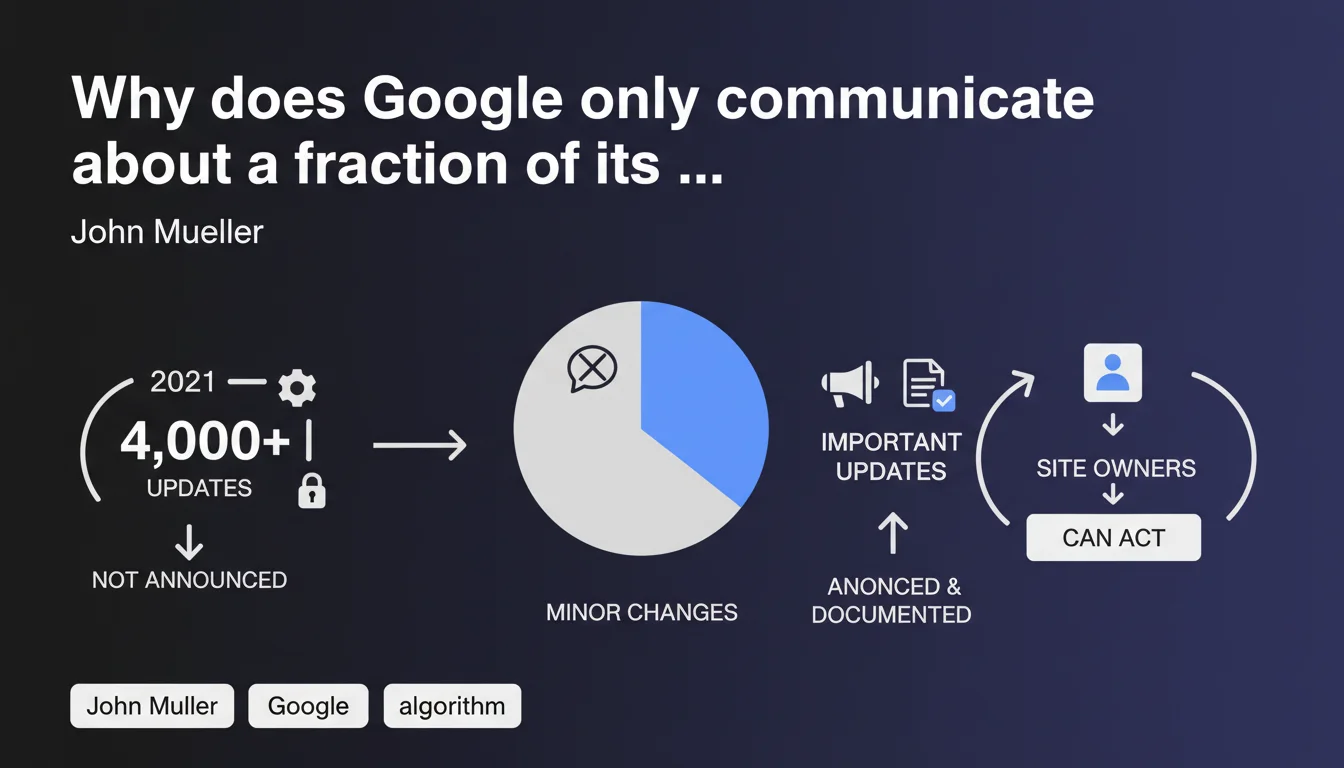
Google deploys over 4,000 updates per year, but only a handful are announced publicly. The majority of changes remain invisible, and only those on which site owners can take action are subject to official communication. In practice, this means that a ranking fluctuation can be caused by a minor undocumented adjustment.
What you need to understand
How many updates does Google really deploy each year?
The figure advanced by John Mueller — over 4,000 updates in 2021 — sheds light on the actual frequency of algorithmic adjustments. This represents an average of over 10 updates per day.
But be careful: these 4,000 changes include micro-adjustments, internal A/B tests, bug fixes, and refinements to existing signals. Not all of them drastically modify the SERPs. Some concern specific geographic segments, niche verticals, or very specific types of queries.
Why does Google only announce certain updates?
Google communicates only about Core Updates and updates that offer concrete actionable leverage to webmasters. The objective? To avoid permanent media noise and concentrate attention on what matters.
Minor changes — weighting adjustments, false positive corrections, incremental improvements in natural language processing — are not subject to announcements. Why? Because they require no specific action on the part of site owners. If Google had to communicate about every iteration, the signal would be drowned in the noise.
What are the implications for an SEO practitioner?
First point: a drop in traffic is not necessarily linked to a Core Update. It may result from a silent adjustment, an evolution in user behavior, or better understanding by Google of search intent on certain queries.
Second point: SERP fluctuation tracking tools (SEMrush Sensor, Mozcast, Advanced Web Rankings) capture these micro-movements. But correlating a drop to a precise event becomes a detective exercise — especially when Google says nothing.
- Google deploys over 10 updates per day, most of them invisible and unannounced.
- Only actionable updates (those a webmaster can intervene on) are communicated publicly.
- A ranking fluctuation can stem from a minor undocumented algorithmic adjustment, not necessarily a penalty.
- SERP monitoring tools capture these movements, but identifying the exact cause often amounts to informed hypothesis.
SEO Expert opinion
Is this statement consistent with field observations?
Yes, and it's actually an understatement. SEO practitioners regularly observe position variations that coincide with no official announcement. Sites see their traffic fluctuate by 10-15% with no Core Update in progress.
The figure of 4,000 annual updates explains why rankings are never completely stable. Google tests constantly, refines, corrects. What Mueller doesn't say — and this is where things get tricky — is how to distinguish a test from a definitive rollout. Some fluctuations observed on Monday disappear by Thursday. Were these tests? Rollbacks? Impossible to confirm.
What nuances should be applied to this claim?
[To verify]: Google remains vague about the definition of "update." Does a 0.5% adjustment to a signal's weight count as an update? Does an A/B test on 2% of US traffic get included in the 4,000? Official communication never clarifies this.
Another point: some changes presented as "minor" have non-negligible impacts on specific verticals. An adjustment in how named entities are processed can disrupt the SERPs of an entire sector without any announcement. News sites and YMYL platforms are particularly exposed to these silent adjustments.
Should every fluctuation be monitored as an alarm signal?
No, and this is a trap many practitioners fall into. Observing a 5% drop on a Tuesday doesn't justify a complete overhaul of your content strategy. Google tests, adjusts, reverts.
The real question: identifying lasting trends. A drop that persists for 10-15 days warrants analysis. A 48-hour fluctuation that resolves itself? Probably a test or regional adjustment. Let's be honest: spending your time analyzing every micro-variation is a waste of time. Energy should be concentrated on structural signals — prolonged drop, loss of featured snippets, degradation in organic CTR.
Practical impact and recommendations
What should you concretely do in the face of this multitude of updates?
First rule: don't panic at every movement in the SERPs. A temporary drop is not a disaster — especially if it resolves on its own. Focus on variations that persist beyond two weeks.
Second rule: monitor the metrics that matter. Overall organic traffic, conversion rate, CTR on strategic pages. A loss of position on a low-volume query has no business impact if your qualified traffic remains stable.
How do you identify if a fluctuation is linked to an unannounced update?
Cross-reference multiple data sources. Compare SERP monitoring tools (Mozcast, SEMrush Sensor, Advanced Web Rankings) with your own Search Console metrics. If the tools show high volatility AND your traffic drops significantly, there's probably a connection.
Then analyze which pages are impacted. If the drop affects all pages uniformly, it's potentially a global signal (authority, perceived quality). If only certain categories are affected, it's probably a thematic adjustment or one related to search intent.
What errors should be avoided in this context of permanent adjustments?
Error #1: over-reacting. Changing your entire editorial strategy after 48 hours of decline is counterproductive. SEO adjustments take time to bear fruit — and if the drop was temporary, you risk breaking what was working.
Error #2: ignoring weak signals that accumulate. A series of small drops over several months can indicate an underlying trend — even without an official announcement. This is where cohort analysis becomes valuable: comparing the performance of content published at different periods to detect a structural change.
- Monitor business metrics (qualified traffic, conversions) rather than raw positions.
- Cross-reference SERP volatility tools with Search Console data to confirm real impact.
- Only modify strategy if the drop persists beyond 10-15 days.
- Analyze which pages and queries are impacted to identify patterns.
- Document observed fluctuations to detect underlying trends over several months.
- Avoid reactive over-optimization — Google tests constantly, some adjustments are temporary.
❓ Frequently Asked Questions
Toutes les mises à jour Google ont-elles un impact sur mon site ?
Comment savoir si une baisse de trafic est due à une mise à jour non annoncée ?
Google teste-t-il des mises à jour avant de les déployer définitivement ?
Pourquoi Google ne communique-t-il pas sur toutes ses mises à jour ?
Dois-je adapter ma stratégie SEO à chaque fluctuation de rankings ?
🎥 From the same video 16
Other SEO insights extracted from this same Google Search Central video · published on 07/09/2022
🎥 Watch the full video on YouTube →
💬 Comments (0)
Be the first to comment.