
Official statement
Other statements from this video 16 ▾
- □ Le balisage Local Business doit-il vraiment se limiter à une seule ville ?
- □ Faut-il vraiment migrer 1:1 sans rien changer lors d'un changement de domaine ?
- □ Schema.org : pourquoi Google ignore-t-il une partie de vos balises structurées ?
- □ Faut-il vraiment rédiger du texte descriptif autour de vos illustrations pour ranker dans Google Images ?
- □ Faut-il publier tous les jours pour améliorer son référencement Google ?
- □ Les mots-clés dans les URLs ont-ils encore un impact en SEO ?
- □ Les images consomment-elles vraiment du budget de crawl au détriment de vos pages stratégiques ?
- □ Peut-on vraiment lancer deux sites quasi-identiques sans risquer de pénalité Google ?
- □ Pourquoi vos liens JavaScript doivent absolument utiliser des balises A avec href valide ?
- □ L'audio sur une page influence-t-il réellement le classement Google ?
- □ Faut-il vraiment éviter de modifier les balises meta avec JavaScript ?
- □ Les mises à jour algorithmiques de Google sont-elles vraiment différentes des pénalités ?
- □ Pourquoi Google ne communique-t-il que sur une fraction de ses mises à jour d'algorithme ?
- □ Les données structurées améliorent-elles vraiment votre classement dans Google ?
- □ Faut-il vraiment éviter d'utiliser noindex et canonical sur la même page ?
- □ Les données structurées vidéo servent-elles uniquement à l'indexation ?
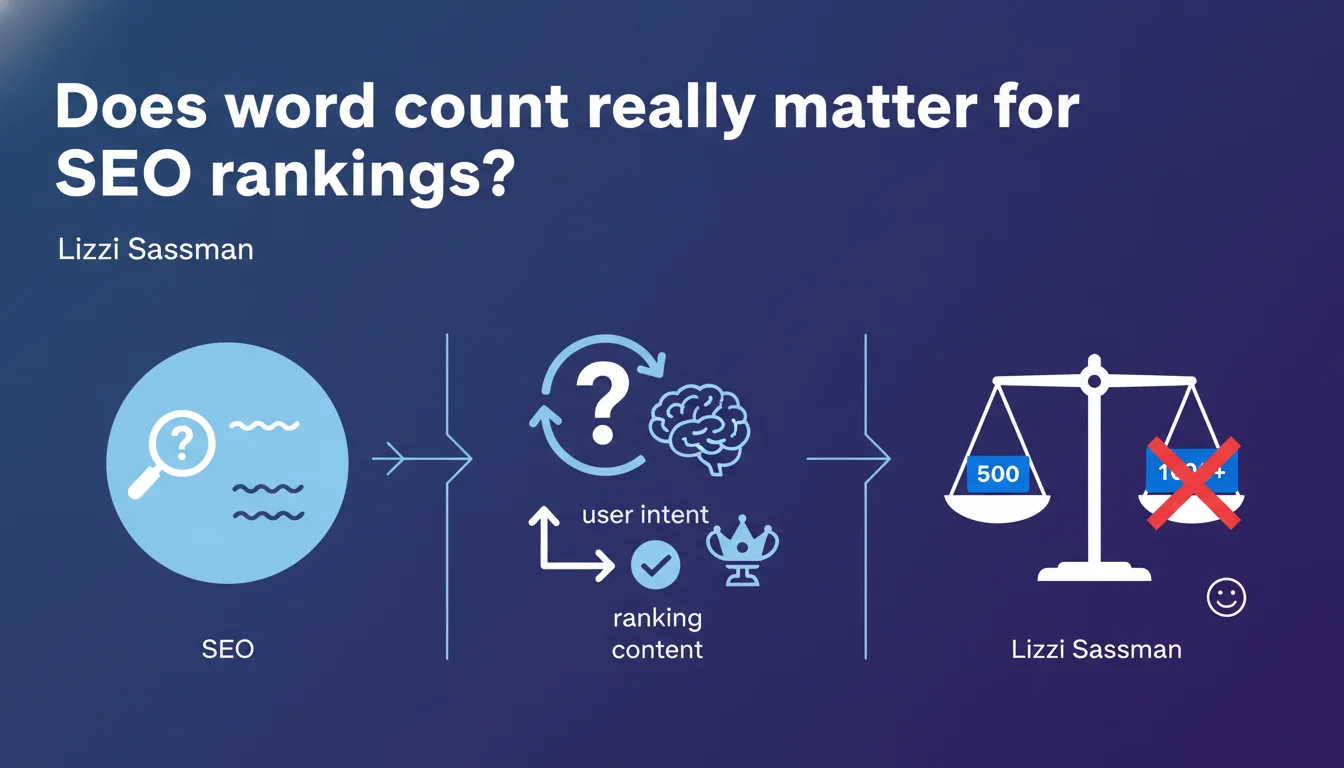
Google states that the number of words on a page is not a quality criterion in itself. What matters is answering the search intent, whether it takes 200 or 2000 words. A short text can outperform verbose content if the user gets what they're looking for faster.
What you need to understand
This statement from Lizzi Sassman hits where it hurts: it dismantles a persistent myth in the industry. How many times have you read that a page should be "at least 500 words" or "ideally 1500 words" to rank?
Google's message is crystal clear: text volume is not a quality signal. A pancake recipe doesn't need 2000 words of historical context about the origins of maple syrup. If the user is looking for a list of ingredients and steps, give them that — cleanly, quickly.
Why this clarification now?
Because the SEO industry started artificially inflating content thinking that "more = better". Analysis tools prescribe minimum word thresholds, writers are paid by the word, competitors are scraped to match their length.
Google wants to break this spiral. The algorithm evaluates relevance and user satisfaction, not character count. A 300-word article that solves a specific problem can crush a 3000-word piece that buries the essential information.
What does this actually change for practitioners?
It challenges mindless benchmarking. If your competitors all write 2000 words on a topic, the answer isn't necessarily to write 2500. Maybe it's to write 800 words ultra-targeted that go straight to the point.
Let's be honest: some queries require depth. A technical guide on HTTPS migration, a detailed product comparison, a legal analysis — there, volume is justified by subject complexity. But a definition? A simple FAQ? A basic tutorial? Padding serves no purpose.
- Word count is not a ranking factor in itself
- Satisfying search intent trumps everything else
- Short content can perfectly well rank if relevant
- The context of the query determines optimal length
- Stop setting arbitrary word quotas for your writers
Does Google measure length in another way?
Not directly. But indirectly? Obviously. Behavioral signals reveal everything: time on page, scroll depth, returns to SERP, clicks on other sections. If a user bounces after 5 seconds because your intro is 300 words before getting to the point, Google sees it.
Conversely, if dense content generates engagement, shares, natural backlinks, it's noted. Length then becomes a consequence of quality, not a cause.
SEO Expert opinion
Is this statement consistent with field observations?
Yes and no. On basic informational queries, we do observe that concise and well-structured content can outperform long pieces. Think featured snippets: Google often extracts 40-60 words from a 500-word page, not a 5000-word one.
But — and here's where it gets tricky — on competitive or transactional queries, the reality is more nuanced. Pages ranking in the top 3 often run 1500-3000 words, not because Google loves volume, but because they cover all facets of the intent.
Example: "best CRM for small businesses". A 400-word page listing 5 names will never cut it. The user wants criteria, comparisons, pricing, reviews, use cases. Length then becomes an involuntary proxy for completeness.
What nuances should be added to this rule?
Google says "word count doesn't matter", but what it doesn't say is that thematic depth does. And guess what? Covering a topic thoroughly takes space.
Google's algorithms — notably NLP models and topical authority systems — analyze semantic coverage. If your content on "buying an electric car" never mentions range, charging stations, government incentives, maintenance costs, it will be judged incomplete. Not because it's short, but because it misses obvious expectations.
[To verify]: Google remains vague about the real weight of NLP signals in ranking. We know BERT and MUM analyze context and entities, but the precise impact of "incomplete semantic coverage" is never quantified publicly.
In what cases doesn't this rule really apply?
On YMYL (Your Money Your Life) niches or medical/legal topics, length becomes a marker of credibility. A 300-word article on "lung cancer symptoms" will never beat a sourced 2000-word dossier written by a doctor.
Same for weak E-A-T sites. If you lack domain authority, backlinks, or history, short content will be perceived as superficial — even if it technically answers the query. Established sites can afford brevity; newcomers must prove expertise through depth.
Practical impact and recommendations
What should you concretely do with this information?
Stop briefing your writers with word quotas. Give them an intent checklist instead. For a query, list the implicit and explicit questions the user asks. The text must answer them — whether it's 400 or 2000 words matters little.
Analyze the SERPs for each target query. If the top 10 results all run 1500+ words, the intent requires depth. If you see 500-800 words ranking #1, Google favors brevity on that topic. Adapt accordingly.
Audit your existing content. Identify over-optimized pages: those where you inflated text to reach an arbitrary threshold. Cut the fat. Remove endless introductions, repetitions, tangents. Keep what's essential.
What mistakes to avoid at all costs?
Don't swing to the opposite extreme. "Google says word count doesn't matter, so I'll do 200 words everywhere." No. Each query has its depth expectations. Under-delivering is as penalizing as over-delivering.
Beware of SEO tools that score content based on text volume. Many still show "your page is 600 words, competitor average is 1200, add 600 words". That's a dumb metric if those 600 extra words add nothing.
And above all: never sacrifice readability for a quota. An indigestible 2000-word blob without subheadings, lists, or breathing room is worse than short, well-spaced text. Google measures engagement, and walls of text drive people away.
How do you verify your approach is right?
Check your behavioral metrics in Google Analytics and Search Console. Time on page, bounce rate, scroll depth, clicks to other pages. If short content performs well on these indicators, don't lengthen it out of principle.
Test. Publish a concise version, measure for 4-6 weeks. If it stagnates, gradually enrich by adding sections that answer satellite questions. Measure the impact. SEO remains empirical.
- Brief writers on intent, not word count
- Analyze SERPs to calibrate expected depth
- Audit existing content to remove useless filler
- Prioritize readability and clear structure (H2, H3, lists)
- Measure user engagement, not word counters
- Test and iterate rather than set rigid rules
- Ignore tools that prescribe arbitrary word quotas
Word count is not an objective, it's an adjustment variable. Your content must be as long as necessary to fully satisfy search intent — no more, no less. This requires careful analysis of queries, SERPs, and user expectations.
This custom approach may seem complex to deploy at scale, especially if you manage hundreds of pages or multiple sites. In that case, working with a specialized SEO agency can save you precious time: they have analysis tools, industry benchmarks, and experience to calibrate optimal content depth for each page without trial and error.
❓ Frequently Asked Questions
Google pénalise-t-il les contenus courts ?
Les outils SEO qui recommandent un nombre de mots minimum sont-ils inutiles ?
Dois-je rallonger mes pages existantes qui font moins de 500 mots ?
Comment savoir si mon contenu est assez complet sans compter les mots ?
Le nombre de mots influence-t-il le crawl budget ?
🎥 From the same video 16
Other SEO insights extracted from this same Google Search Central video · published on 07/09/2022
🎥 Watch the full video on YouTube →
💬 Comments (0)
Be the first to comment.