
Official statement
Other statements from this video 16 ▾
- □ Le balisage Local Business doit-il vraiment se limiter à une seule ville ?
- □ Faut-il vraiment migrer 1:1 sans rien changer lors d'un changement de domaine ?
- □ Faut-il vraiment rédiger du texte descriptif autour de vos illustrations pour ranker dans Google Images ?
- □ Faut-il publier tous les jours pour améliorer son référencement Google ?
- □ Le nombre de mots est-il vraiment sans importance pour le référencement ?
- □ Les mots-clés dans les URLs ont-ils encore un impact en SEO ?
- □ Les images consomment-elles vraiment du budget de crawl au détriment de vos pages stratégiques ?
- □ Peut-on vraiment lancer deux sites quasi-identiques sans risquer de pénalité Google ?
- □ Pourquoi vos liens JavaScript doivent absolument utiliser des balises A avec href valide ?
- □ L'audio sur une page influence-t-il réellement le classement Google ?
- □ Faut-il vraiment éviter de modifier les balises meta avec JavaScript ?
- □ Les mises à jour algorithmiques de Google sont-elles vraiment différentes des pénalités ?
- □ Pourquoi Google ne communique-t-il que sur une fraction de ses mises à jour d'algorithme ?
- □ Les données structurées améliorent-elles vraiment votre classement dans Google ?
- □ Faut-il vraiment éviter d'utiliser noindex et canonical sur la même page ?
- □ Les données structurées vidéo servent-elles uniquement à l'indexation ?
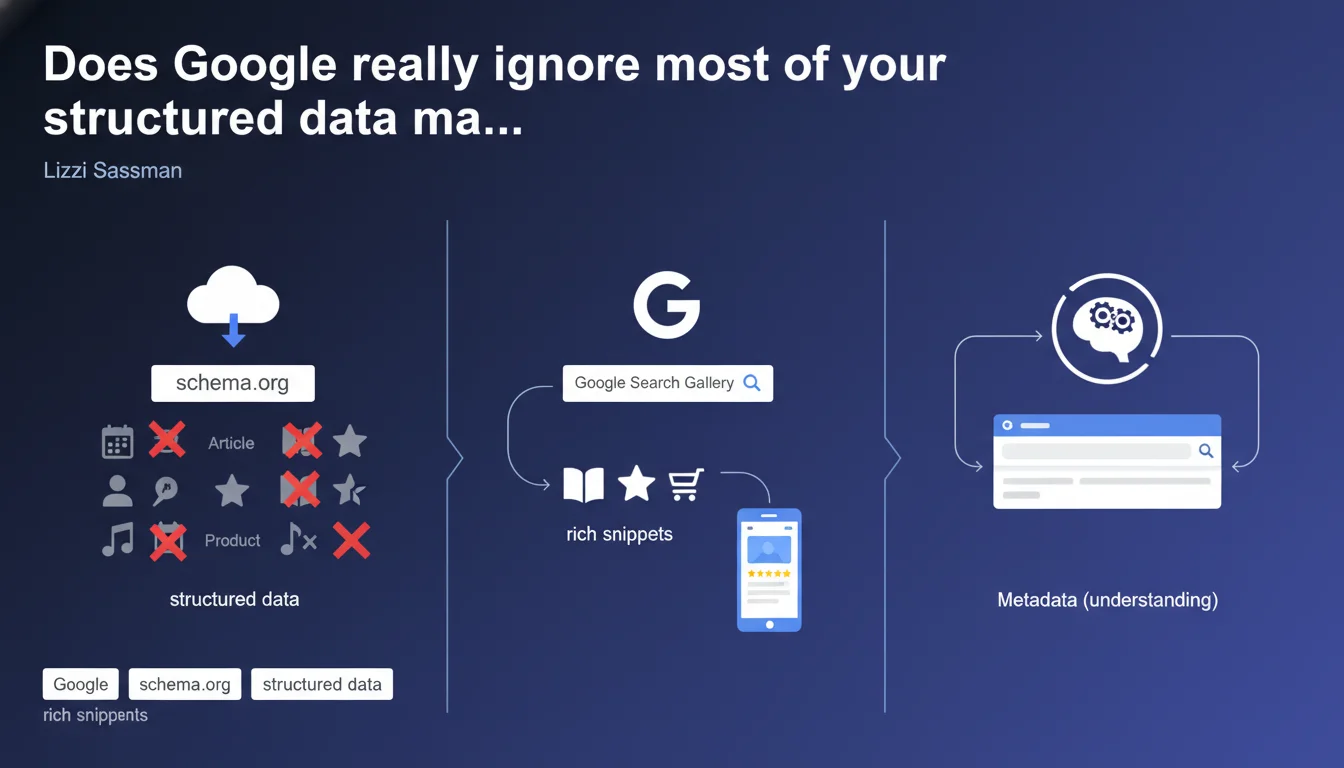
Google supports only a fraction of available schema.org entities. The Search Gallery exhaustively lists the tags that trigger rich snippets, while other properties serve solely as internal metadata for semantic understanding without any visual impact.
What you need to understand
What is the difference between supported tags and understood tags?
Google makes a fundamental distinction between schema.org entities that it displays visually (rich snippets, knowledge panels) and those it analyzes semantically without graphical output. The Search Gallery represents the official inventory of tags that generate an enriched result.
Other schema.org properties — even validated by testing tools — feed into Google's content understanding systems without producing any visible effect. In concrete terms? Your markup can be technically correct without triggering anything in the SERPs.
Why doesn't Google support all entities?
The answer comes down to two constraints: user relevance and maintenance cost. Each type of enriched result requires specific development, usage testing, and spam monitoring. Google concentrates its resources on formats that genuinely improve the search experience.
Some schema.org entities are too niche, others lack sufficient quality data on the web. The engine prioritizes typologies that are massively adopted and already validated by billions of queries.
How do you identify tags that actually trigger rich snippets?
The Search Gallery is the only reliable source — it precisely lists the supported types (Product, Recipe, Event, FAQ, etc.) with their required and recommended properties. Everything not featured there falls into invisible metadata territory.
- The official Search Gallery is the sole reference for tags generating enriched display
- Tags absent from this list can still help Google understand the page without visual effect
- Technically valid markup (according to schema.org) does not guarantee a rich snippet
- Google testing tools validate syntax, not eligibility for enriched display
SEO Expert opinion
Is this distinction consistent with field observations?
Absolutely. We regularly observe sites with flawless schema.org markup that trigger no enriched results — simply because the entity type used is not part of the Search Gallery catalog. This is a recurring source of frustration.
The problem is that Google never clearly communicates the gap between understanding and output. Many practitioners believe that validated markup = guaranteed enriched result, when the logic is far more selective. [To verify]: the actual impact of invisible metadata on ranking remains unclear — Google claims they "help understand," without ever specifying the measurable SEO gain.
What nuances should be added to this statement?
Lizzi Sassman recalls a known rule but underestimates one point: apparently unsupported tags can indirectly influence other systems. For example, properties not listed in the Search Gallery may feed knowledge graphs or associated search suggestions.
And that's where it gets tricky: it's impossible to precisely measure the contribution of invisible metadata. We're flying blind. The pragmatic approach is to prioritize tags documented in the Search Gallery while maintaining coherent semantic markup for the rest.
In which cases should you still markup beyond the Search Gallery?
If your content requires fine semantic understanding — scientific articles, medical data, technical content — comprehensive markup remains relevant. Even without rich snippets, it facilitates entity extraction by Google's NLP systems.
Practical impact and recommendations
What should you concretely do to maximize rich snippets?
Start with the Search Gallery and identify the types of enriched results relevant to your content: products, recipes, events, FAQs, articles, reviews, etc. Each type has its required properties — respect them scrupulously.
Use Google's Rich Results Test to validate syntax, but don't stop there. Manually check the SERPs to see if your competitors achieve enriched results on your target queries. If they do, analyze their markup via View Page Source.
What errors should you avoid when implementing structured data tags?
Don't markup unsupported entities hoping for future impact — Google guarantees no adoption timeline. Also avoid markup spam: marking up invisible or deceptive content to force a rich snippet triggers manual penalties.
Let's be honest: many sites over-markup out of ignorance. They add 10 different schema.org types to a single page, thinking it increases their chances. Result? Bloated code, semantic conflicts, zero benefit.
How do you verify that your implementation is compliant and effective?
Three steps: technical validation via the Rich Results Test, performance monitoring in Search Console (Enhancements section), and manual SERP audits on your priority keywords. If the rich snippet doesn't appear after 2-3 weeks, reconsider your markup.
- Consult the Search Gallery to identify schema.org types supported by Google
- Prioritize tags that generate visible enriched display (Product, Recipe, FAQ, etc.)
- Validate your markup with the Rich Results Test, but also manually verify in the SERPs
- Don't over-markup: focus on required and recommended properties
- Monitor Search Console reports to detect structured data errors
- Avoid markup spam: only mark up content that is truly visible and relevant
- Complement with non-visual schema.org metadata only if it strengthens semantic understanding of your content
❓ Frequently Asked Questions
Toutes les balises schema.org validées par le Rich Results Test génèrent-elles un résultat enrichi ?
Faut-il supprimer les balises schema.org non supportées par Google ?
Comment savoir si un nouveau type schema.org sera supporté par Google à l'avenir ?
Les métadonnées schema.org invisibles influencent-elles le ranking ?
Peut-on cumuler plusieurs types de balises structurées sur une même page ?
🎥 From the same video 16
Other SEO insights extracted from this same Google Search Central video · published on 07/09/2022
🎥 Watch the full video on YouTube →
💬 Comments (0)
Be the first to comment.