
Official statement
Other statements from this video 16 ▾
- □ Le balisage Local Business doit-il vraiment se limiter à une seule ville ?
- □ Faut-il vraiment migrer 1:1 sans rien changer lors d'un changement de domaine ?
- □ Schema.org : pourquoi Google ignore-t-il une partie de vos balises structurées ?
- □ Faut-il vraiment rédiger du texte descriptif autour de vos illustrations pour ranker dans Google Images ?
- □ Le nombre de mots est-il vraiment sans importance pour le référencement ?
- □ Les mots-clés dans les URLs ont-ils encore un impact en SEO ?
- □ Les images consomment-elles vraiment du budget de crawl au détriment de vos pages stratégiques ?
- □ Peut-on vraiment lancer deux sites quasi-identiques sans risquer de pénalité Google ?
- □ Pourquoi vos liens JavaScript doivent absolument utiliser des balises A avec href valide ?
- □ L'audio sur une page influence-t-il réellement le classement Google ?
- □ Faut-il vraiment éviter de modifier les balises meta avec JavaScript ?
- □ Les mises à jour algorithmiques de Google sont-elles vraiment différentes des pénalités ?
- □ Pourquoi Google ne communique-t-il que sur une fraction de ses mises à jour d'algorithme ?
- □ Les données structurées améliorent-elles vraiment votre classement dans Google ?
- □ Faut-il vraiment éviter d'utiliser noindex et canonical sur la même page ?
- □ Les données structurées vidéo servent-elles uniquement à l'indexation ?
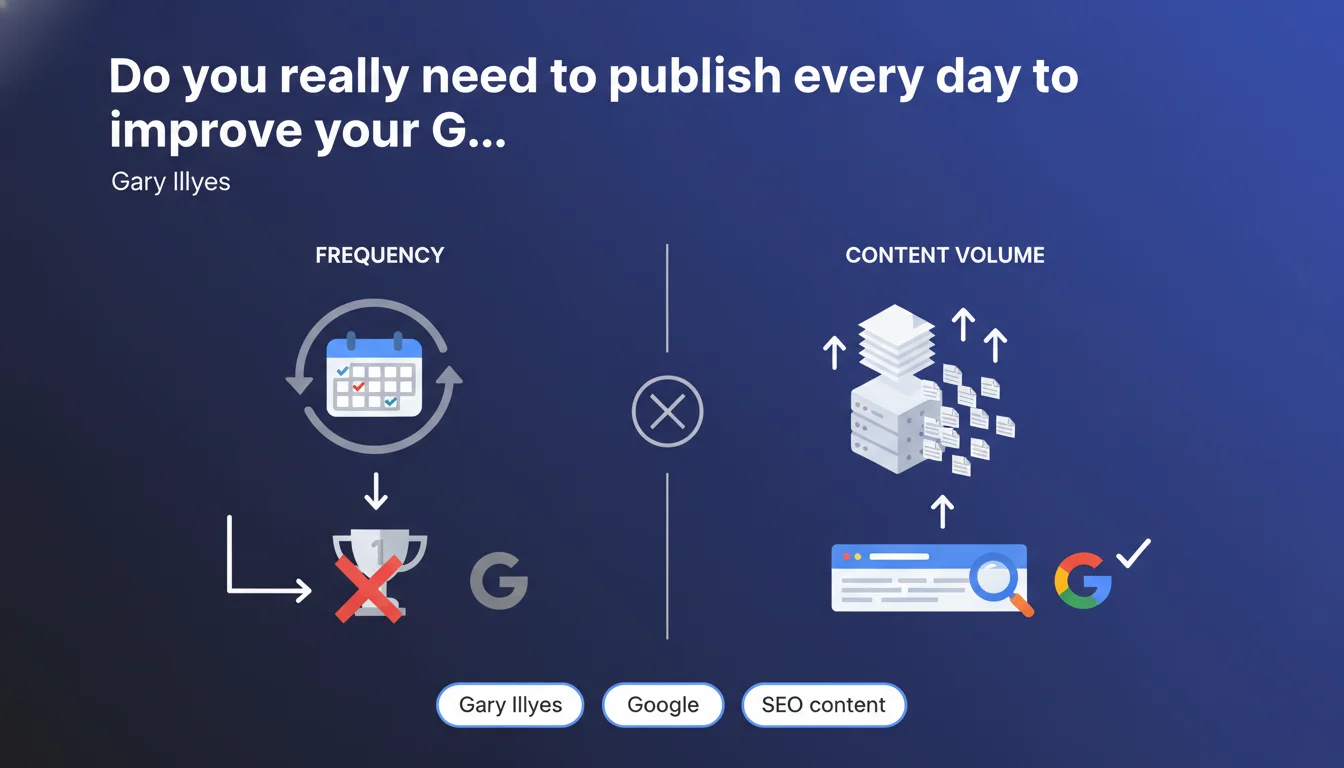
Publication frequency has no direct impact on rankings in Google. What matters is the total volume of indexed pages and their relevance — publishing 50 mediocre articles per month won't beat 4 solid articles that truly answer a search intent.
What you need to understand
Why does Google say that publication frequency doesn't influence rankings?
Gary Illyes directly attacks a stubborn myth: publishing daily doesn't give an algorithmic bonus. Google doesn't reward editorial cadence as such. There's no "industrial freshness" signal that boosts a site because it releases content every day at 8am.
This statement aims to curb blind quantitative strategies — those that prioritize pace over quality. Google doesn't want content farms that think they can outwit the algorithm through a scheduled editorial calendar.
What does "the more pages you have indexed, the more you can appear" really mean?
It's the nuance — and it's critical. Each indexed page is a potential entry door to your site. The more search queries, semantic variations, and different intentions you cover, the more chances you have to be visible.
But be careful: Gary doesn't say "publish 100 pages a day". He says that volume serves overall visibility, provided that each page brings something unique and meets a real demand. Otherwise, it's just noise.
Does publication frequency play an indirect role?
Yes — and that's where it gets interesting. Frequency can influence crawl budget: a site that publishes regularly encourages Googlebot to return more often. This improves indexing responsiveness, not ranking.
Similarly, publishing regularly can generate recurring backlinks, build audience loyalty, and improve user signals. These are positive collateral effects, but disconnected from simply adhering to a calendar.
- Publication frequency is not a direct ranking factor
- The volume of indexed pages mechanically increases visibility opportunities
- Publishing regularly can improve crawl budget and freshness perception by users, but these are indirect effects
- Quality always trumps quantity — one additional page that adds nothing dilutes your authority
SEO Expert opinion
Is this statement consistent with real-world observations?
Yes and no. Yes, because we all see sites that publish three times a year and dominate their niche — frequency is clearly not the key. No, because news sites and media outlets that publish massively and regularly often have an advantage on fresh queries and trending topics.
The problem is that Gary doesn't distinguish between contexts. For a niche e-commerce site, publishing every day makes no sense. For a news outlet, it's structural. The statement lacks granularity — and that's typical of Google. [To verify]: how far does this rule apply in ultra-competitive verticals where freshness is an implicit criterion?
What nuances should we add?
First nuance: content freshness remains a criterion for Query Deserves Freshness (QDF). If you're blogging about the iPhone 17, publishing once a year won't cut it. Frequency isn't a direct signal, but it becomes a contextual necessity on certain queries.
Second nuance: the volume of indexed pages only works if those pages are relevant and differentiated. Adding 200 near-duplicate or thin content pages will only trigger Panda or dilute your internal PageRank. Google doesn't say "publish a lot", it says "cover more valuable ground".
Third nuance: crawl budget. On a large site, publishing massively without structure risks saturating Googlebot and slowing down the indexing of strategic pages. Frequency must be calibrated according to your site's crawlability.
In what cases doesn't this rule fully apply?
News sites are an exception. Google News explicitly favors freshness and responsiveness. Publishing every day — or even several times a day — becomes a requirement to stay visible in Top Stories and news carousels.
UGC platforms (forums, marketplaces, social networks) also play a different game: the volume of user-generated content can compensate for a lack of centralized editorial strategy. Again, the frequency of content updates acts as an indirect vitality signal.
Practical impact and recommendations
What should you concretely do after this statement?
Stop setting yourself arbitrary frequency targets. "Publish 3 articles per week" only makes sense if those 3 articles answer an identified demand, cover a specific search intent, and provide more value than what already exists.
Focus on intelligent semantic expansion: identify uncovered keyword clusters, unanswered questions in your niche, adjacent topics where you can build authority. Each new page must be justified by a visibility opportunity, not by an editorial calendar.
What mistakes should you absolutely avoid?
Don't fall into the volume-for-volume trap. Publishing 50 articles per month churned out on an assembly line (AI or low-cost) will only trigger Helpful Content penalties or dilute your authority. Google increasingly detects mass-produced content.
Also avoid over-optimizing your crawl budget by publishing too fast on a technically weak site. If your infrastructure can't keep up (slowness, 5xx errors, poorly managed facets), you'll saturate Googlebot and slow down indexing of pages that truly matter.
Finally, don't confuse indexing with ranking. Having 10,000 indexed pages is useless if 9,500 are positioned beyond the 50th position. Better to have 500 performing pages than 5,000 ghost pages.
How should you structure your editorial strategy after this statement?
Prioritize a quality-opportunity approach: identify semantic gaps, uncovered intentions, recurring questions from your audience. Each new page must meet a documented need — analyze Search Console, forums, and suggestion tools.
Set up a flexible editorial calendar: publish when you have something to say, not because it's Tuesday. If you have nothing relevant to produce this week, invest instead in updating existing content — often more profitable than average new content.
Monitor your actual indexation rate via Search Console: if Google only indexes 40% of your new pages, there's no point publishing more. First, solve structural issues (duplication, thin content, crawl budget).
- Audit your existing content: identify underperforming or redundant pages
- Prioritize updating already-indexed and ranked content rather than systematically publishing new material
- Check your actual indexation rate in Search Console — if Google refuses to index, find out why
- Build an editorial roadmap based on semantic gaps and keyword opportunities, not weekly quotas
- Test the impact of publication frequency on your crawl budget: observe Googlebot behavior after each content wave
- Focus your efforts on high-potential conversion or traffic pages, even if it means reducing overall frequency
❓ Frequently Asked Questions
Publier tous les jours améliore-t-il mon référencement Google ?
Pourquoi certains sites qui publient massivement sont-ils bien classés ?
Faut-il privilégier la mise à jour de contenu existant ou publier du nouveau contenu ?
La fréquence de publication influence-t-elle le crawl budget ?
Est-ce que Google pénalise les sites qui publient trop de contenu ?
🎥 From the same video 16
Other SEO insights extracted from this same Google Search Central video · published on 07/09/2022
🎥 Watch the full video on YouTube →
💬 Comments (0)
Be the first to comment.