
Official statement
Other statements from this video 16 ▾
- □ Le balisage Local Business doit-il vraiment se limiter à une seule ville ?
- □ Faut-il vraiment migrer 1:1 sans rien changer lors d'un changement de domaine ?
- □ Schema.org : pourquoi Google ignore-t-il une partie de vos balises structurées ?
- □ Faut-il vraiment rédiger du texte descriptif autour de vos illustrations pour ranker dans Google Images ?
- □ Faut-il publier tous les jours pour améliorer son référencement Google ?
- □ Le nombre de mots est-il vraiment sans importance pour le référencement ?
- □ Les mots-clés dans les URLs ont-ils encore un impact en SEO ?
- □ Les images consomment-elles vraiment du budget de crawl au détriment de vos pages stratégiques ?
- □ Pourquoi vos liens JavaScript doivent absolument utiliser des balises A avec href valide ?
- □ L'audio sur une page influence-t-il réellement le classement Google ?
- □ Faut-il vraiment éviter de modifier les balises meta avec JavaScript ?
- □ Les mises à jour algorithmiques de Google sont-elles vraiment différentes des pénalités ?
- □ Pourquoi Google ne communique-t-il que sur une fraction de ses mises à jour d'algorithme ?
- □ Les données structurées améliorent-elles vraiment votre classement dans Google ?
- □ Faut-il vraiment éviter d'utiliser noindex et canonical sur la même page ?
- □ Les données structurées vidéo servent-elles uniquement à l'indexation ?
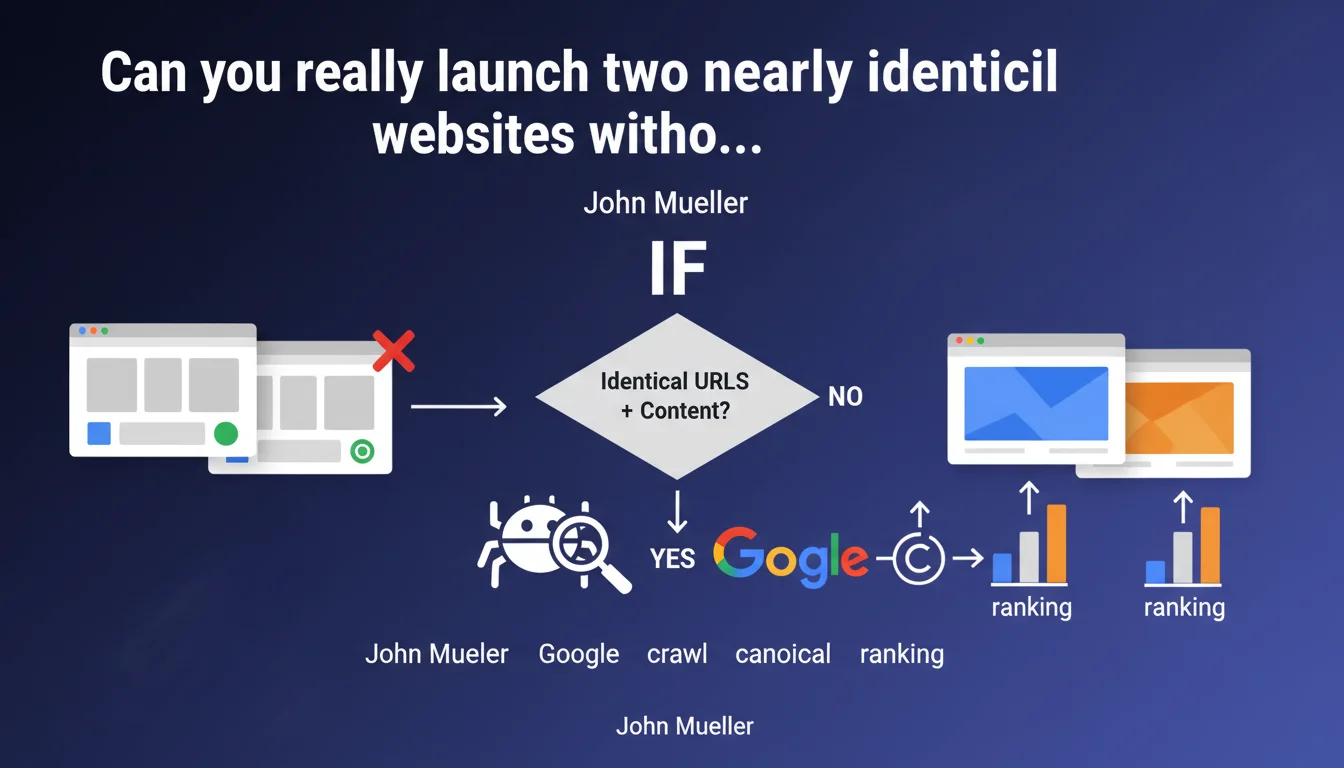
Google does not penalize the existence of two nearly identical websites, but its systems will choose a canonical page and ignore the other for crawling and ranking. For both versions to appear in search results, the differences must be substantial — not just a modified logo or colors.
What you need to understand
What's the difference between a penalty and deprioritization?
Let's be honest: no penalty does not mean no consequence. Google clearly distinguishes between manual action (a human sanction) and automatic algorithmic treatment. In this specific case, no filter will damage your two websites.
On the other hand, automatic canonicalization systems will select one version and set the other aside. Concretely? Only one website will get the crawl budget, prioritized indexing, and SERP positions. The other technically exists, but Google ignores it.
What triggers this automatic canonicalization?
Mueller mentions identical URLs and content. The detection mechanism relies on duplication signals: same HTML structure, same text, same title and meta tags. Google's algorithms identify these duplicates and apply their clustering logic.
The critical nuance — and this is where it gets tricky: Google does not specify the exact similarity threshold. Changing a logo or colors obviously isn't enough. But how many textual differences are needed? 20%? 50%? No official figure.
What are the key takeaways?
- No manual action will be taken against duplicate websites — you won't receive an alert in Search Console for this specific reason
- Google's systems will arbitrarily choose which version to index and rank, based on their own criteria (history, backlinks, user signals...)
- To avoid this forced selection, differences must be significant at the content level, not cosmetic
- The statement remains vague on the exact degree of differentiation needed for both versions to coexist in the index
SEO Expert opinion
Is this statement consistent with real-world observations?
Yes, broadly. On real projects involving multi-country or multi-brand websites with similar content, we do indeed observe this silent prioritization. Google initially indexes both domains, then one gradually disappears from results without notification.
What's missing — and it's frustrating — is the transparency on selection criteria. Why is one website chosen as canonical over the other? Domain age? Volume of backlinks? Historical traffic? [To verify]: Google never precisely documents these arbitrations, which makes any multi-site strategy partially random.
What nuances should be added to this official statement?
Mueller speaks of being "significantly different" but without defining the term. Between a logo change and a complete rewrite, there's an enormous spectrum. Based on real-world testing, modifying 30-40% of visible text is generally not enough — you need to rethink the information architecture itself.
Another point: this logic applies to legitimate websites. If Google detects manipulative intent (doorway sites, satellite networks for pushing backlinks), other algorithmic filters may come into play, even without formal manual action.
In what cases does this rule not fully apply?
Websites with distinct geographical or linguistic targeting benefit from increased tolerance. Two nearly identical versions (e.g., en-US and en-GB) can coexist if hreflang signals and Search Console are properly configured. Google accepts this functional redundancy here.
On the other hand, duplicating a website across two generic domains (.com / .net) with the same English content without clear geographical reason? You're entering the gray area where Google will apply its canonicalization without hesitation.
Practical impact and recommendations
What should you do concretely if you have two similar websites?
First step: audit the actual degree of duplication. Compare equivalent pages with text similarity tools (not just visual inspection). If the rate of identical text exceeds 70-80%, you're clearly in the zone at risk of forced canonicalization.
Next, decide on a strategy: either you substantially differentiate the content (different angles, distinct in-depth explorations, redefined user targets), or you accept that only one website will truly be visible and prioritize optimizing that one.
If both websites have a reason to exist (distinct brands, separated geographical markets), clearly structure these differences: localized content, specific sections, consistent technical signals (hreflang, local domains, regional hosting if relevant).
What mistakes must you absolutely avoid?
- Don't just change the header, footer, or visual design — Google analyzes main content
- Avoid launching a second website "just in case" without a clear differentiation strategy — you're diluting your resources for nothing
- Don't rely on cross-domain canonical tags to force a choice — Google can ignore them if it detects an inconsistency
- Never duplicate a website across multiple generic TLDs without valid geographical or linguistic reason
- Don't forget that even without penalty, crawl budget cannibalization remains real: two websites = double server load, double maintenance, zero SEO gains
How can you verify that your configuration is optimal?
Monitor server logs and Search Console: if Googlebot heavily crawls one website and progressively ignores the other, that's a sign of canonicalization in progress. Also check site: commands for each domain — the progressive drop in indexed pages on one indicates it's being pushed aside.
Use the URL Inspection tool in Search Console to see if Google actually indexes your pages or considers them duplicates of a canonical version elsewhere. If the detected canonical consistently points to the other domain, you have your answer.
❓ Frequently Asked Questions
Si Google canonicalise un de mes deux sites, puis-je forcer le choix de l'autre ?
Est-ce que modifier 30% du texte suffit pour éviter la canonicalisation ?
Deux sites avec des marques différentes mais le même catalogue produit sont-ils concernés ?
Les sites multilingues avec traductions directes risquent-ils cette canonicalisation ?
Recevrais-je une notification dans Search Console si un de mes sites est ignoré ?
🎥 From the same video 16
Other SEO insights extracted from this same Google Search Central video · published on 07/09/2022
🎥 Watch the full video on YouTube →
💬 Comments (0)
Be the first to comment.