
Official statement
Other statements from this video 16 ▾
- □ Le balisage Local Business doit-il vraiment se limiter à une seule ville ?
- □ Faut-il vraiment migrer 1:1 sans rien changer lors d'un changement de domaine ?
- □ Schema.org : pourquoi Google ignore-t-il une partie de vos balises structurées ?
- □ Faut-il vraiment rédiger du texte descriptif autour de vos illustrations pour ranker dans Google Images ?
- □ Faut-il publier tous les jours pour améliorer son référencement Google ?
- □ Le nombre de mots est-il vraiment sans importance pour le référencement ?
- □ Les mots-clés dans les URLs ont-ils encore un impact en SEO ?
- □ Les images consomment-elles vraiment du budget de crawl au détriment de vos pages stratégiques ?
- □ Peut-on vraiment lancer deux sites quasi-identiques sans risquer de pénalité Google ?
- □ Pourquoi vos liens JavaScript doivent absolument utiliser des balises A avec href valide ?
- □ L'audio sur une page influence-t-il réellement le classement Google ?
- □ Faut-il vraiment éviter de modifier les balises meta avec JavaScript ?
- □ Les mises à jour algorithmiques de Google sont-elles vraiment différentes des pénalités ?
- □ Pourquoi Google ne communique-t-il que sur une fraction de ses mises à jour d'algorithme ?
- □ Les données structurées améliorent-elles vraiment votre classement dans Google ?
- □ Faut-il vraiment éviter d'utiliser noindex et canonical sur la même page ?
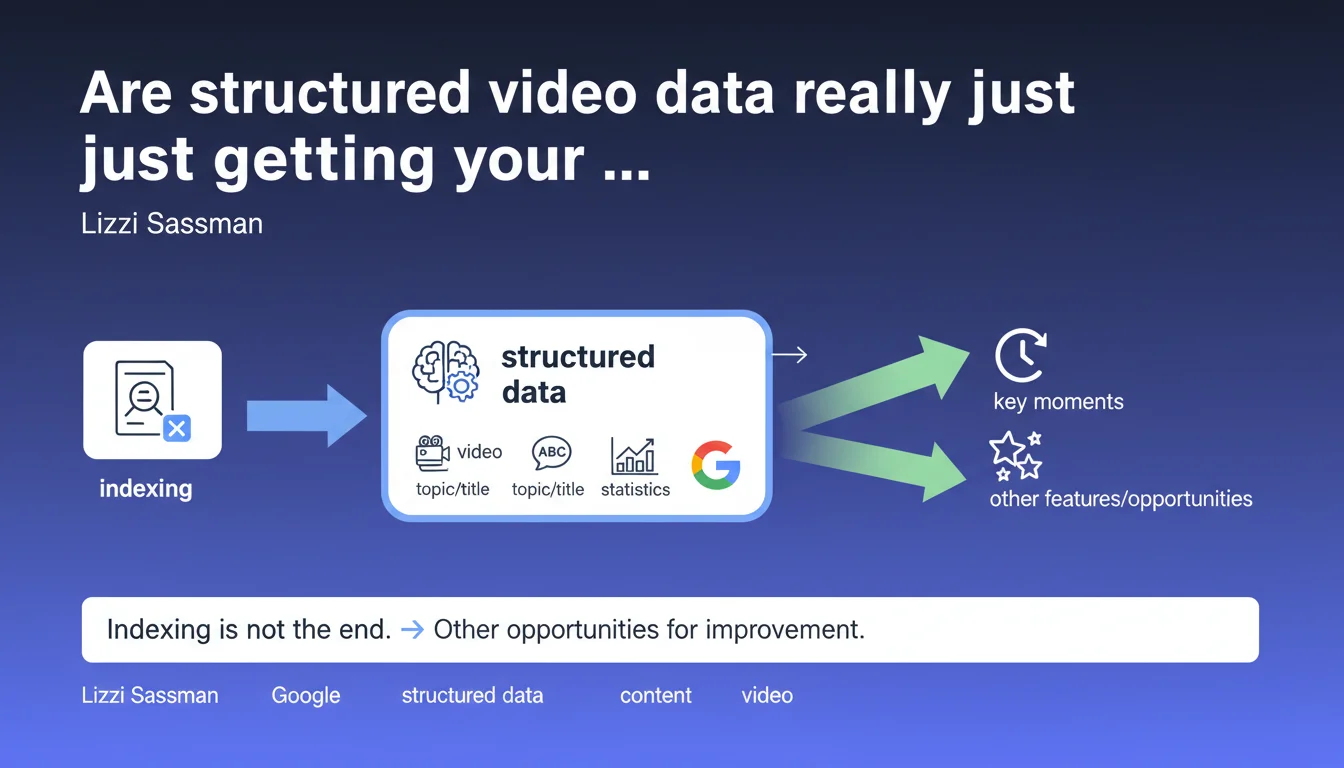
Google confirms that structured video data goes far beyond simply getting your content indexed. They primarily help improve contextual understanding (topic, title, statistics) and unlock access to advanced features like key moments. Indexing is just the first step — fine-tuning optimization requires comprehensive markup.
What you need to understand
What's the difference between indexing and eligibility for rich features?
Video indexing means Google has spotted your content and added it to its index. That's the foundation. But it doesn't guarantee visibility or enrichment in the SERPs.
Eligibility for rich features, on the other hand, depends on the quality and completeness of your markup. Without structured data, you remain sidelined — no video carousels, no dynamic thumbnails, no clickable key moments.
Why does Google insist that indexing is not the end of the process?
Because many sites simply add a <video> tag and think they've done the job. Let's be honest: it's not enough.
Google needs structured context to understand what your video is about, its duration, its author, its publication date. Without this, it can't offer advanced user experiences. And you're missing out on massive visibility leverage.
What specific structured data is expected?
The VideoObject schema is the standard. It includes properties like name, description, thumbnailUrl, uploadDate, duration, contentUrl, and finer metadata like hasPart for chapters.
The richer your markup, the more Google can segment and qualify your content. Key moments, for example, require precise annotation of timestamps and descriptions for each section.
- Indexing guarantees presence in the index, not visibility
- VideoObject structured data increases eligibility for rich snippets
- Key moments require granular markup (timestamps, descriptions)
- Without markup, you're letting Google guess — that's never optimal
SEO Expert opinion
Is this recommendation consistent with field observations?
Absolutely. We see that videos with complete VideoObject markup achieve significantly higher click-through rates in video SERPs. Carousels and key moments generate real incremental traffic.
However — and this is where things get tricky — many sites implement the schema poorly. Missing properties, invalid URLs, inconsistent durations. Google can index the video, but sloppy markup blocks eligibility for advanced features.
What nuances should we add to this statement?
Google doesn't specify exactly what the eligibility thresholds are for each feature. We know key moments require hasPart or Clip markup, but quality criteria remain fuzzy. [To verify]: does the minimum video duration play a role? No official data on that.
Another point: Google says markup helps "better understand," but it doesn't explain how that impacts algorithmic ranking. Structured data improves display, that's certain. Whether it directly influences ranking remains a gray area.
In what cases does this rule not apply?
If your site hosts short videos (< 30 seconds), like stories or clips, key moments are pointless. Markup remains useful for context, but you won't leverage the full toolkit.
Likewise, if your videos are exclusively hosted on YouTube or Vimeo and you don't manage the markup on your site, you're entirely dependent on the platform. Google will often prioritize their native markup, and you lose control.
Practical impact and recommendations
What do you need to implement concretely on your video pages?
Start with the minimum viable version: a VideoObject schema with name, description, thumbnailUrl, uploadDate, duration, and contentUrl. Without these properties, you're not even in the race for rich results.
Next, if your video runs longer than 2-3 minutes and logically breaks down into sections, add hasPart or Clip markup to structure key moments. Each segment should have an explicit name, a URL with timestamp, and ideally a short description.
What errors should you avoid at all costs?
First classic mistake: marking up a video that is not directly visible on the page. If the user has to click to open a modal or external player, Google may consider the markup inconsistent with actual content.
Second pitfall: using thumbnail or content URLs that aren't publicly accessible. Google must be able to crawl these resources. If they're blocked by robots.txt or behind authentication, the markup is useless.
Third error: duplicating the same VideoObject markup across multiple pages without adapting the context. Each page with video should have its own unique schema, even if it's the same video — the publication context changes.
How do you verify your markup is working?
Use Google's rich results testing tool. It detects syntax errors, missing properties, and inconsistencies. But beware: technically valid markup doesn't guarantee eligibility — content must also comply with quality guidelines.
Then check Search Console, under "Enhancements" > "Videos". Google reports detected issues there: invalid thumbnails, inaccessible URLs, inconsistent durations. Fix them as you go.
- Implement VideoObject with all mandatory properties (name, description, thumbnailUrl, uploadDate, duration, contentUrl)
- Add hasPart or Clip markup for videos longer than 2-3 minutes
- Validate the schema with the rich results testing tool
- Monitor errors in Search Console, Videos section
- Verify that thumbnail and content URLs are crawlable
- Avoid duplicating the same markup without contextual adaptation
❓ Frequently Asked Questions
Est-ce que le balisage VideoObject améliore le classement de ma vidéo dans les résultats de recherche ?
Faut-il ajouter des données structurées même si ma vidéo est hébergée sur YouTube ?
Les moments clés apparaissent-ils automatiquement si j'ajoute le balisage hasPart ?
Puis-je utiliser le même schéma VideoObject pour plusieurs pages qui embedent la même vidéo ?
Quelles propriétés VideoObject sont réellement obligatoires pour éviter les erreurs dans la Search Console ?
🎥 From the same video 16
Other SEO insights extracted from this same Google Search Central video · published on 07/09/2022
🎥 Watch the full video on YouTube →
💬 Comments (0)
Be the first to comment.