
Official statement
Other statements from this video 16 ▾
- □ Should Local Business markup really be limited to just one city?
- □ Should you really do a 1:1 migration without changing anything during a domain switch?
- □ Does Google really ignore most of your structured data markup?
- □ Does adding descriptive text around your images really boost their rankings in Google Images?
- □ Do you really need to publish every day to improve your Google SEO?
- □ Does word count really matter for SEO rankings?
- □ Do keywords in URLs still have an impact on SEO?
- □ Do images really consume your crawl budget at the expense of your strategic pages?
- □ Can you really launch two nearly identical websites without risking a Google penalty?
- □ Why must your JavaScript links absolutely use A tags with valid href attributes?
- □ Does audio content on a page actually influence your Google ranking?
- □ Should you really avoid modifying meta tags with JavaScript?
- □ Are Google's algorithm updates really that different from penalties?
- □ Why does Google only communicate about a fraction of its algorithm updates?
- □ Do structured data really improve your Google rankings?
- □ Are structured video data really just about getting your content indexed?
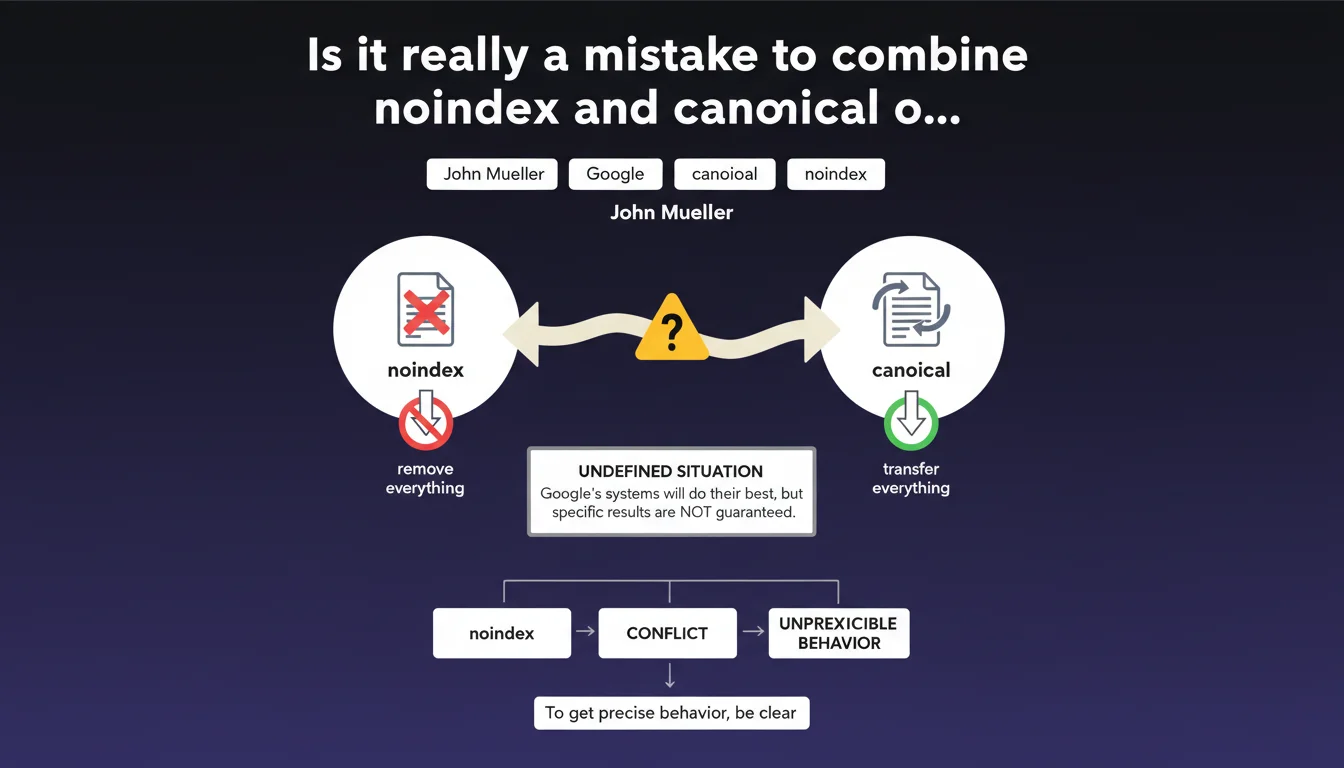
Combining noindex and rel=canonical on the same URL creates a conflict of instructions for Google: one asks for indexation removal, the other indicates a preferred version to index. The search engine will do its best but without any guarantee of results. For precise control, you need to choose one clear and consistent directive.
What you need to understand
Why are these two directives incompatible?
The noindex explicitly tells search engines not to index the affected page. It's a firm instruction that requests complete removal of the URL from search results.
The rel=canonical, on the other hand, signals that another page is the reference version. It suggests that content and signals should be transferred to this canonical URL — which logically implies that there is something to transfer, therefore something to index somewhere.
Using both simultaneously amounts to saying "don't index this page" and "transfer everything to this other version" — a contradiction that algorithms must arbitrate without clear guidance.
How does Google handle this conflict in practice?
Mueller clarifies that Google's systems "will do their best," which reflects an absence of guaranteed behavior. Concretely, this means that the engine will choose one directive according to its own internal logic — and this choice can vary depending on crawls, updates, or contexts.
This situation creates unpredictability: impossible to know whether Google will prioritize noindex (and remove the page) or canonical (and attempt to transfer signals). For a professional seeking precise control over indexation, this is unacceptable.
In what cases does this configuration appear despite everything?
This conflict often arises from poorly configured CMS setups: templates that systematically apply a canonical to a "clean" version while adding noindex to certain pages (paginations, filters, variants).
You also find it in technical migrations where contradictory directives persist by mistake, or in cases where multiple teams intervene without coordination on technical and SEO aspects.
- Noindex: instruction for complete removal from indexation
- Canonical: suggestion of preferred version with signal transfer
- Combination = logical conflict without guaranteed result
- Google arbitrates according to its own logic, unpredictably
- Frequent origin: CMS errors or lack of technical coordination
SEO Expert opinion
Is this statement consistent with field observations?
Yes, and it's even a finding that many SEOs have made without Google confirming it so explicitly. In technical audits, you regularly encounter pages in noindex + canonical that sometimes disappear from the index, sometimes remain there for weeks before finally being removed.
What Mueller brings here is the confirmation that this ambiguity is not a bug but an absence of specification. Google guarantees nothing because you're giving it contradictory instructions. It seems obvious when put that way, but how many production sites carry this kind of flawed configuration?
Why doesn't Google enforce a clear hierarchy between these directives?
Good question. You might imagine that a directive as firm as noindex would systematically override any other instruction, canonical included. But Google apparently prefers to let its algorithms "do their best" — in other words, guess the actual intent.
The problem is that this approach creates uncertainty for practitioners. [To verify]: we have no public data on the exact criteria that tip the balance one way or the other. Is it the age of the directive? The consistency of internal linking? The number of external signals? Mueller doesn't say, and that's frustrating.
An SEO seeking technical mastery cannot settle for "let's see what happens." Let's be honest: this is exactly the kind of answer that pushes you to test everything in real conditions before deploying.
In what cases might this configuration seem tempting?
Some SEOs think combining noindex + canonical allows them to "keep the juice while avoiding indexation." The idea: prevent a page from polluting the index while consolidating its signals toward the canonical version. It sounds clever on paper.
Except this logic relies on a misunderstanding. If Google honors noindex, it will probably not transfer the signals — because a non-indexed page doesn't deserve having its signals consolidated elsewhere. If instead it prioritizes canonical, then noindex will be ignored and the page will remain indexed. Either way, the initial objective fails.
Practical impact and recommendations
What should you do concretely when you detect this configuration?
First, identify all affected pages. A crawl with Screaming Frog or equivalent tool allows you to quickly spot URLs carrying both a meta robots noindex and a rel=canonical pointing to another page.
Then, make a decision: what do you really want for each URL? If the goal is complete deindexation, keep noindex and remove canonical. If the goal is consolidation toward a reference version, remove noindex and ensure the canonical points correctly.
And if the situation is more complex — for example, pagination you wish to deindex but whose signals you want to transfer to the main page — then the solution involves a 301 redirect, not contradictory directives.
What mistakes must you absolutely avoid in this context?
First common mistake: letting this configuration persist thinking "Google will figure it out." No. Google says explicitly: the result is not guaranteed. Impossible to build solid SEO strategy on randomness.
Second mistake: applying a canonical "by default" on all pages without considering their indexation status. Many CMS do this. Result: pages in noindex end up with active canonical, creating exactly the conflict Mueller points out.
Third mistake: believing that a noindex page still transfers PageRank via its canonical. Nothing proves this, and algorithmic logic suggests the opposite.
How do you audit and fix your site at scale?
For a medium to large site, manual auditing is not feasible. You need to automate detection via complete crawl, then cross-reference data: pages with noindex tag AND canonical different from self-canonical.
Next, analyze each segment: paginations, filters, end-of-life product pages, regional variants. Each type requires coherent decision applied systematically.
- Crawl the site to detect pages with noindex + active canonical
- Segment affected URLs by type (pagination, filters, etc.)
- Decide for each segment: complete deindexation (noindex only) or consolidation (canonical only)
- If signal transfer is necessary, prioritize 301 redirect over conflicting canonical
- Systematically remove canonical from pages you truly want deindexed
- Verify after deployment that Google Search Console reflects the expected behavior
- Document applied rules to prevent any regression during future CMS changes
❓ Frequently Asked Questions
Peut-on utiliser noindex et canonical pour conserver le PageRank tout en désindexant une page ?
Que se passe-t-il concrètement quand Google détecte noindex + canonical sur la même page ?
Comment savoir si mon CMS génère automatiquement ce conflit ?
Le X-Robots-Tag noindex est-il concerné par ce conflit avec canonical ?
Si je retire le canonical d'une page en noindex, vais-je perdre du PageRank ?
🎥 From the same video 16
Other SEO insights extracted from this same Google Search Central video · published on 07/09/2022
🎥 Watch the full video on YouTube →
💬 Comments (0)
Be the first to comment.