
Official statement
What you need to understand
What was Google's historical position on this combination?
For years, Google formally advised against the simultaneous use of a noindex tag and a canonical tag on the same page. This recommendation was based on seemingly simple logic: these two directives can appear contradictory.
The canonical tag indicates which version of a page should be indexed when multiple URLs present similar content. Conversely, the noindex tag explicitly requests not to index the page. Using both together therefore created confusion in the signals sent to robots.
Why is John Mueller now nuancing this recommendation?
The recent statement introduces a more contextual and pragmatic approach. Mueller acknowledges that there are legitimate use cases where this combination can make sense, particularly when you want to finely manage indexation while consolidating signals.
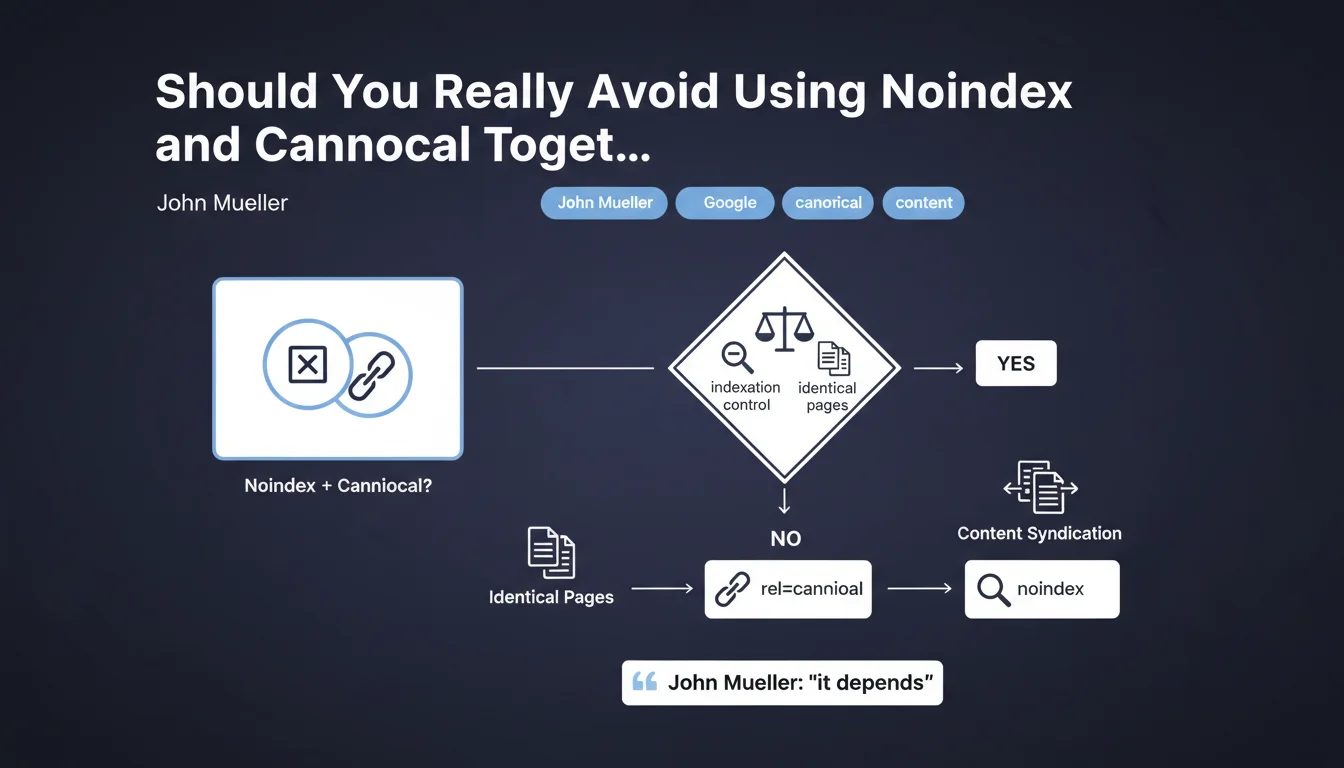
He proposes a distinction based on the priority given to indexation control. If your absolute priority is not to index a page while redirecting SEO equity to a canonical version, this combination becomes acceptable.
What are the recommended use case scenarios?
For identical pages of low importance, the simple canonical tag is more than sufficient. Google will choose the version to index and consolidate the signals.
For syndicated or republished content, where you want to avoid duplication without using canonical (because the content is different), noindex alone is preferable.
- Unimportant identical pages: use only rel=canonical
- Different syndicated content: favor noindex alone
- Strict indexation control with consolidation: noindex + canonical can be justified
- The combination remains an exception, not a general rule
- Simultaneous use often signals a site architecture problem
SEO Expert opinion
Is this evolution consistent with practices observed in the field?
In my practice, I have indeed found that Google handles this combination without major dysfunction for several years now. The search engine generally gives priority to noindex, which makes sense from a hierarchical perspective.
However, this technical tolerance does not necessarily validate the usefulness of the practice. In 95% of cases, well-thought-out architecture avoids needing this combination. Mueller's nuance reflects technical reality more than a new recommendation to follow systematically.
What are the limitations and risks of this approach?
The main risk lies in the maintenance and comprehension complexity that this practice introduces. Technical teams who take over a site may misinterpret these contradictory signals and make mistakes during redesigns.
Moreover, this combination often masks deeper structural problems: poorly managed pagination, unoptimized filter facets, automatically generated content without added value. Treating the symptom rather than the cause is never a good long-term SEO strategy.
In what exceptional cases is this combination truly justified?
The rare legitimate situations concern constrained technical environments where you don't fully control URL generation. For example, some e-commerce platforms generate URL variants with parameters that you cannot technically remove.
In these specific cases, combining noindex and canonical allows you to block indexation while consolidating equity toward the clean version. But ideally, intervention at the development level would be preferable to prevent the generation of these parasitic URLs.
Practical impact and recommendations
How do you audit the current use of these tags on your site?
Start by extracting all pages containing both noindex and canonical simultaneously via your crawl tool (Screaming Frog, Oncrawl, Botify). Analyze each case to understand the intention behind this configuration.
Then check in Search Console whether these pages generate warnings or indexation problems. Also examine server logs to see if Googlebot continues to intensively crawl these pages, which would indicate confusion.
What concrete actions should you take depending on your situation?
If you discover this combination on identical pages without strategic importance, remove the noindex and keep only the canonical. This is the cleanest solution and recommended by Google.
For truly duplicated content that you absolutely don't want indexed, remove the canonical and keep the noindex. If you want to consolidate equity, consider instead a 301 redirect to the canonical version.
In the rare cases where you are technically blocked, document precisely why this combination is necessary. This documentation will be valuable for future contributors and during technical evolutions allowing you to resolve the problem at its source.
- Crawl the entire site to identify all pages with noindex + canonical
- Document each case: why does this combination exist?
- Prioritize cleaning up misconfigured pages with high SEO potential
- Favor canonical alone for low-importance duplicates
- Use noindex alone for syndicated content to exclude
- Consider 301 redirects as an alternative to consolidate definitively
- Set up alerts to detect new occurrences
- Train technical teams in best practices for tag management
Google's nuanced position on the noindex + canonical combination reflects a technical reality more than a new recommendation. In the vast majority of cases, this combination should still be avoided because it signals an architecture or content strategy problem.
The optimal approach is to choose the appropriate tool according to context: canonical for duplicates to consolidate, noindex for content to exclude, and ideally technical solutions (redirects, prevention of URL generation) to address problems at their source.
These technical optimizations require specialized expertise and a comprehensive vision of your digital ecosystem. Fine management of indexation directives is part of a broader SEO strategy, where each decision must be consistent with your business objectives. For complex sites or constrained technical environments, support from a specialized SEO agency can prove decisive in avoiding costly mistakes and implementing sustainable solutions adapted to your specific context.
💬 Comments (0)
Be the first to comment.