
Official statement
Other statements from this video 16 ▾
- □ Should Local Business markup really be limited to just one city?
- □ Should you really do a 1:1 migration without changing anything during a domain switch?
- □ Does Google really ignore most of your structured data markup?
- □ Does adding descriptive text around your images really boost their rankings in Google Images?
- □ Do you really need to publish every day to improve your Google SEO?
- □ Does word count really matter for SEO rankings?
- □ Do images really consume your crawl budget at the expense of your strategic pages?
- □ Can you really launch two nearly identical websites without risking a Google penalty?
- □ Why must your JavaScript links absolutely use A tags with valid href attributes?
- □ Does audio content on a page actually influence your Google ranking?
- □ Should you really avoid modifying meta tags with JavaScript?
- □ Are Google's algorithm updates really that different from penalties?
- □ Why does Google only communicate about a fraction of its algorithm updates?
- □ Do structured data really improve your Google rankings?
- □ Is it really a mistake to combine noindex and canonical on the same page?
- □ Are structured video data really just about getting your content indexed?
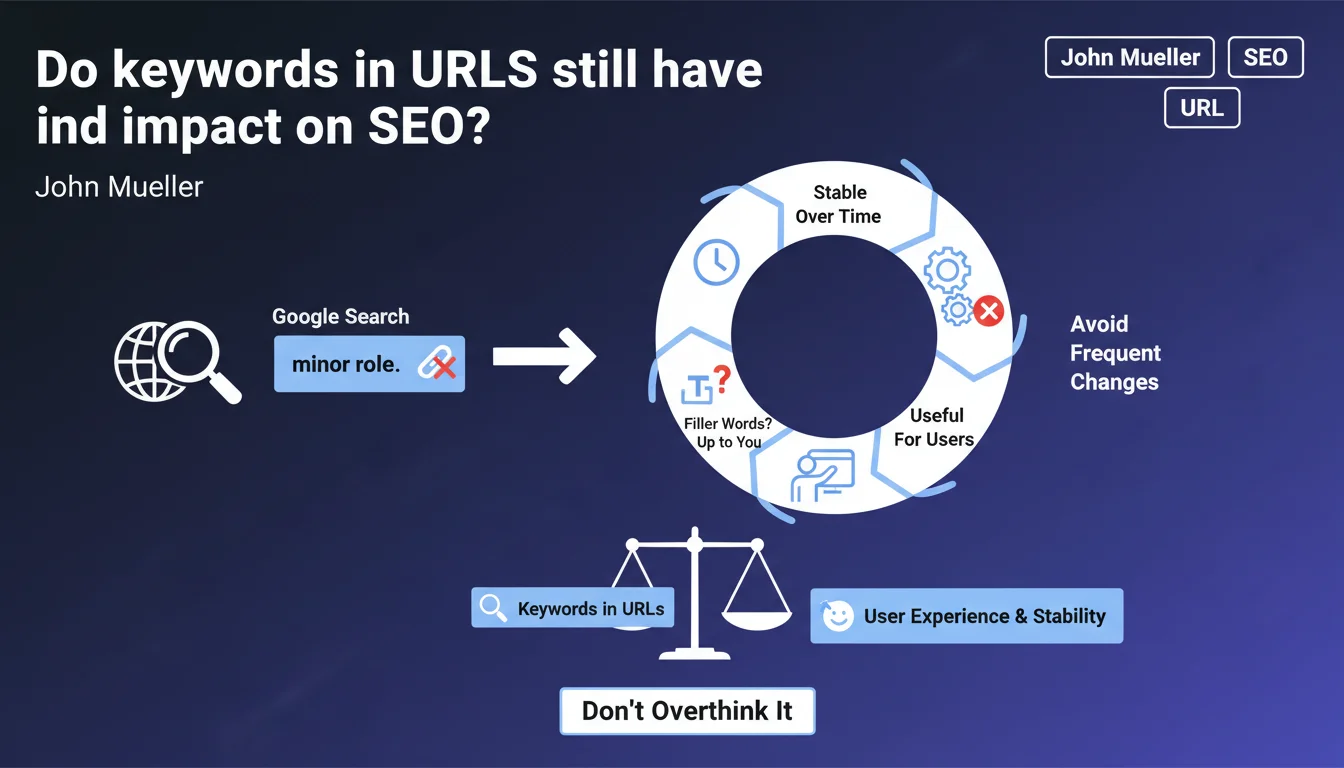
Google states that words in URLs play only a minor role in search rankings. The priority is URL stability and their usefulness for users. Whether or not to include filler words is entirely your choice, with no notable SEO consequences.
What you need to understand
What is Google's exact position on keywords in URLs?
John Mueller is categorical: words in URLs play a minor role in Google Search rankings. This statement contrasts with certain practices that meticulously optimize every URL segment to include strategic keywords.
Google prioritizes URL stability — their ability to remain constant over time — rather than their semantic content. Frequently changing URLs generates redirects, dilutes page authority, and creates friction for indexing.
Why does Google downplay the importance of words in URLs?
This position reflects the algorithm's evolution toward contextual understanding of content. Google analyzes text, tags, entities, engagement signals — the URL becomes a marginal signal compared to these richer elements.
Google's approach also aims to discourage over-optimization. URLs stuffed with keywords smell like manipulation, not user experience.
What does "useful for users" concretely mean?
A useful URL is readable, predictable, and descriptive. It gives a clear indication of what the user will find on the page, without technical jargon or cryptic identifiers.
Example: /guide-seo-audit is preferable to /p?id=8472&cat=seo. The first informs, the second does not. But between /guide-seo-audit and /complete-guide-technical-seo-audit-2024, the SEO difference is negligible.
- Minor role of keywords in URLs for Google rankings
- URL stability prioritized over semantic optimization
- Filler words (the, and, or, etc.) have no impact on search rankings
- The URL should be readable and descriptive for the user, not the algorithm
- Frequently changing URLs harms more than an imperfect structure
SEO Expert opinion
Is this position consistent with what we observe in practice?
Yes and no. On competitive queries, the URL alone never makes the difference between two comparable pages. However, on niche or precise transactional queries, an exact match between search query and URL can provide a micro-advantage — but this signal remains marginal.
A/B tests on thousands of pages show that modifying a URL to add a keyword generates no measurable traffic gain if the content remains identical. The correlation observed between optimized URLs and good rankings mostly reflects overall discipline: those who care for their URLs generally care for everything else.
What nuances should we add to this statement?
Mueller says "minor role," not "no role." In certain contexts — exact match domains, EMDs, branded URLs — the URL can carry a contextual relevance signal. [To verify]: Google has never published figures on this relative weight.
Another point: this statement concerns Google Search, not CTR in SERPs. A clear and reassuring URL increases click-through rate, especially against obscure or parameterized URLs. The indirect impact on SEO through behavioral signals exists.
In what cases does this rule not fully apply?
On multilingual or multi-regional sites, URL structure (/fr/, /en/, /de/) remains a technical signal for hreflang and geographic targeting. Here, the URL has a functional role, not semantic.
For e-commerce sites with filters, URL parameter management impacts crawl budget and canonicalization. The choice between /category?color=red and /category/red is more about technical architecture than keyword stuffing.
Practical impact and recommendations
What should you concretely do with existing URLs?
If your current URLs are stable, readable, and free of unnecessary parameters, don't touch them. Modifying URLs solely to add a keyword is counterproductive: you lose link history, create redirects, and risk errors.
For new pages, prioritize simplicity and consistency. No need for all synonyms or long-tail keywords in every segment. A short, descriptive URL is sufficient.
What mistakes must you absolutely avoid?
Don't stuff URLs with keywords — /expert-seo-consultant-freelance-paris-agency-search-optimization is counterproductive. You waste silo structure potential and harm readability.
Avoid frequent URL changes. Each modification requires a 301 redirect, and redirect chains (A → B → C) dilute link equity and slow crawling.
Eliminate session identifiers, tracking parameters, and non-canonicalized dynamic URLs. They create duplicate content and fragment indexing.
How do you verify that my URL strategy is optimal?
Audit your URLs with Screaming Frog or a crawler: identify overly long URLs (>100 characters), unnecessary parameters, underscores instead of hyphens. Check the consistency of depth levels — strategic pages should be close to the root.
Monitor your redirects in Search Console: spikes of 301s after a redesign often signal poor migration planning. Test reindexing speed — stable URLs reindex faster.
- Keep existing URLs if they are functional and stable
- Create short, readable, and descriptive URLs for new pages
- Avoid keyword stuffing in URL segments
- Don't modify URLs without a major strategic reason
- Implement clean 301 redirects in case of migration
- Eliminate unnecessary parameters and canonicalize variants
- Prefer hyphens (-) to underscores (_) to separate words
- Regularly audit URL structure with a crawler
❓ Frequently Asked Questions
Faut-il supprimer les mots de liaison (de, le, et) dans les URLs ?
Une URL avec mot-clé exact classe-t-elle mieux qu'une URL neutre ?
Peut-on changer les URLs d'un site existant pour les optimiser ?
Les tirets ou underscores dans les URLs font-ils une différence ?
Quelle longueur maximale pour une URL optimale ?
🎥 From the same video 16
Other SEO insights extracted from this same Google Search Central video · published on 07/09/2022
🎥 Watch the full video on YouTube →
💬 Comments (0)
Be the first to comment.