
Official statement
Other statements from this video 14 ▾
- □ How does Google actually count impressions and clicks within People Also Ask blocks?
- □ Do links from a subdomain to the main domain carry less SEO value?
- □ Does Google really show you all the links that matter for your SEO in Search Console?
- □ Can an invalid AMP page still be indexed by Google?
- □ Are massive footer links really killing your site's context?
- □ Should you disable automatic links to boost your SEO performance?
- □ Is hidden text still a problem for SEO in 2024?
- □ Why does Google refuse to index some of your pages?
- □ Can a handful of untagged affiliate links really escape Google penalties?
- □ Why do your images never appear in Google Images despite solid SEO performance?
- □ Why does Google insist that sitemaps should never be your only safety net?
- □ Should you really be using canonicals on your filtered internal search pages?
- □ Can Core Web Vitals Really Tank Your Rankings by 48 Positions?
- □ Why does the schema.org validator contradict Google's tools?
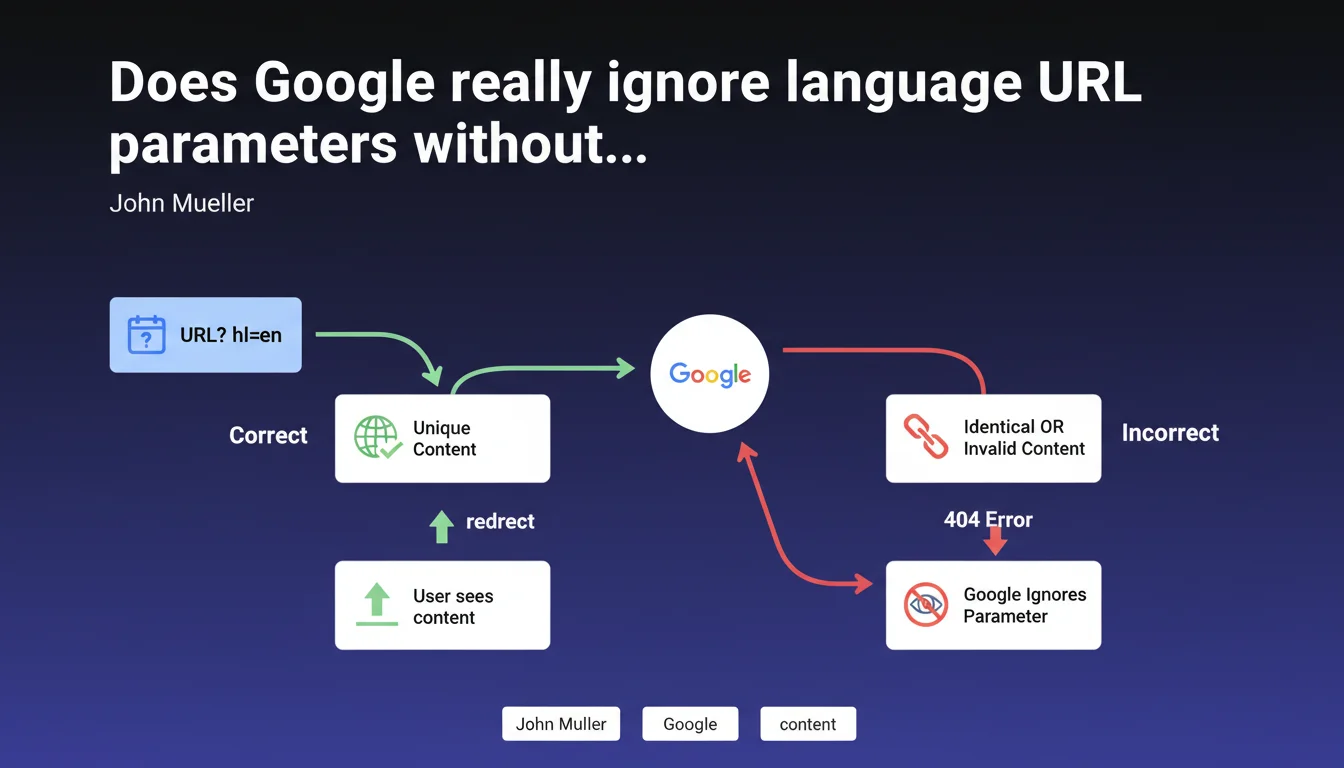
Google automatically learns to ignore URL parameters (such as hl=language) if they frequently return identical content or invalid pages. To prevent this, each parametric language variant must display unique content in the targeted language, with redirects or 404s for unsupported languages.
What you need to understand
How does Google decide to ignore a URL parameter?
The search engine doesn't make this decision randomly. Its algorithms detect patterns of identical or invalid content despite parameter variation. If hl=fr, hl=es and hl=de consistently return the same English page, Google records this behavior.
The system progressively learns that the parameter has no real impact on the content served. It eventually treats it as insignificant — exactly as it would with an advertising tracking parameter. The consequence? Only one version gets indexed, and your language variants disappear from search results.
What triggers this learning mechanism?
Two main scenarios: identical content despite the parameter, or repeated errors for certain values. In the first case, you always display the default language without accounting for the parameter. In the second, you generate empty pages or soft 404s when an unsupported language is requested.
Google crawls, detects the inconsistency, and adjusts its treatment. The problem? This decision is made without notifying you. You don't receive a Search Console alert indicating that your language parameters are now being ignored. You discover it by observing the gradual disappearance of your localized versions from the index.
Why does this approach pose a problem for international SEO?
Because it penalizes approximative implementations without offering an obvious second chance. Once Google has learned to ignore your parameter, fixing the problem doesn't guarantee an immediate return to normal. The system must relearn that the parameter has become significant.
This machine learning mechanism works both ways, but with a frustrating temporal asymmetry. Degrading takes a few crawls. Rebuilding trust can take weeks or even months depending on crawl frequency and site size.
- Google ignores parameters that don't actually change the content served
- The system learns automatically without prior notification to the webmaster
- Repeated errors (404, empty content) accelerate this process of being ignored
- Once the parameter is ignored, fixing the implementation doesn't instantly restore indexation
- This logic applies specifically to language parameters (hl, lang, locale, etc.)
SEO Expert opinion
Is this statement consistent with field observations?
Absolutely. We regularly observe multilingual sites with URL parameters where only the default version remains indexed. The pattern is classic: initial development with poorly calibrated server-side language detection, followed by gradual deindexation of variants without the technical team understanding why.
What's missing from Mueller's statement? Concrete metrics on the tolerance threshold. How many crawls with identical content does it take to trigger parameter ignoring? What proportion of errors is acceptable? [To be verified] — Google never communicates these thresholds, probably to avoid circumvention optimization.
What are the gray areas not addressed?
The statement remains silent on mixed implementations: what happens if 80% of your language parameters work correctly, but 20% return default content? Does Google ignore the entire parameter or only the problematic values?
Another fuzzy point: the interaction with hreflang. If you simultaneously use URL parameters AND hreflang annotations, which one takes priority if Google detects an inconsistency? Field experience suggests hreflang remains priority, but the official statement doesn't specify this.
In what cases does this rule not apply?
Mueller speaks specifically of language parameters detected as insignificant. This doesn't affect classical URL structures for internationalization: subdomains (fr.site.com), subdirectories (site.com/fr/), or dedicated domains (site.fr). These approaches remain reliable.
The mechanism also doesn't concern legitimate technical parameters that actually modify content (filters, sorting, pagination when properly implemented). Google distinguishes between a parameter meant to change the language but doesn't, and a filter parameter that works as intended.
Practical impact and recommendations
What should you concretely do to avoid this problem?
First, verify that each combination of language parameter actually returns content in the requested language. No silent fallback to English if the language isn't available. If a user requests ?hl=ja and you don't support Japanese, display a 404 or explicitly redirect them to a page listing your available languages.
Next, audit your current implementation. Crawl your site with different language parameter values and compare the content served. If you detect identical content despite different parameters, Google has probably already detected it too.
What errors should you absolutely avoid?
Never display the same default language regardless of the parameter. This is the fatal mistake that triggers the ignoring mechanism. If your server-side logic doesn't recognize the language code, it must return a real HTTP error, not default content.
Also avoid soft 404s: pages that return a 200 OK but display "this language is not available." Google crawls them, observes the absence of actual content, and begins considering the parameter unreliable. Prefer a real 404 or a 301 redirect to the appropriate fallback language.
- Manually test each supported language code: does the content actually change?
- Verify that unsupported languages return 404 or an explicit redirect
- Crawl the site with different parameter values to detect duplicate content
- Check in Search Console if all your language variants are indexed
- Compare the number of indexed URLs with the theoretical number of pages × languages
- Set up monitoring to detect indexation drops by language
- If you use hreflang, verify consistency with URL parameters
- Consider migrating to subdirectories or subdomains if parameters cause issues
How do you verify your implementation is correct?
Use the URL inspection tool in Search Console to test several language variants. Look at the rendered HTML: does Google see different content depending on the parameter? If the rendered snapshot is identical for ?hl=fr and ?hl=es, you have a problem.
Also monitor index coverage reports. A gradual disappearance of pages with language parameters is a red flag. If you had 1000 pages indexed × 5 languages = 5000 URLs and this number drops toward 1000, Google has probably learned to ignore your parameters.
Managing language parameters requires absolute technical rigor. Each language must serve unique content, and each unsupported language must return an explicit error. An approximative implementation doesn't generate an immediate alert — it gradually degrades your multilingual indexation.
Given the complexity of these configurations and the risks of gradual deindexation, some international projects would benefit from support by an international SEO agency. The technical expertise required to audit, correct, and monitor these implementations often exceeds internal resources, particularly when managing hreflang, URL parameters, and complex multilingual architectures simultaneously.
❓ Frequently Asked Questions
Les paramètres d'URL sont-ils moins fiables que les sous-répertoires pour le multilingue ?
Si Google ignore déjà mes paramètres linguistiques, corriger le code suffira-t-il ?
Comment savoir si Google ignore actuellement mes paramètres de langue ?
Faut-il déclarer les paramètres linguistiques dans Search Console ?
Peut-on combiner paramètres d'URL et hreflang pour le multilingue ?
🎥 From the same video 14
Other SEO insights extracted from this same Google Search Central video · published on 05/03/2022
🎥 Watch the full video on YouTube →
💬 Comments (0)
Be the first to comment.