
Official statement
Other statements from this video 14 ▾
- □ Comment Google comptabilise-t-il les impressions et clics dans les People Also Ask ?
- □ Les liens depuis un sous-domaine vers le domaine principal ont-ils moins de valeur en SEO ?
- □ Tous les liens dans Search Console sont-ils vraiment utiles pour votre SEO ?
- □ Une page AMP invalide peut-elle quand même être indexée par Google ?
- □ Les liens massifs en footer tuent-ils vraiment le contexte de votre site ?
- □ Faut-il désactiver les liens automatiques pour améliorer son SEO ?
- □ Pourquoi Google refuse-t-il d'indexer certaines de vos pages ?
- □ Quelques liens d'affiliation sans attribut peuvent-ils vraiment échapper à toute pénalité ?
- □ Pourquoi vos images n'apparaissent-elles jamais dans Google Images malgré un bon SEO ?
- □ Pourquoi Google insiste-t-il pour que les sitemaps ne soient jamais votre seul filet de sécurité ?
- □ Faut-il vraiment utiliser des canonicals sur vos pages de recherche interne filtrées ?
- □ Les Core Web Vitals peuvent-ils vraiment faire chuter votre positionnement de 48 places ?
- □ Pourquoi le validateur schema.org contredit-il les outils de Google ?
- □ Pourquoi Google ignore-t-il certains paramètres d'URL de langue ?
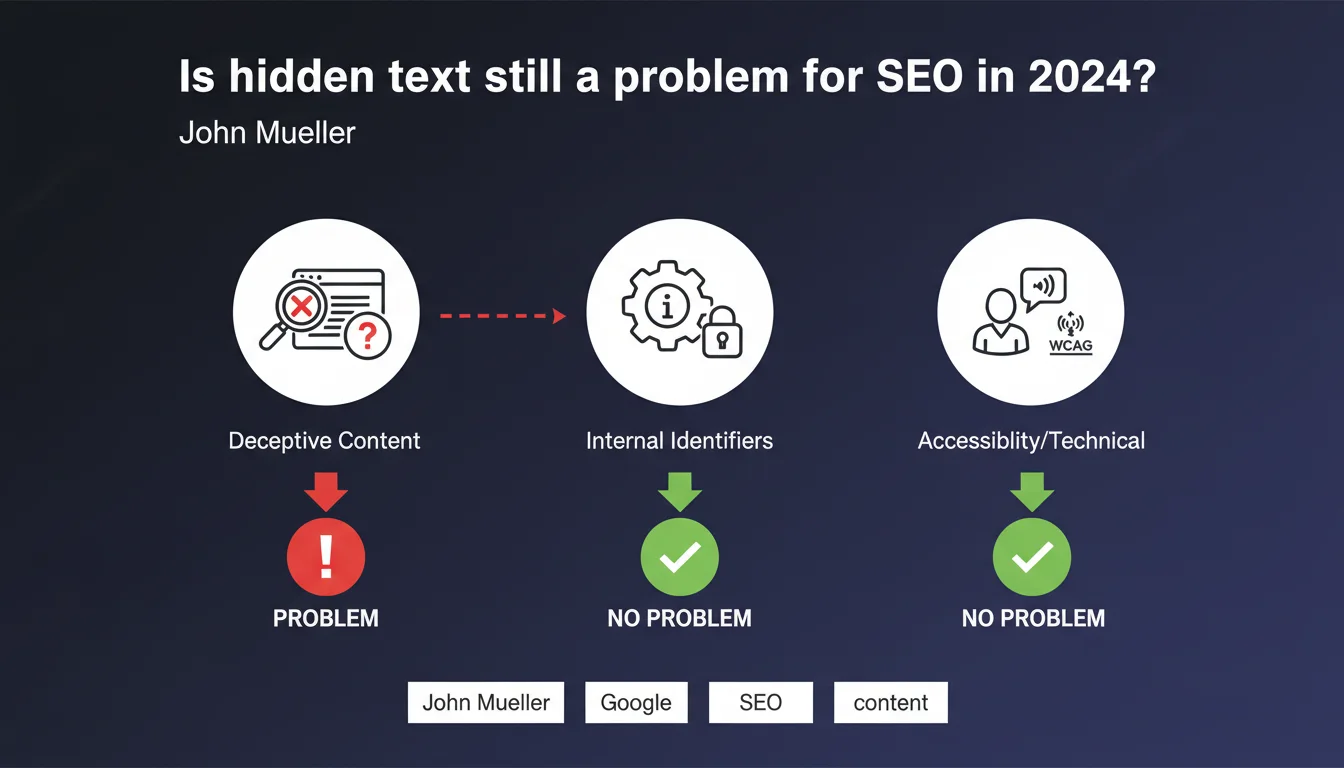
Hidden text is only problematic when it serves to manipulate search engines about the true content of a page. Google perfectly tolerates its use for legitimate technical reasons: internal identifiers, accessibility, functional needs. Intention matters more than the technique itself.
What you need to understand
Why is Google changing its position on hidden text?
For years, hidden text was demonized as a black hat spam technique. The idea was simple: hide content from users while serving it to search engines to manipulate rankings. Google long advised against any form of invisible text.
But this binary rule failed to account for the technical evolution of the modern web. JavaScript interfaces, accordion content, ARIA attributes for accessibility — so many legitimate uses that involve content that is technically "hidden." Mueller clarifies: it's not the technique that's problematic, it's the intention.
What distinguishes acceptable use from manipulative use?
Google now makes a distinction between deceptive hidden text and functional hidden text. If your invisible content serves to stuff keywords that the user will never see, that's spam. If you're hiding technical identifiers, structured metadata, or content accessible through an interactive element (dropdown menu, tab), no problem.
The engine now evaluates context and consistency: does the hidden content enhance the experience or distort it? Could a normal user access this content if they wanted to?
How does Google detect the intention behind hidden text?
Google obviously doesn't communicate about its detection algorithms, but we can infer a few mechanisms. Behavioral signals play a role: if hidden content generates a high bounce rate or clicks without engagement, that's suspicious.
Technical patterns are also analyzed. White text on white background, divs in absolute position off-screen, font-size set to 0 — these archaic techniques are obvious red flags. Conversely, content in an HTML5 <details> tag or hidden via aria-hidden for accessibility passes without issue.
- Manipulative intention: text stuffed with keywords, invisible to the user, with no added value
- Legitimate use: internal identifiers, structured metadata, content accessible through user interaction
- Key criterion: consistency between what the user sees and what Googlebot crawls
- Detection signals: user behaviors, suspicious technical patterns, contextual analysis
SEO Expert opinion
Does this nuance really change things for practitioners?
Yes and no. For clean sites that use hidden text for technical purposes — accordions, menus, structured metadata — this clarification reassures. It confirms what we were already observing: Google doesn't systematically penalize these uses.
But for SEOs who were flirting with the line, this statement provides no free pass. [To verify]: Google provides no precise metrics to distinguish "acceptable" from "deceptive." We remain in subjective interpretation, which leaves room for arbitrary decisions in manual actions.
What practices remain risky despite this openness?
Let's be honest: some SEOs will test the limits. Hiding "long tail" content in tabs not visible on load, but technically accessible, is a gray zone. Google may tolerate it if the content provides real value — or penalize it if it smells like over-optimization.
Masked text overlays for mobile, content in lazy-load never displayed, accordion divs with 15 tabs where 14 remain closed on average — all of that can work... until it breaks. The risk isn't zero, even if the intention is defensible.
Do field observations confirm this official position?
Broadly, yes. Sites that use modern UI components (tabs, accordions, modals) don't suffer massive penalties, provided the content is consistent with the page. However, e-commerce sites that hid entire product lists in "invisible" divs have been hit in recent years.
What often gets stuck is the automated detection vs manual action. The algorithm may tolerate it, but a human reviewer may interpret it differently. Hence the importance of documenting your technical choices if you go into review.
Practical impact and recommendations
What should you check on your pages right now?
Start with an audit of existing masked text. Inspect your key pages and list all invisible content: display:none attributes, visibility:hidden, aria-hidden, text off-viewport. Categorize each occurrence: functional or suspect?
Next, test the user/crawler consistency. Use the URL Inspection tool in Search Console to see how Googlebot renders your page. If entire blocks of text appear in the rendered HTML but never on screen, ask yourself: is this really necessary?
What mistakes should you absolutely avoid?
Never hide content exclusively for Googlebot. If your text is invisible to 100% of real users but crawled by search engines, that's disguised cloaking. No matter the technical justification, you're in violation.
Also avoid deceptive accordions: sections that display closed by default with a generic title ("Learn more") but hide 2000 words of content never consulted. Google can interpret that as an attempt at manipulation, especially if the open rate is near zero.
How do you adapt your practices safely?
Prioritize progressive transparency. If you need to hide content for UX reasons (accordions, tabs), make sure the title of each section is explicit and the user understands what they'll find when they click. Google values this clarity.
For accessibility, use ARIA attributes semantically. aria-hidden="true" on purely decorative elements, visually-hidden for content intended for screen readers — these practices are not only tolerated, but encouraged.
- Audit all masked content on your strategic pages
- Verify consistency between user rendering and Googlebot rendering (Search Console)
- Remove any hidden text that provides no value to the end user
- Document legitimate technical uses (accessibility, metadata) in case of manual action
- Test interaction rates on masked content (accordions, tabs): if nobody clicks, why is it there?
- Use semantic HTML5 tags (
<details>,<summary>) rather than CSS hacks - Avoid overlays or pop-ups with hidden content that never trigger
❓ Frequently Asked Questions
Peut-on utiliser du texte caché dans des accordéons sans risque de pénalité ?
Les attributs aria-hidden posent-ils problème pour le SEO ?
Comment savoir si mon texte caché sera considéré comme trompeur ?
Les pop-ups avec du contenu masqué au chargement sont-ils tolérés ?
Faut-il éviter complètement display:none et visibility:hidden ?
🎥 From the same video 14
Other SEO insights extracted from this same Google Search Central video · published on 05/03/2022
🎥 Watch the full video on YouTube →
💬 Comments (0)
Be the first to comment.