
Official statement
Other statements from this video 14 ▾
- □ Comment Google comptabilise-t-il les impressions et clics dans les People Also Ask ?
- □ Les liens depuis un sous-domaine vers le domaine principal ont-ils moins de valeur en SEO ?
- □ Tous les liens dans Search Console sont-ils vraiment utiles pour votre SEO ?
- □ Une page AMP invalide peut-elle quand même être indexée par Google ?
- □ Les liens massifs en footer tuent-ils vraiment le contexte de votre site ?
- □ Faut-il désactiver les liens automatiques pour améliorer son SEO ?
- □ Le texte caché est-il encore un problème pour le SEO ?
- □ Pourquoi Google refuse-t-il d'indexer certaines de vos pages ?
- □ Quelques liens d'affiliation sans attribut peuvent-ils vraiment échapper à toute pénalité ?
- □ Pourquoi vos images n'apparaissent-elles jamais dans Google Images malgré un bon SEO ?
- □ Pourquoi Google insiste-t-il pour que les sitemaps ne soient jamais votre seul filet de sécurité ?
- □ Les Core Web Vitals peuvent-ils vraiment faire chuter votre positionnement de 48 places ?
- □ Pourquoi le validateur schema.org contredit-il les outils de Google ?
- □ Pourquoi Google ignore-t-il certains paramètres d'URL de langue ?
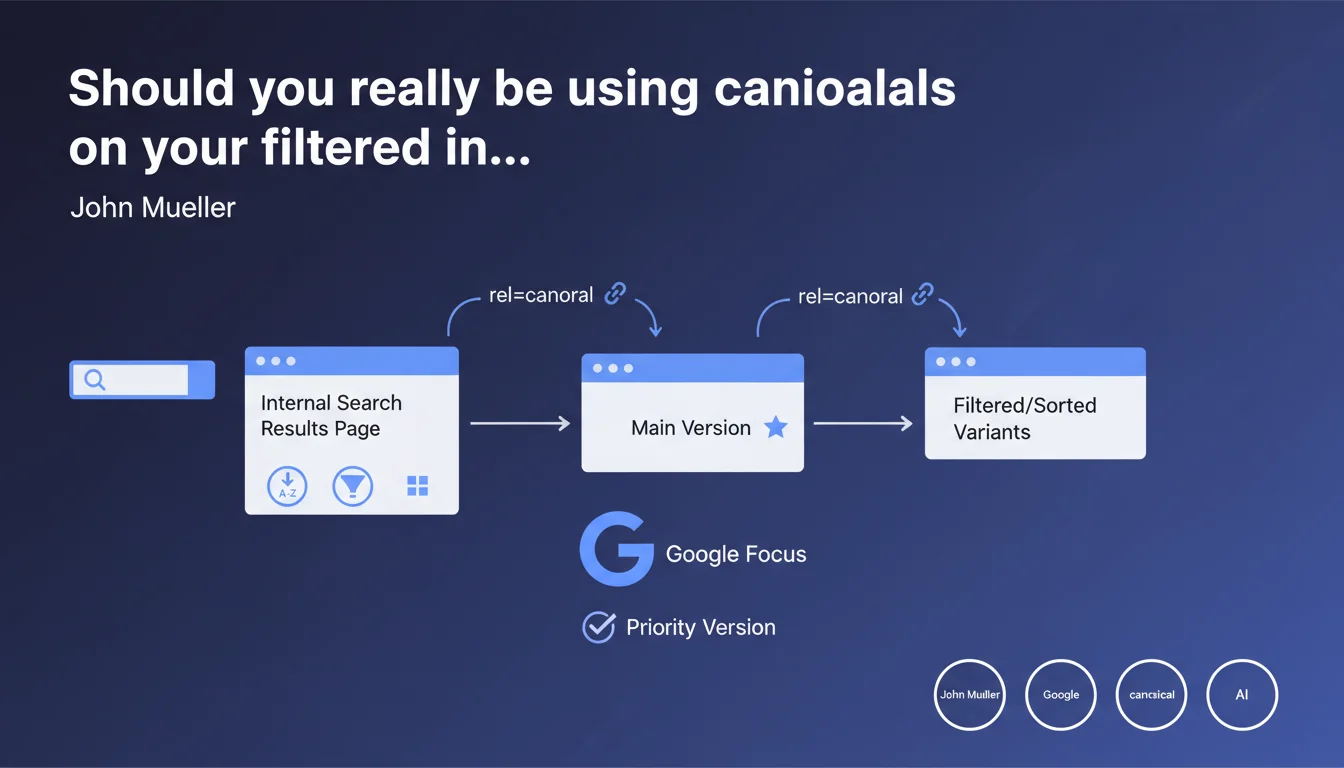
Google recommends setting a main version for your internal search results pages and using rel=canonical on all variants (filters, sorts) to point to this priority version. The goal: avoid crawl budget dilution and concentrate authority on a single URL rather than dispersing signals across dozens of similar variations.
What you need to understand
Why does Google insist on this practice for internal search results?
E-commerce sites and content platforms often generate hundreds or even thousands of URLs through their filters (price, color, size) and sort options (popularity, recency, ascending/descending price). Each combination creates a unique URL with nearly identical content.
Google faces a dilemma: crawling all these pages consumes crawl budget without providing real value, and above all, it doesn't know which version to prioritize for indexing. Result: signal dilution, perceived duplication, and sometimes indexation of non-relevant pages.
What is a "main version" in this context?
It's the reference URL you choose as the priority entry point for a given category or search. Usually, this is the version without any filter or sort applied — the default state of your results page.
All other variants (sorted by price, filtered by brand, etc.) should point to this canonical URL via a rel="canonical" tag. Concretely, you're telling Google: "These 50 variations are interesting for the user, but you focus on this one."
What are the concrete benefits of this approach?
- Crawl budget savings: Google doesn't waste time exploring dozens of identical variations
- Signal consolidation: backlinks and authority concentrate on a single URL instead of being dispersed
- Indexation control: you decide which version appears in the SERPs, not Google
- Duplicate content reduction: even if the content isn't strictly identical, Google no longer perceives it as problematic
- Indirect better user experience: by indexing the right page, Google sends users to the main entry point of your catalog, not to an obscure filtered version
SEO Expert opinion
Does this recommendation match real-world observations?
Yes, and it's actually one of the rare Google statements that enjoys complete consensus in the SEO community. Sites that don't canonicalize their filtered pages consistently end up with indexation problems and wasted crawl budget.
We regularly observe cases where Google indexes ultra-specific filtered URLs ("Red shoes size 42 sorted by ascending price") at the expense of the main category. Result: poor visibility on generic queries, diluted traffic, degraded user experience.
What nuances should be applied to this rule?
First subtlety: some filters create genuinely different content that deserves its own indexation. Typical example: a page "Women's running shoes" isn't just a simple variation of "Shoes", it's a separate category with its own traffic potential.
In this case, you should avoid the canonical and treat this page as a separate landing page to optimize. The trap: many sites canonicalize all filters systematically without thinking about the search intent behind each combination.
Second point: pure sorts (display order without content modification) should ALWAYS point to the default version. No exceptions. A price sort adds no SEO value, only noise.
What technical pitfalls should practitioners watch out for?
"Chained" canonicals remain the most frequent problem. Page A points to B, which points to C, which points to D. Google hates this and often ignores the entire chain. Absolute rule: all variants must point directly to the main version, never to another variation.
Another pitfall: contradictory canonicals between the HTML header and XML sitemap. If your sitemap lists a filtered URL as important but it canonicalizes to another page, you're sending contradictory signals.
Practical impact and recommendations
What should you do concretely on your site?
First step: audit all your internal search results URLs. List the parameters used (filters, sorts, pagination) and identify which ones generate unique content versus those that just reorganize.
For each page type (category, search, listing), define which version will be your master canonical. Generally, it's the shortest URL, without parameters, in its default state.
Then implement the <link rel="canonical" href="MAIN_URL"> tag in the <head> of all variants. Verify that each URL points directly to the master, never in cascade.
- Identify all active filtering and sorting parameters on the site
- Distinguish filters creating unique content (to index) from simple variations (to canonicalize)
- Define one main canonical URL per page family
- Implement rel=canonical in the HTML of each variant
- Check for the absence of canonical chains (A→B→C)
- Control consistency with XML sitemap (list ONLY canonical versions)
- Test with Google Search Console: verify which URLs are indexed
- Monitor crawl budget: observe the reduction in pages crawled after implementation
What errors should you absolutely avoid?
Don't canonicalize all filtered pages systematically without analysis. Some filters generate strategic pages for your SEO — killing them with a canonical would be counterproductive.
Also avoid canonicalizing to a page in noindex or a 301 redirect. Google ignores this type of broken configuration and will decide itself which version to index.
Last common mistake: forgetting to update the XML sitemap. If you canonicalize 10,000 URLs but they all appear in your sitemap, you've only solved part of the problem.
How do you verify that your implementation is working?
Use Google Search Console to inspect a few filtered URLs. In the "Coverage" tab, verify that Google correctly identifies your canonical and respects your directive.
Also monitor the number of indexed pages in GSC. After correct implementation, this number should drop significantly — this is normal and desirable.
Managing canonicals on internal results pages requires careful analysis of your architecture and a precise understanding of the search intents associated with each filter. Between technical concerns (canonical chains, sitemap/HTML consistency) and strategic ones (which pages really deserve to be indexed), the equation quickly becomes complex.
For sites with several thousand URLs or evolving catalogs, bringing in a specialized SEO agency can prove worthwhile. Personalized support helps avoid costly mistakes and define a canonicalization strategy tailored to your industry and visibility objectives.
❓ Frequently Asked Questions
Peut-on utiliser noindex au lieu de canonical sur les pages filtrées ?
Que se passe-t-il si Google n'est pas d'accord avec mon choix de canonical ?
Faut-il canonicaliser les pages de pagination des résultats de recherche ?
Les paramètres UTM doivent-ils être canonicalisés ?
Comment gérer les filtres multiples combinés (couleur + taille + prix) ?
🎥 From the same video 14
Other SEO insights extracted from this same Google Search Central video · published on 05/03/2022
🎥 Watch the full video on YouTube →
💬 Comments (0)
Be the first to comment.