
Official statement
Other statements from this video 14 ▾
- □ Comment Google comptabilise-t-il les impressions et clics dans les People Also Ask ?
- □ Tous les liens dans Search Console sont-ils vraiment utiles pour votre SEO ?
- □ Une page AMP invalide peut-elle quand même être indexée par Google ?
- □ Les liens massifs en footer tuent-ils vraiment le contexte de votre site ?
- □ Faut-il désactiver les liens automatiques pour améliorer son SEO ?
- □ Le texte caché est-il encore un problème pour le SEO ?
- □ Pourquoi Google refuse-t-il d'indexer certaines de vos pages ?
- □ Quelques liens d'affiliation sans attribut peuvent-ils vraiment échapper à toute pénalité ?
- □ Pourquoi vos images n'apparaissent-elles jamais dans Google Images malgré un bon SEO ?
- □ Pourquoi Google insiste-t-il pour que les sitemaps ne soient jamais votre seul filet de sécurité ?
- □ Faut-il vraiment utiliser des canonicals sur vos pages de recherche interne filtrées ?
- □ Les Core Web Vitals peuvent-ils vraiment faire chuter votre positionnement de 48 places ?
- □ Pourquoi le validateur schema.org contredit-il les outils de Google ?
- □ Pourquoi Google ignore-t-il certains paramètres d'URL de langue ?
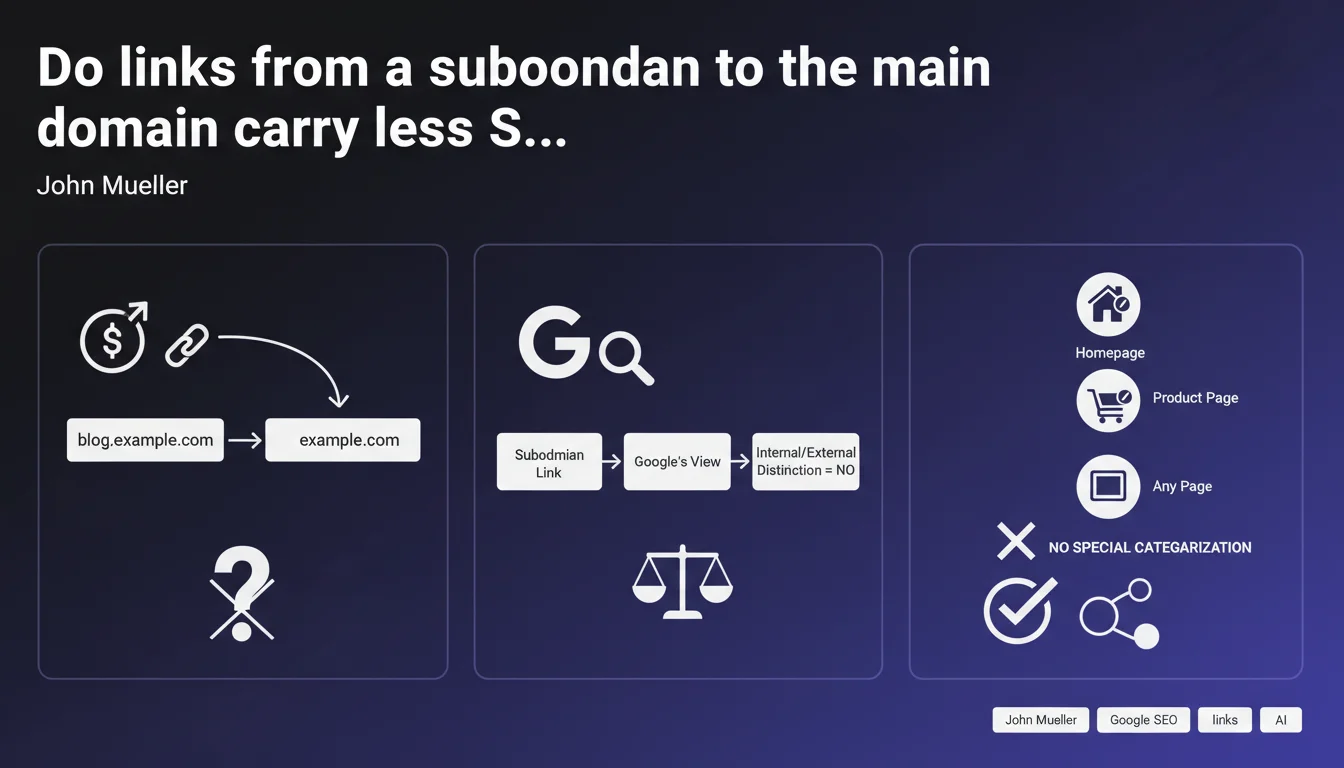
Google treats links between subdomains and domains exactly like standard internal links. No special bonus or penalty — just a link from one page to another. This technical neutrality changes the game for site architecture and internal linking strategies.
What you need to understand
Why does this statement challenge some common practices?
For years, many SEO practitioners have treated subdomains as semi-autonomous entities, sometimes even as distinct domains in Google's eyes. This belief fueled the idea that a link from blog.example.com to example.com could have a different value — or even be perceived as an external backlink.
Mueller puts this to rest. For Google, there is no marked algorithmic distinction between a standard internal link and an inter-subdomain link. The search engine does not categorize pages by type (homepage, product, blog) — it treats them as distinct URLs, period.
What does this change for multi-domain site architecture?
If your strategy relied on the idea that a dedicated blog subdomain artificially strengthens the main domain through "external" links, you can forget that leverage. Google will not fall for it: it identifies that blog.example.com and example.com belong to the same ecosystem.
Conversely, this also means your subdomains are not penalized by default. If you had avoided this structure out of fear of PageRank dilution, that concern is no longer valid — as long as your internal linking remains coherent.
What are the technical implications for internal linking?
- No algorithmic difference between a standard internal link and an inter-subdomain link
- Google recognizes no implicit hierarchy between homepage, product page, or blog page — just pages
- SEO silo strategies must be based on link structure and content, not on subdomain division
- Internal PageRank flows the same way, regardless of URL structure
- Subdomains are neither a shortcut nor a handicap — it is the logical organization of the site that matters
SEO Expert opinion
Is this statement consistent with real-world observations?
Largely, yes. Tests conducted on multi-domain environments show that Google does indeed treat subdomains as extensions of the main domain, provided the content is clearly related. However, it is not always that straightforward.
We sometimes observe differences in crawling and indexation between the main domain and subdomains, particularly if the latter host very distinct content (forum, separate e-commerce, web application). In these cases, Google may allocate a different crawl budget — which indirectly creates a form of segmentation. Not a penalty, but differentiated resource management.
What nuances should be added to this claim?
Mueller says Google does not specifically categorize pages as "homepage" or "product page". [To verify] — this statement is technically accurate, but it obscures certain contextual signals that Google clearly exploits (structured data, breadcrumbs, position in the site hierarchy).
We know Google identifies the homepage in Search Console, that it understands navigation signals, and that it displays product rich snippets. So saying "they are just pages" is true from a pure algorithmic standpoint, but reductive. The search engine understands the role of pages — it simply does not treat them with a fixed predetermined weight.
In what cases does this rule not apply fully?
If your subdomain hosts content completely disconnected from the main domain (different language, unrelated subject, different technology), Google might eventually treat them as more autonomous entities. This is not a hard rule, but a reality observed on projects where the subdomain becomes in effect a separate site.
Practical impact and recommendations
Should you prefer subdomains or subdirectories for a blog?
The short answer: it does not matter to Google, so choose based on your technical and editorial constraints. If blog.example.com simplifies your workflow (separate CMS, dedicated team), go for it. If example.com/blog simplifies management, same thing.
However, keep in mind that consolidation into subdirectories often remains simpler for internal linking and PageRank concentration. Not an algorithmic imperative, but a practical convenience.
What should you verify on a site with multiple subdomains?
- Each subdomain should be declared in Search Console as a distinct property to track its performance
- Verify that inter-subdomain linking is coherent: contextual links, clear navigation, relevant anchor text
- Check for duplicate content between the main domain and subdomains (canonical tags, URL parameter management)
- Ensure that the robots.txt file and XML sitemap of each subdomain are properly configured
- Monitor the crawl budget allocated to each subdomain in crawl reports — significant discrepancies may signal a structural issue
- Test the consistency of brand signals (Organization structured data, cross-domain mentions) to avoid fragmentation
What errors should you avoid with a multi-domain architecture?
Do not fall into the trap of thinking a subdomain will "boost" your main domain through artificial links. Google will give you no extra credit for this gymnastics.
Also avoid fragmenting your content across multiple subdomains without a clear strategic reason. Each division creates management complexity — and if internal linking is not flawless, you dilute your authority instead of concentrating it.
❓ Frequently Asked Questions
Un lien depuis blog.example.com vers example.com est-il considéré comme un backlink externe ?
Les sous-domaines ont-ils un budget crawl séparé du domaine principal ?
Google reconnaît-il automatiquement qu'une page est une page d'accueil ou une fiche produit ?
Vaut-il mieux migrer un sous-domaine blog vers un sous-répertoire pour améliorer le SEO ?
Les sous-domaines peuvent-ils cannibaliser le domaine principal dans les SERP ?
🎥 From the same video 14
Other SEO insights extracted from this same Google Search Central video · published on 05/03/2022
🎥 Watch the full video on YouTube →
💬 Comments (0)
Be the first to comment.