
Official statement
Other statements from this video 14 ▾
- □ How does Google actually count impressions and clicks within People Also Ask blocks?
- □ Do links from a subdomain to the main domain carry less SEO value?
- □ Does Google really show you all the links that matter for your SEO in Search Console?
- □ Can an invalid AMP page still be indexed by Google?
- □ Are massive footer links really killing your site's context?
- □ Should you disable automatic links to boost your SEO performance?
- □ Is hidden text still a problem for SEO in 2024?
- □ Why does Google refuse to index some of your pages?
- □ Can a handful of untagged affiliate links really escape Google penalties?
- □ Why do your images never appear in Google Images despite solid SEO performance?
- □ Why does Google insist that sitemaps should never be your only safety net?
- □ Should you really be using canonicals on your filtered internal search pages?
- □ Can Core Web Vitals Really Tank Your Rankings by 48 Positions?
- □ Does Google really ignore language URL parameters without warning?
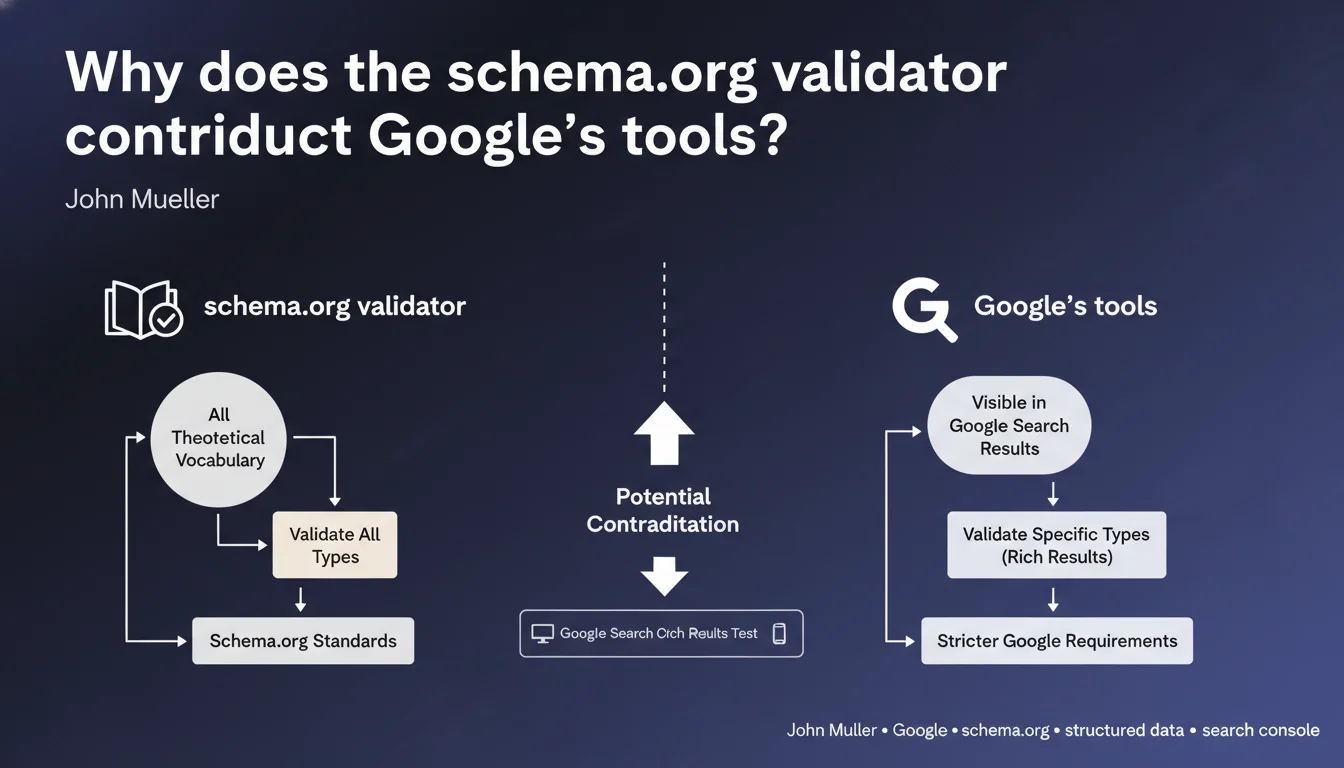
The schema.org validator accepts all theoretical properties of the vocabulary, while Google tools (Rich Results Test, Search Console) only validate what can actually trigger a rich display in the SERP. Google sometimes imposes stricter constraints than the schema.org standard itself.
What you need to understand
What is the fundamental difference between these two validators?
The schema.org validator functions as a syntax checker: it ensures that your markup respects the grammar and vocabulary of the standard. If you declare a VideoObject with all its optional properties, it will tell you that it's technically correct.
Google tools, on the other hand, adopt a functional logic. They only verify the types of structured data that trigger a specific display in results — rich snippets, carousels, Knowledge Panel. If your markup is perfect according to schema.org but doesn't match any enriched format supported by Google, Google tools will ignore it or report errors.
Why does Google impose stricter rules than schema.org?
Google has its own quality guidelines to prevent abuse. For example, schema.org allows an AggregateRating on any entity, but Google requires that these ratings come from real users and be accompanied by verifiable reviews.
This divergence protects user experience. Google doesn't want to display fake stars in search results. Result: markup that is valid schema.org can be rejected by Google if you don't meet its specific eligibility criteria.
What are the essential points to remember?
- The schema.org validator validates syntactic compliance with the complete vocabulary
- The Rich Results Test and Search Console only validate what can trigger an enriched display in Google
- Google can impose additional requirements (mandatory properties, strict formats, business rules)
- Green markup on schema.org doesn't guarantee it will be exploited in the SERP
- Always verify with Google tools to know if your markup is actually eligible
SEO Expert opinion
Is this statement consistent with practices observed in the field?
Absolutely. It's a recurring issue in audits: a site passes green on the schema.org validator, but Search Console reports errors or detects no rich results. The client thinks they did everything right, when in fact they've marked up a type that Google doesn't support.
Concrete example: you can mark up a SoftwareApplication with schema.org in a perfectly valid way, but if Google doesn't support this type for an enriched display in your sector, you'll get nothing. The schema.org validator tells you "OK", Google tells you "we don't care".
What nuances should be added to this statement?
Mueller doesn't clarify that Google can exploit structured data without visible enriched display. Some properties feed the Knowledge Graph or improve semantic understanding without triggering a snippet. It's opaque, but it's real.
Another point: Google's "stricter requirements" aren't always exhaustively documented. You sometimes discover implicit rules through testing — typically on eligibility criteria for FAQs or HowTo. [To verify]: some restrictions seem to evolve without official announcement.
In what cases does this rule not apply?
If you're marking up for other search engines (Bing, Yandex) or for content aggregators, the schema.org validator remains your reference. Google isn't the only consumer of structured data.
And if your goal is pure semantics — helping crawlers better understand your content without aiming for a specific rich snippet — valid schema.org markup retains all its value, even if Google doesn't display it. But let's be honest: 90% of SEOs mark up to get stars, not for the pleasure of semantics.
Practical impact and recommendations
What should you concretely do to avoid unpleasant surprises?
Adopt a two-step workflow. First, verify the syntax with the schema.org validator to ensure your JSON-LD is technically correct. Then, systematically run the Rich Results Test to know if Google recognizes your markup and if it's eligible for enriched display.
Don't rely on manual testing alone. Integrate Search Console into your monitoring: it reports errors detected by Googlebot under real conditions, which the Rich Results Test doesn't always do. Some errors only appear after indexing.
What errors should you absolutely avoid?
Don't mark up "just in case". If Google doesn't support a type of structured data for enriched display in your sector, you're wasting your time. Consult the rich results gallery to know what's actually eligible.
Another classic mistake: copying a schema.org example without checking the mandatory properties required by Google. For example, Google requires image on recipes, while schema.org considers it optional. If you rely solely on the schema.org validator, you'll miss this.
How do I verify that my site meets Google's expectations?
Use the Rich Results Test on representative URLs of each content type. Verify that all mandatory properties are present and that Google detects the expected type.
In Search Console, check the Enhancements report (recipes, job postings, FAQs, etc.). If a type doesn't appear when you've marked it up, it's either because Google doesn't support it or your markup doesn't meet its strict criteria.
- Validate syntax with the schema.org validator
- Test eligibility with Google's Rich Results Test
- Check Search Console > Enhancements reports after indexation
- Consult the rich results gallery to know supported types
- Respect mandatory properties required by Google, even if schema.org considers them optional
- Avoid marking up types unsupported by Google for your sector
- Follow Google's quality guidelines (real reviews, verified content, etc.)
❓ Frequently Asked Questions
Un balisage valide sur schema.org est-il automatiquement reconnu par Google ?
Le Rich Results Test remplace-t-il le validateur schema.org ?
Quelles sont les exigences strictes de Google les plus courantes ?
Faut-il supprimer un balisage qui ne déclenche pas de rich snippet ?
Comment savoir quels types de données structurées Google supporte ?
🎥 From the same video 14
Other SEO insights extracted from this same Google Search Central video · published on 05/03/2022
🎥 Watch the full video on YouTube →
💬 Comments (0)
Be the first to comment.