
Official statement
Other statements from this video 14 ▾
- □ How does Google actually count impressions and clicks within People Also Ask blocks?
- □ Do links from a subdomain to the main domain carry less SEO value?
- □ Does Google really show you all the links that matter for your SEO in Search Console?
- □ Can an invalid AMP page still be indexed by Google?
- □ Are massive footer links really killing your site's context?
- □ Should you disable automatic links to boost your SEO performance?
- □ Is hidden text still a problem for SEO in 2024?
- □ Why does Google refuse to index some of your pages?
- □ Why do your images never appear in Google Images despite solid SEO performance?
- □ Why does Google insist that sitemaps should never be your only safety net?
- □ Should you really be using canonicals on your filtered internal search pages?
- □ Can Core Web Vitals Really Tank Your Rankings by 48 Positions?
- □ Why does the schema.org validator contradict Google's tools?
- □ Does Google really ignore language URL parameters without warning?
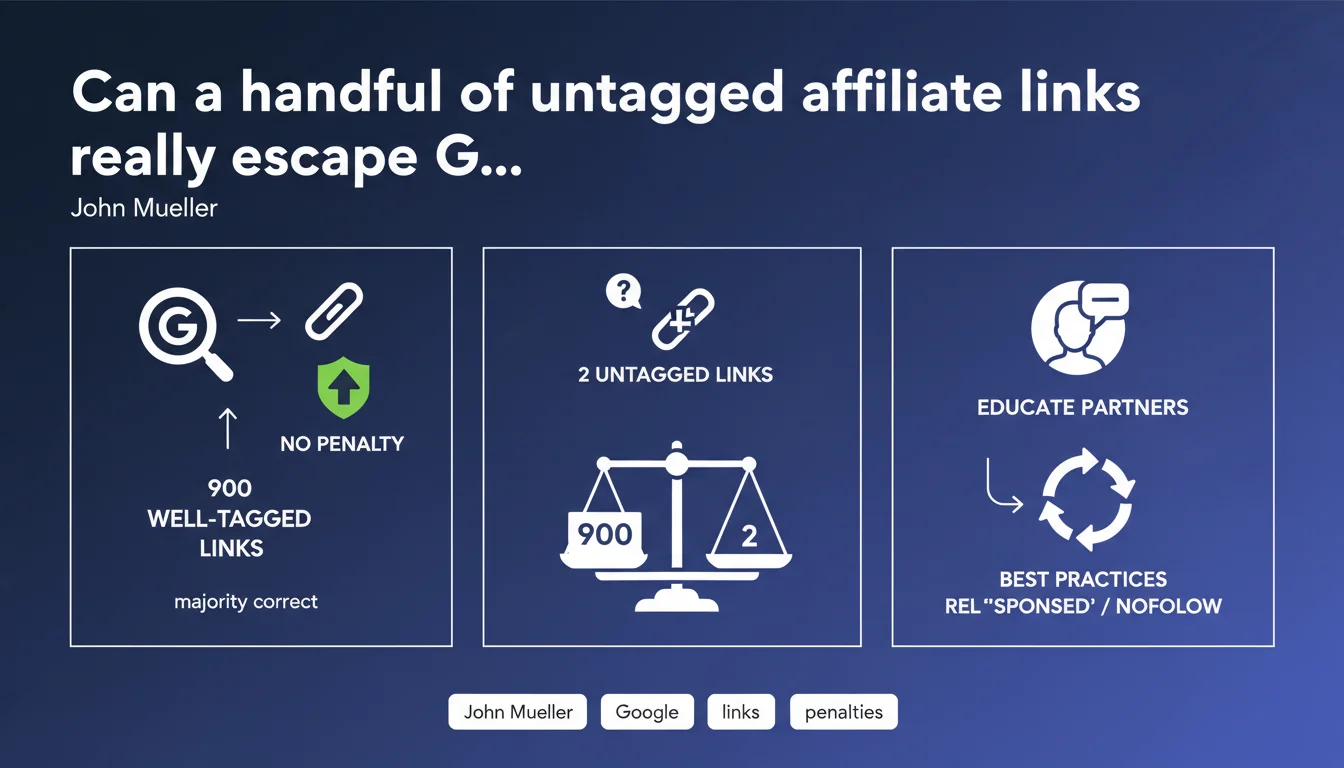
Google tolerates a small number of untagged affiliate links if the majority properly uses rel='sponsored' or nofollow attributes. A site with 900 correctly marked affiliate links and 2 without attributes won't be penalized. The key is raising affiliate partners' awareness about best practices.
What you need to understand
Does Google really apply a tolerance principle to affiliate tagging?
Mueller's statement introduces a rarely explicit nuance in official guidelines: Google doesn't operate on a binary "all or nothing" mode. The pursuit of a perfect 100/100 ratio isn't the algorithm's priority.
This tolerance stems from real-world reality. A site with hundreds of affiliate partners cannot control every link with surgical precision. Google knows this — and adapts its evaluation accordingly.
What's the difference between rel='sponsored' and nofollow in this context?
Since 2019, Google recommends rel='sponsored' for commercial and affiliate links, rather than the generic nofollow. Both remain acceptable, but sponsored provides clearer semantic indication to the algorithm.
In practice, many affiliates still use nofollow out of habit. Google doesn't make a punitive distinction between the two — what matters is that an attribute is present to signal the commercial nature of the link.
Why is this clarification coming now?
Large-scale affiliate programs generate link volumes that are difficult to supervise. Publishers feared that a small percentage of errors would trigger manual action.
Mueller addresses a real concern: the fear of disproportionate penalties. His message aims to reassure good-faith actors while maintaining pressure on systematic abusive practices.
- Google tolerates a small number of exceptions if the majority of links is properly tagged
- The difference between rel='sponsored' and nofollow doesn't result in penalties
- The algorithm evaluates the overall trend, not each individual link
- Manual actions target systematic abuse, not marginal errors
SEO Expert opinion
Does this displayed tolerance really reflect on-the-ground practices?
On paper, yes. In the daily reality of SEO audits, the situation is more nuanced. We do observe that sites with a few untagged links escape sanctions — but the exact limit remains unclear.
The "900 tagged / 2 untagged" ratio cited by Mueller is an example, not an official threshold. [To verify] No documentation specifies at what percentage Google shifts toward manual action. This gray zone leaves publishers in uncertainty.
Let's be honest: this statement carefully avoids defining what constitutes a "small number." Is it 1%? 5%? 10%? The absence of concrete figures makes practical application difficult.
Are all affiliate links equal in Google's eyes?
No, and that's where Mueller's message shows its limits. An affiliate link in an editorial product comparison doesn't carry the same weight as a link hidden in a sidebar stuffed with advertising banners.
If the few untagged links point to low-quality sites, in manifestly commercial contexts, Google could harden its evaluation. Context always matters.
Does this statement actually change recommended practices?
Not really. It confirms what practitioners were already observing: Google seeks abusive patterns, not isolated errors. But it doesn't authorize laxity.
The recommendation remains unchanged: systematically tag all affiliate links. This tolerance should never serve as justification for neglecting tagging — it exists to manage the unavoidable imperfections at scale.
Practical impact and recommendations
What should you concretely do with existing affiliate links?
First reflex: audit what exists. Crawl your site to identify all outgoing links to affiliate programs and verify the presence of rel='sponsored' or nofollow. Tools like Screaming Frog allow you to extract this data quickly.
For CMS platforms, implement automatic rules. WordPress offers plugins that automatically add the sponsored attribute to links containing certain domains or UTM parameters. It's more reliable than manual supervision.
How to manage affiliates who don't respect tagging?
Integrate compliance into your affiliate guidelines. If you manage a program with multiple partners, include concrete HTML examples in your documentation. Many affiliates aren't technicians — they need ready-to-use templates.
Set up a quarterly review of incoming links if you're an advertiser, or outgoing links if you're a publisher. Automated crawling can detect new non-compliant links before they become a problem.
What errors must you absolutely avoid?
Never treat this tolerance as a permanent free pass. A small percentage of uncorrected errors can become a problem if Google detects an upward trend or lack of governance.
Also avoid removing existing attributes under the pretext that "a few can slip through." This logic is dangerous — it creates a precedent and progressive drift. Tagging should remain the norm, not the exception.
- Crawl the site to identify all affiliate links and verify their tagging
- Implement automatic rules in the CMS to add rel='sponsored' by default
- Train editorial teams on best practices for tagging
- Update partner guidelines with concrete HTML examples
- Schedule a quarterly review of outgoing or incoming links depending on your role
- Prioritize correcting links in obvious commercial contexts
- Document exceptions to track the evolution of the compliant/non-compliant ratio
❓ Frequently Asked Questions
Combien de liens d'affiliation non balisés Google tolère-t-il exactement ?
Faut-il privilégier rel='sponsored' ou nofollow pour les liens d'affiliation ?
Un lien d'affiliation sans attribut peut-il quand même transmettre du PageRank ?
Cette tolérance s'applique-t-elle aussi aux liens sponsorisés classiques ?
Dois-je corriger immédiatement tous les liens d'affiliation non conformes ?
🎥 From the same video 14
Other SEO insights extracted from this same Google Search Central video · published on 05/03/2022
🎥 Watch the full video on YouTube →
💬 Comments (0)
Be the first to comment.