
Official statement
Other statements from this video 14 ▾
- □ How does Google actually count impressions and clicks within People Also Ask blocks?
- □ Do links from a subdomain to the main domain carry less SEO value?
- □ Does Google really show you all the links that matter for your SEO in Search Console?
- □ Can an invalid AMP page still be indexed by Google?
- □ Should you disable automatic links to boost your SEO performance?
- □ Is hidden text still a problem for SEO in 2024?
- □ Why does Google refuse to index some of your pages?
- □ Can a handful of untagged affiliate links really escape Google penalties?
- □ Why do your images never appear in Google Images despite solid SEO performance?
- □ Why does Google insist that sitemaps should never be your only safety net?
- □ Should you really be using canonicals on your filtered internal search pages?
- □ Can Core Web Vitals Really Tank Your Rankings by 48 Positions?
- □ Why does the schema.org validator contradict Google's tools?
- □ Does Google really ignore language URL parameters without warning?
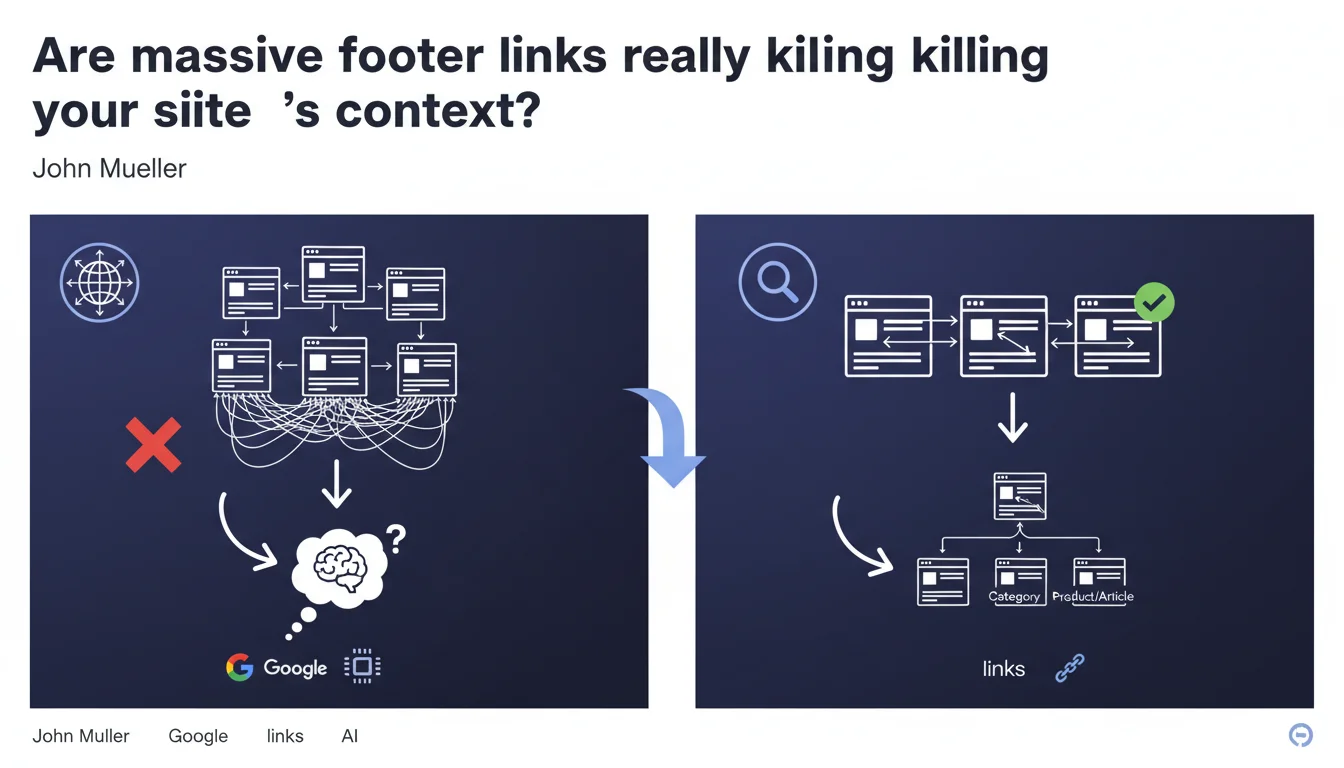
Multiplying internal links in the footer — where every page points to all others — dilutes context and blurs site hierarchy in Google's eyes. Extreme cross-linking brings no SEO benefit, quite the opposite: it prevents the engine from distinguishing important pages from secondary ones. Targeted linking between related content remains relevant, but footer over-optimization is counterproductive.
What you need to understand
Why does Google penalize footers bloated with links?
Google relies on the context of internal links to understand a site's structure and rank pages. When every page on the site contains 200 identical footer links, that signal becomes noise: it's impossible to distinguish a strategic page from an ancillary one.
The engine assigns relative value to links. If everything is linked to everything, nothing stands out — it's the "everyone is special so nobody is" effect. Crawl budget scatters, internal PageRank dilutes, and thematic understanding collapses.
What counts as an "acceptable level of cross-linking"?
Mueller doesn't give a precise number — as usual. The idea is to link pages together when the link provides real contextual value: a blog post to a related product, a pillar page to its sub-pages, and so on.
The footer can contain useful links — legal notices, contact, sitemap — but not your entire product catalog or all categories. A footer with 5 to 15 links remains manageable. Beyond 30-40 identical links across all pages, you're entering the red zone.
How does Google detect this kind of over-optimization?
Google's algorithms analyze the repetition of link blocks and their position in the DOM. A footer that's identical across 100% of pages, stuffed with links, is trivial to detect. The engine also compares anchor diversity and the thematic consistency of destinations.
If the pattern reveals manipulation (artificially boosting certain pages by linking to them everywhere), Google can ignore these links or devalue their weight. In extreme cases, this can contribute to a manual action — though that's rare for internal linking alone.
- Link context trumps sheer quantity
- An overstuffed footer dilutes internal PageRank and blurs hierarchy
- Google favors targeted links between thematically related content
- No official threshold, but beyond 30-40 identical footer links, risk increases
- Internal over-optimization can trigger algorithmic devaluation
SEO Expert opinion
Is this guideline consistent with what we observe in the field?
Yes, largely. A/B tests on e-commerce sites show that trimming an obese footer — going from 200 links to 20 — often improves crawl and boosts strategic pages in SERPs. The signal isn't always dramatic, but it's measurable.
However, Mueller remains vague on the exact threshold. "Massive," "extreme" — it's subjective. A 500-page site with 50 footer links isn't in the same category as a 10,000-page site with 300 links. [To verify]: the impact likely depends on the ratio of footer links to contextual links in page body.
What nuances should we add to this rule?
Not all footer links are created equal. A link to a "Terms of Sale" page doesn't weigh much in the crawl budget, while a footer link to each product page does. The nature of the linked page matters as much as raw volume.
Site context also plays a role. A media outlet with 10,000 articles and a minimal footer will naturally have dispersed linking. A 20-page brochure site can handle a slightly denser footer without issues — as long as it remains coherent.
In what cases doesn't this logic apply?
On some sites with ultra-flat architecture (e.g., directories, marketplaces), a dense footer may be a necessary evil to ensure accessibility of all sections. But even then, it's better to segment: a conditional mega-menu or dedicated sitemap.
Multilingual or multi-country sites often use the footer for language/region selectors. That remains acceptable as long as these links represent only a minority fraction of the total footer. The problem emerges when the footer becomes a catch-all for commercial links with no editorial logic.
Practical impact and recommendations
What should you do concretely to clean up your footer?
Start with a footer audit. Extract the links present on 10-20 typical pages, count them, and categorize them (legal, navigation, products, etc.). If you exceed 30 identical links across all pages, there's cleanup to do.
Remove redundant or low-value links. Keep the essentials: legal notices, contact, terms, sitemap. For categories/products, favor a single link to a structured HTML sitemap rather than 50 direct links.
How do you reorganize internal linking to preserve context?
Invest in contextual linking: links in your content body, with varied and relevant anchors, to thematically related pages. This is where Google best captures the relationship between pages.
Create pillar pages that centralize links to sub-sections, instead of dispersing everything in the footer. For example, a "Our Services" page that lists and links all your services, with just one footer link to this pivot page.
What mistakes must you avoid?
Don't replace an obese footer with an obese sidebar. The problem remains the same: repeated link blocks everywhere. Google looks at all template links (footer, header, sidebar) — not just the footer in isolation.
Also avoid hiding a link-packed footer in CSS "for Google." That's detectable and can shift into cloaking if the gap is too wide between mobile and desktop versions. Better to clean it up for real.
- Audit footers: count links present on a sample of pages
- Remove redundant or non-essential footer links (target: 15-25 max)
- Favor a single footer link to a structured HTML sitemap
- Strengthen contextual linking in content body
- Create pillar pages to centralize links to sub-sections
- Avoid moving the problem to sidebar or header
- Don't hide link blocks in CSS — actually clean up the code
❓ Frequently Asked Questions
Combien de liens footer maximum pour éviter de diluer le contexte ?
Les liens footer ont-ils encore du poids SEO en 2025 ?
Peut-on être pénalisé manuellement pour un footer trop chargé ?
Faut-il supprimer tous les liens produits du footer d'un site e-commerce ?
Le mega-menu compte-t-il aussi comme des liens template problématiques ?
🎥 From the same video 14
Other SEO insights extracted from this same Google Search Central video · published on 05/03/2022
🎥 Watch the full video on YouTube →
💬 Comments (0)
Be the first to comment.