
Official statement
Other statements from this video 14 ▾
- □ Comment Google comptabilise-t-il les impressions et clics dans les People Also Ask ?
- □ Les liens depuis un sous-domaine vers le domaine principal ont-ils moins de valeur en SEO ?
- □ Tous les liens dans Search Console sont-ils vraiment utiles pour votre SEO ?
- □ Une page AMP invalide peut-elle quand même être indexée par Google ?
- □ Les liens massifs en footer tuent-ils vraiment le contexte de votre site ?
- □ Faut-il désactiver les liens automatiques pour améliorer son SEO ?
- □ Le texte caché est-il encore un problème pour le SEO ?
- □ Pourquoi Google refuse-t-il d'indexer certaines de vos pages ?
- □ Quelques liens d'affiliation sans attribut peuvent-ils vraiment échapper à toute pénalité ?
- □ Pourquoi vos images n'apparaissent-elles jamais dans Google Images malgré un bon SEO ?
- □ Pourquoi Google insiste-t-il pour que les sitemaps ne soient jamais votre seul filet de sécurité ?
- □ Faut-il vraiment utiliser des canonicals sur vos pages de recherche interne filtrées ?
- □ Pourquoi le validateur schema.org contredit-il les outils de Google ?
- □ Pourquoi Google ignore-t-il certains paramètres d'URL de langue ?
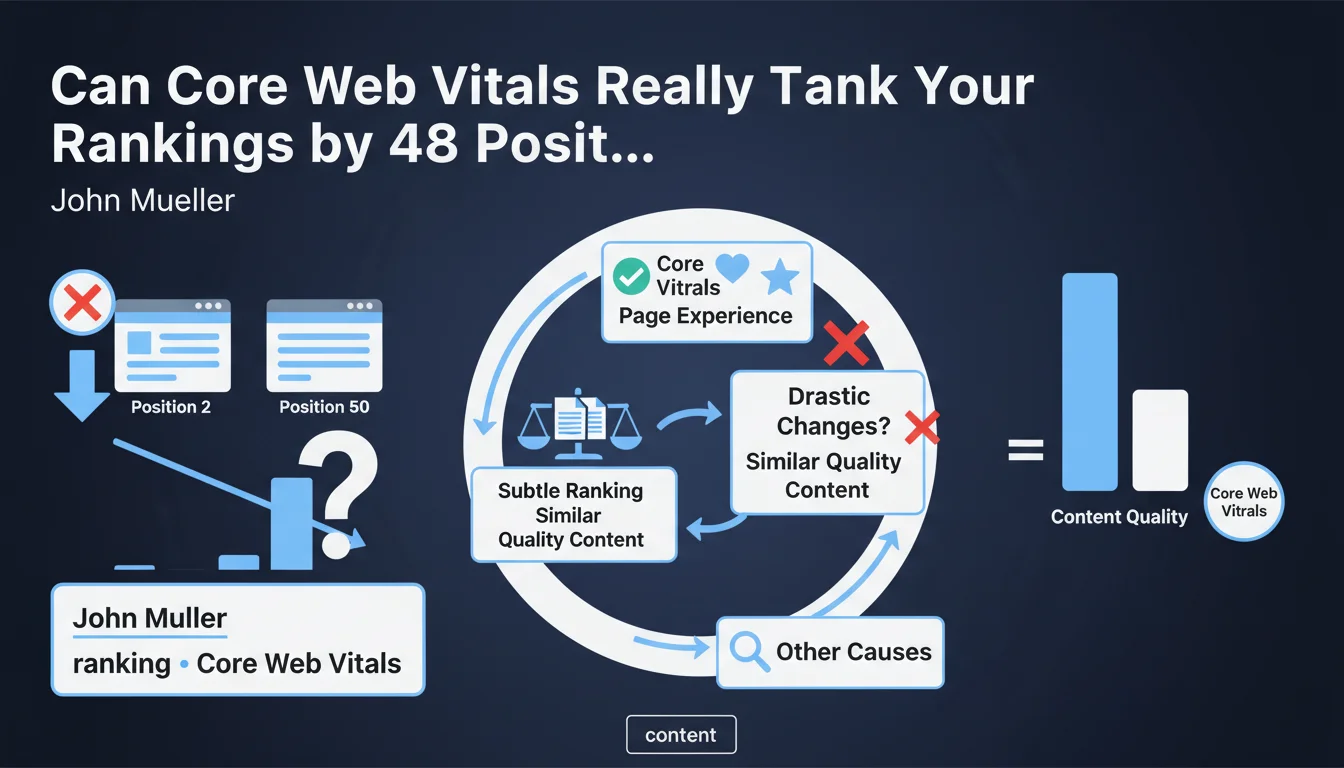
Google states that Page Experience, including Core Web Vitals, is a "subtle" ranking signal that only differentiates between content of similar quality. A drastic drop in position (example: from position 2 to 50) cannot be caused solely by Core Web Vitals — you need to look for other causes. The signal mainly serves as a tie-breaker between equivalent pages.
What you need to understand
What does a "subtle ranking signal" really mean?
When Google talks about a subtle signal, it refers to a low-weight tiebreaker criterion in the overall algorithm. In practical terms, if two pages offer similar quality content, good technical performance can tip the scales. But it's clearly not a dominant factor like content relevance or backlink quality.
The term "subtle" is deliberately vague — Google never specifies the exact weight of a signal. What we know: Core Web Vitals come after relevance and authority evaluation. They don't compensate for weak content or nonexistent backlinks.
Why does Google specifically state that a page doesn't drop 48 positions because of CWV?
This clarification aims to counter a persistent myth in the industry: that of a drastic penalty linked to Core Web Vitals. Since their rollout as a ranking signal, some SEO professionals have attributed massive drops to technical performance alone.
Mueller insists: if you lose 48 positions, look elsewhere. A duplicate content problem, a core algorithm update, a loss of backlinks, or even a technical error (misconfigured canonicals, accidental noindex) are far more likely causes. CWV is just a minor adjustment.
Do Core Web Vitals Really Matter in SEO?
Yes, but only in specific contexts. For competitive queries where multiple pages are equal in content and authority, technical performance can make the difference between position 3 and position 5. It's rare, but it happens.
However, for most websites, the impact remains marginal. If your content is mediocre or your link profile weak, optimizing your CWV won't change anything. Conversely, a site with excellent E-E-A-T signals and solid content won't be torpedoed by average CWV.
- Core Web Vitals are a tiebreaker signal, not a dominant criterion.
- A massive drop in positions (>20 places) is never caused solely by CWV.
- The signal comes after relevance and authority evaluation.
- Technical performance matters most for highly competitive queries with equivalent pages.
- Google doesn't communicate the exact weight of the signal — it's deliberately vague.
SEO Expert opinion
Is this statement consistent with field observations?
Yes and no. In principle, data aligns: correlation studies (Search Engine Journal, Moz) do show that CWV isn't a dominant factor. Poorly rated pages can rank in the top 3 if they excel on content and authority. No large-scale study has proven that a site loses massive organic traffic solely because of poor CWV.
But — and here's where it gets tricky — Google remains deliberately vague about the exact weight of the signal. The term "subtle" means nothing in practice. 1% algorithmic weight? 5%? We don't know. And that complicates prioritizing technical optimizations against other initiatives (content, link building, structure). [To verify] in your own contexts through A/B testing or correlation analysis on your data.
In what cases doesn't this rule apply?
There are exceptions — even though Google never explicitly mentions them. For ultra-competitive queries (YMYL sectors, high-margin e-commerce), where the top 10 results have equivalent content and authority, CWV can actually play a more pronounced role. Not revolutionary, but enough to grab a position or two.
Another nuance: technical performance indirectly influences user behavior. A slow site generates more pogo-sticking, less session time, and high bounce rates. These behavioral signals — which aren't officially confirmed as ranking criteria — could impact positioning. So yes, improving CWV can have an indirect effect, without the technical signal being solely responsible.
Should you really trust Google at face value?
Let's be honest: Google has an incentive to downplay the impact of certain signals to avoid over-optimization. If Google announced tomorrow that CWV accounts for 15% of the algorithm, we'd witness an absurd micro-optimization race — at the expense of content.
That said, Mueller's statement is consistent with Google's general philosophy: content is king. And it's observable. Sites with strong authority and expert content rank even with catastrophic CWV. So on this specific point, Google probably isn't lying — but it remains deliberately vague by strategy.
Practical impact and recommendations
What should you concretely do if your rankings drop?
First rule: don't look for a single scapegoat. If you lose 20+ positions, start by auditing your SEO fundamentals: indexation (robots.txt, canonicals, accidental noindex), content (duplication, quality, E-E-A-T), and link profile (lost backlinks, toxic links). CWV is just one element among many.
Use Search Console to cross-reference the drop period with the Core Web Vitals report. If your URLs go from "Good" to "Poor" exactly when you lose positions, dig deeper. But don't jump to conclusions: correlation isn't causation. Also check the algorithm update history (core updates, spam updates).
What errors should you avoid when optimizing Core Web Vitals?
Mistake number one: sacrificing content to shave milliseconds off your LCP. I've seen sites remove essential images, lighten informative text, or degrade UX to go green in PageSpeed Insights. Result? Zero SEO gain, but a drop in conversions.
Second trap: focusing solely on lab data (Lighthouse, PSI) at the expense of field data (CrUX). Google uses Core Web Vitals measured on real users, not artificial scores from a local test. If your PageSpeed is 95 but 60% of your mobile visitors have LCP > 4s, the field data is what counts.
- Audit indexation, content, and link profile before blaming CWV.
- Cross-reference Search Console data (CWV) with ranking history.
- Prioritize optimizations that don't negatively impact UX or content.
- Monitor CrUX data (field), not just Lighthouse (lab).
- Test optimizations with A/B if possible — measure actual impact.
- Don't over-optimize: perfect CWV scores without business gains are pointless.
How should you prioritize your SEO initiatives given this reality?
If your content is weak, your CWV can be perfect — you won't rank. Conversely, if your content is excellent but your performance is catastrophic, you might lose a position or two against equivalent competitors. The hierarchy is clear: content > authority > technical.
That said, don't neglect technical SEO. Core Web Vitals indirectly influence user experience, so bounce rate, session time, and ultimately conversions. A well-executed technical initiative improves business, even if the pure SEO impact remains modest.
❓ Frequently Asked Questions
Un site avec de mauvais Core Web Vitals peut-il quand même bien se positionner ?
Si mes positions chutent de 30 places, dois-je d'abord optimiser les Core Web Vitals ?
Quel est le poids exact des Core Web Vitals dans l'algorithme de Google ?
Faut-il privilégier les données de laboratoire (Lighthouse) ou les données terrain (CrUX) ?
Optimiser les Core Web Vitals améliore-t-il les conversions même sans impact SEO ?
🎥 From the same video 14
Other SEO insights extracted from this same Google Search Central video · published on 05/03/2022
🎥 Watch the full video on YouTube →
💬 Comments (0)
Be the first to comment.