
Official statement
What you need to understand
Why Does This Google Announcement Reassure Site Owners?
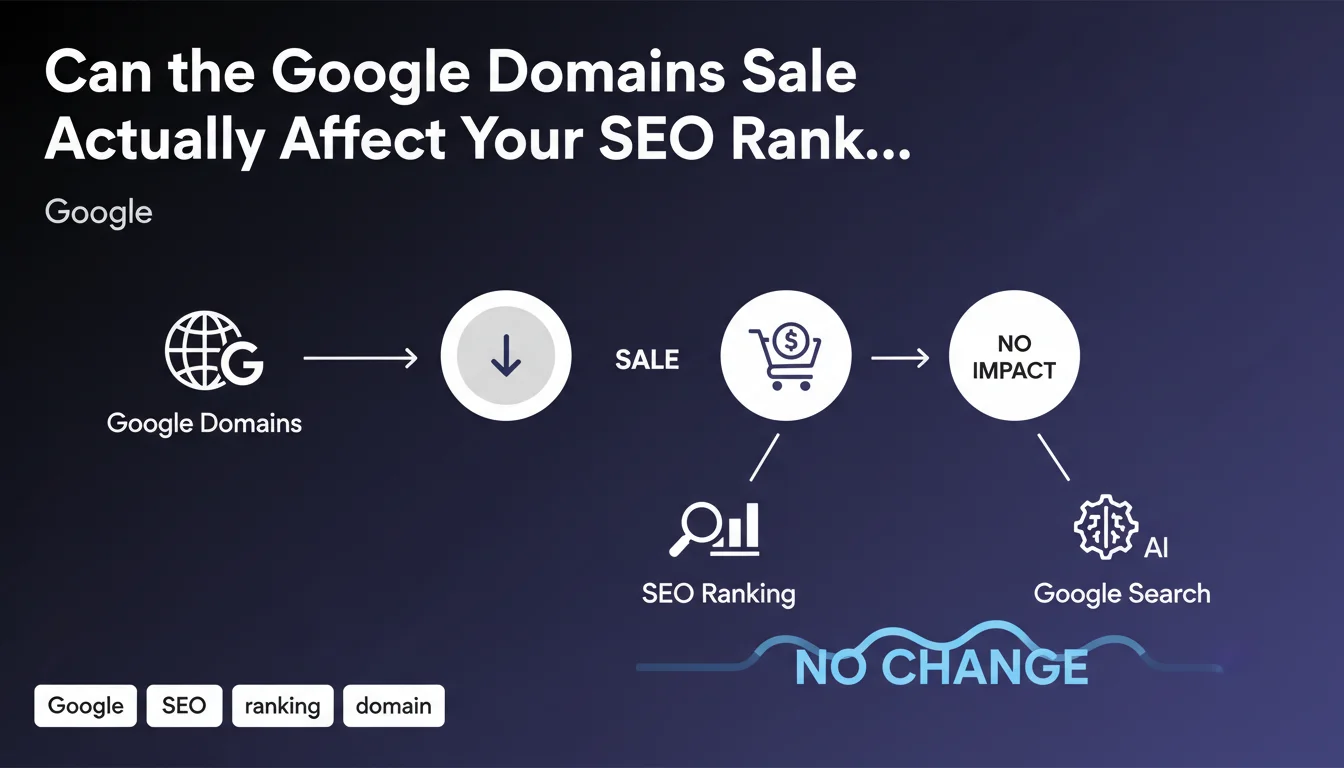
Following the sale of Google Domains to Squarespace, many webmasters and SEO professionals worried about a potential impact on their rankings. Google officially clarified that this business transaction will in no way affect rankings in search results.
This statement reinforces a fundamental principle: the choice of domain name registrar has never been and will never be a ranking factor. Whether you use Google Domains, Squarespace, GoDaddy or OVH, Google's algorithm treats all domains identically.
What Elements Actually Determine Rankings?
Google reaffirms that only factors related to content quality, user experience, site technical aspects and authority influence SEO. The technical provider managing your domain name remains completely neutral in this equation.
- Domain registrar is not a Google ranking factor
- Migration to Squarespace requires no specific SEO action
- Search performance depends solely on your site's quality
- This statement confirms a practice observed all along
Was This Situation Predictable from an SEO Perspective?
Absolutely. There was no technical or algorithmic reason for a change in ownership of the Google Domains service to impact hosted sites. The DNS system and indexation function independently of these commercial considerations.
This clarification is more about preventive communication to avoid unjustified concerns within the SEO community, rather than an actual technical issue.
SEO Expert opinion
Is This Statement Consistent with Practices Observed in the Field?
With 15 years of SEO experience, I can confirm that this position from Google is perfectly consistent with what we observe daily. We have never found any correlation between the choice of a registrar and organic search performance.
Comparative tests conducted on thousands of sites show that domains hosted with different registrars present equivalent performance at equal content quality. The registrar operates solely at the administrative management level of the domain, a layer completely invisible to ranking algorithms.
What Important Nuances Should Be Added to This Statement?
Be careful though: while the registrar itself doesn't impact SEO, certain technical decisions related to the change could have consequences. For example, improper DNS configuration during migration, unintentional DNS server changes, or service interruption.
Similarly, if you take advantage of the change to modify other parameters (hosting, URL structure, SSL certificate), these modifications could have an impact. You must clearly distinguish the registrar change itself from collateral actions you might undertake.
Can This Rule Be Generalized to Other Google Services?
This statement fits into a broader logic: Google maintains a strict separation between its commercial services (Gmail, Google Ads, Google Domains) and its search engine. Using or not using a Google service gives you no advantage or disadvantage in SEO.
This is a fundamental neutrality principle that Google has always defended to preserve the credibility of its search results. This approach is essential to maintain user trust and avoid accusations of favoritism.
Practical impact and recommendations
What Should You Concretely Do If You're a Google Domains Customer?
The answer is simple: nothing specific on the SEO side. Simply follow the migration instructions communicated by Google and Squarespace to administratively transfer your domain. Your rankings will not be affected by this transfer.
Focus on service continuity: verify that your site remains accessible during and after migration. This is the only element that could indirectly affect your SEO if poorly managed.
What Critical Mistakes Must You Absolutely Avoid During the Transition?
The main mistake would be to modify your DNS configurations inappropriately. Don't touch A, AAAA, CNAME or TXT records without knowing exactly what you're doing.
Also avoid changing multiple elements simultaneously: if you're migrating your registrar, this is not the time to also change hosts, redesign your site or switch to HTTPS. Isolate each modification to easily identify the source of any potential problem.
- Verify that all your DNS records are properly documented before migration
- Test your site's accessibility immediately after the transfer
- Monitor your rankings and organic traffic during the 2 weeks following migration
- Check in Google Search Console that no crawl errors appear
- Ensure your SSL certificate remains valid and active
- Verify that your existing 301 redirects continue to function
- Confirm that your professional emails linked to the domain remain operational
How Can You Optimize This Transition for Your Overall SEO Strategy?
Take advantage of this migration to conduct a comprehensive technical audit of your online presence. This is an opportunity to check the overall health of your configuration: loading speed, URL structure, internal linking, content quality.
This administrative transition can be seen as an opportune moment to take stock of your entire natural referencing strategy. A thorough audit will identify priority optimizations to improve your organic performance.
💬 Comments (0)
Be the first to comment.