
Official statement
What you need to understand
Why Does Google Recommend Launching a Domain in Advance?
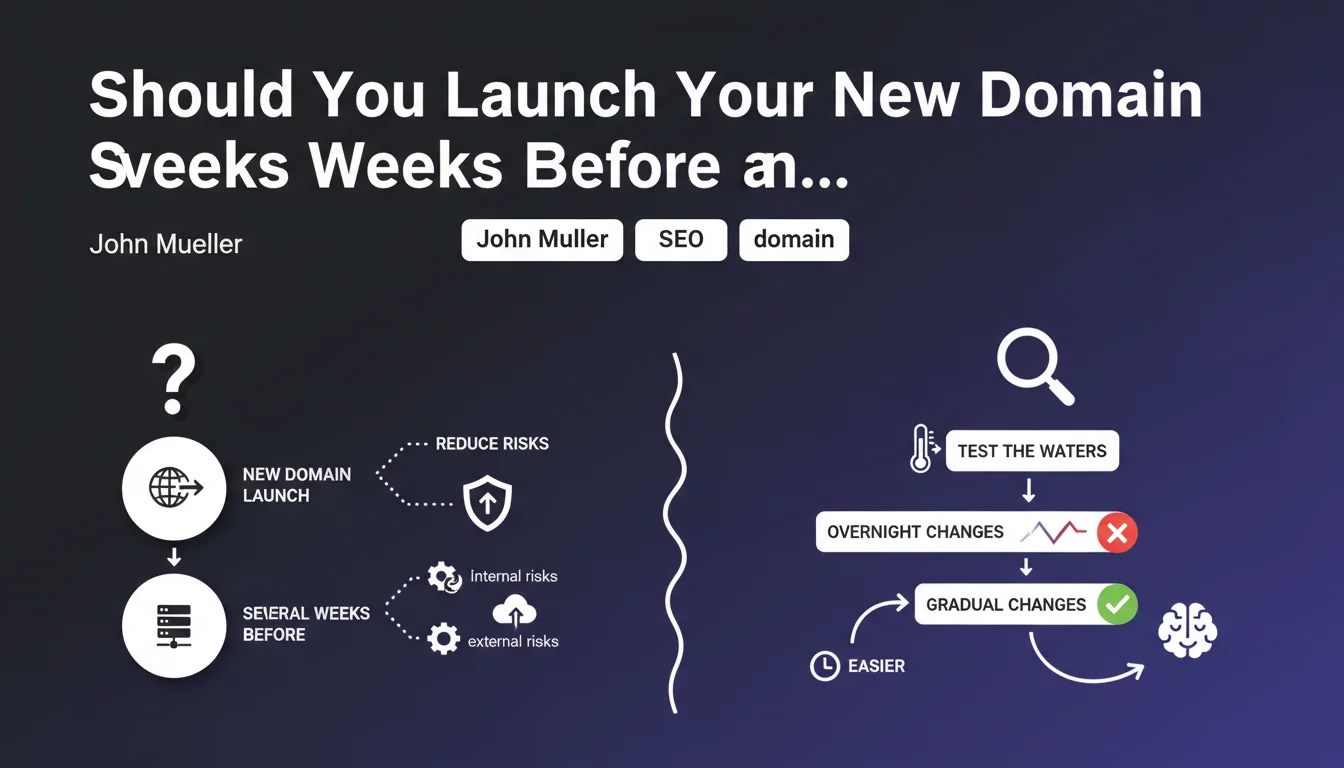
When Google indexes a new domain, several internal processes are set in motion: domain discovery, legitimacy assessment, initial crawl budget allocation, and trust signal analysis.
By launching the domain several weeks before migration, you allow Google to create a profile for this domain, remove it from the potential "sandbox" for new domains, and establish an initial foundation of trust.
- The domain is already known and indexed by Google before migration
- Anti-spam systems have had time to evaluate the domain
- The crawl budget begins to build up progressively
- Configuration errors can be detected and corrected without impacting traffic
What Are the Risks of a Rushed Migration?
A migration carried out overnight combines all risk factors: URL changes, unknown new domain, massive redirects, and potentially undetected technical errors.
Google must then simultaneously handle the discovery of a new domain and the processing of hundreds or thousands of 301 redirects, which can slow down the process and create a period of uncertainty in search results.
What Can Be Tested During This Preparation Period?
This anticipated launch phase allows you to validate technical aspects: DNS configuration, SSL certificate, server response time, www/non-www handling, and proper robots.txt functioning.
You can also set up a preparation page or minimal showcase site so that Google begins crawling the domain and establishing its first signals.
- Verification of DNS resolution and global propagation
- Testing of HTTPS configuration and certificates
- Validation of server performance and response times
- Checking HTTP headers and status codes
- Implementation of tracking tools (Search Console, Analytics)
SEO Expert opinion
Is This Approach Systematically Necessary?
The value of launching a domain in advance strongly depends on the migration context. For a high-traffic site with thousands of pages, this precaution is particularly relevant because the stakes are significant.
On the other hand, for a small site with a few dozen pages and limited traffic, the impact will be less critical. Google now handles migrations fairly well, especially if they are properly prepared technically.
What Are the Optimal Timeframes to Follow?
John Mueller mentions "several weeks," which suggests a period of 3 to 6 weeks minimum. This timeframe allows Google to crawl the domain several times and establish an availability pattern.
Beyond 8 weeks, the marginal benefit diminishes. The essential thing is that Google has discovered and indexed the domain, verified its legitimacy, and that webmaster tools are configured.
Does This Statement Contradict the Usual Advice?
No, this recommendation fits within the preparation logic that Google advocates for all migrations. It simply adds a temporal dimension that is often overlooked.
It also confirms that Google applies different filters to new domains, even if these filters are less restrictive than before. The discovery period still exists.
Practical impact and recommendations
How Do You Concretely Prepare the Early Launch of the Domain?
Start by registering the domain and configuring functional hosting, even minimal. Install a valid SSL certificate and ensure the domain responds correctly in HTTPS.
Set up a simple temporary page that announces the upcoming arrival of the new site. This page must be indexable (no noindex) but can indicate that it is temporary.
Immediately configure Google Search Console and Google Analytics to start collecting data, even minimal. Verify domain ownership through multiple methods to secure access.
- Register the domain and configure hosting at least 6 weeks before the planned migration
- Install a valid SSL certificate and force HTTPS
- Create a temporary indexable page announcing the future site
- Configure Search Console and Analytics immediately
- Verify DNS configuration and global propagation
- Test response times and server stability
- Submit a minimal sitemap in Search Console
What Critical Errors Should Be Avoided During This Phase?
Definitely do not block crawling with a restrictive robots.txt or noindex tag. The goal is precisely for Google to discover and index the domain.
Also avoid creating duplicate content with your current site. The temporary page must be unique and should not replicate existing content from your main site.
Don't forget to monitor metrics in Search Console: presence of crawl errors, indexing speed, and potential security signals.
How Do You Plan the Migration Once the Domain Is Prepared?
Once the 3 to 6 weeks have elapsed, check in Search Console that the domain is properly indexed and shows no critical errors. This is the signal that you can proceed with the migration.
Then prepare your complete 301 redirect plan, page by page, and test it in a staging environment. Schedule the migration at a time of low traffic to limit impact.
After migration, monitor key metrics daily: organic traffic, rankings, crawl rate, and potential errors. A well-prepared migration generally stabilizes within 2 to 4 weeks.
- Wait until the domain is indexed and error-free in Search Console
- Prepare a comprehensive 301 redirect mapping
- Test redirects in a pre-production environment
- Schedule migration during a low-traffic period
- Update the XML sitemap with new URLs
- Declare the change of address in Search Console
- Monitor post-migration metrics daily
💬 Comments (0)
Be the first to comment.