
Official statement
What you need to understand
Why Is Google Warning Against Using LLMs for SEO Diagnostics?
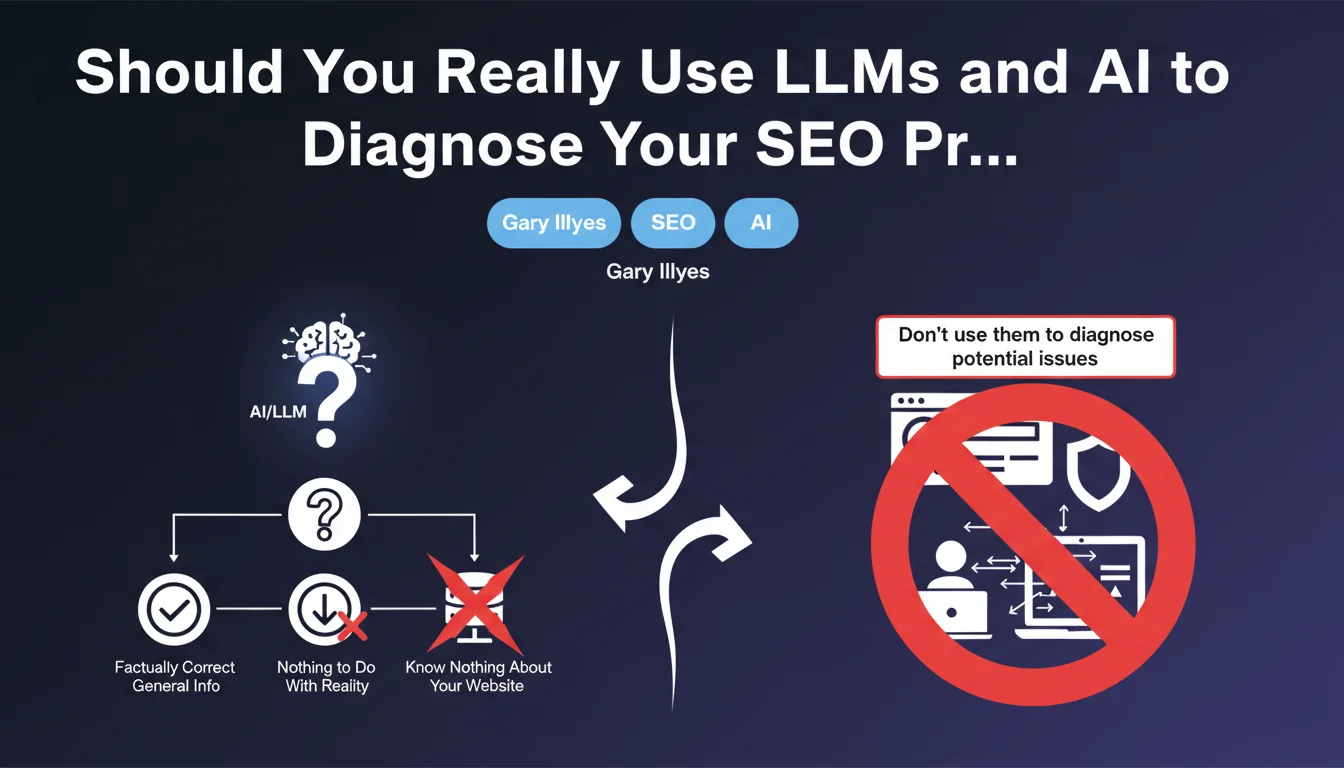
Google, through Gary Illyes, expresses significant reservations about using language models to diagnose SEO issues. The main reason is that these tools, as impressive as they may be, have no specific knowledge of your website.
LLMs operate based on statistical probabilities and general training data. They cannot analyze the technical specifics of your infrastructure, your penalty history, or your particular server configurations.
What's the Difference Between General Information and Personalized Diagnosis?
LLMs excel at providing factually correct general information about SEO best practices. They can explain what an XML sitemap is, how to structure your title tags, or the principles of internal linking.
However, they can also produce hallucinations or recommendations unsuited to your specific context. An LLM might suggest a technical solution incompatible with your CMS or misinterpret the symptoms of a complex problem.
What Are the Real Risks of an Incorrect AI Diagnosis?
The main danger lies in blindly applying generic recommendations to particular situations. An AI diagnosis could waste your time on false leads or, worse, make you modify elements that were working correctly.
LLMs cannot access Google Search Console, analyze your actual server logs, or understand your modification history. They lack the critical context necessary for a reliable diagnosis.
- LLMs don't have access to your site's specific data
- They can generate plausible but incorrect information (hallucinations)
- The wow factor shouldn't replace methodical analysis
- General information is useful, but not personalized diagnostics
- Risk of following recommendations unsuited to your context
SEO Expert opinion
Is This Statement Consistent With Practices Observed in the Field?
Absolutely. As an SEO expert, I regularly observe erroneous AI diagnostics that cause more confusion than they provide solutions. LLMs tend to oversimplify complex situations that require in-depth analysis.
For example, faced with a traffic drop, an LLM will often propose a generic list of possible causes without prioritization or context. A human expert will begin by examining the exact timing, correlating with algorithmic updates, analyzing affected traffic segments.
What Important Nuances Should Be Added to This Recommendation?
This isn't about completely rejecting AI, but rather defining its scope of usefulness. LLMs are excellent for documentation, explaining concepts, or generating keyword ideas. They can accelerate certain repetitive tasks and serve as assistants.
The crucial distinction lies between information and diagnosis. Asking "What is a robots.txt file?" is relevant. Asking "Why isn't my site ranking?" will lead to generic and potentially misleading answers.
In Which Specific Cases Can AI Still Be Useful for SEO?
LLMs present real value for certain well-defined SEO tasks. Semantic content analysis, generation of meta tag variations, identifying patterns in large keyword lists are relevant use cases.
AI also excels at automation tasks: text reformulation, content template creation, or entity extraction from corpora. The essential thing is that the SEO practitioner maintains control and systematically validates outputs.
Practical impact and recommendations
How Can You Use LLMs Intelligently Without Falling Into Their Traps?
The key lies in a hybrid and methodical approach. Use LLMs as assistants for generic tasks, but never as substitutes for thorough technical analysis. Every recommendation must be validated by your own data.
Invest in professional analysis tools that actually access your data: crawlers, log analyzers, position tracking platforms. These tools provide factual data on which to base your diagnostics.
What Critical Mistakes Should You Absolutely Avoid?
Never implement major technical modifications based solely on an unverified AI recommendation. This includes URL structure modifications, server configuration changes, or interventions on the robots.txt file.
Also avoid asking LLMs overly vague questions like "Analyze my SEO". Without access to your actual data, you'll get useless generalities. Be specific in your questions and seek general information, not diagnostics.
What Methodology Should You Adopt to Effectively Diagnose Your SEO Issues?
Always start with objective data collection: Google Search Console, analytics, technical crawls, log analysis. Establish a precise timeline of events and correlate with known algorithmic updates.
Formulate hypotheses based on this data, then test them methodically. LLMs can help you understand concepts or explore leads, but validation must come from your actual observations and measurements.
- Use LLMs for general information and learning, not for personalized diagnostics
- Systematically validate any AI recommendation with your own analytics and Search Console data
- Prioritize professional analysis tools that actually access your infrastructure
- Continuously train yourself in SEO fundamentals to develop your critical thinking
- Document your modifications to be able to evaluate the actual impact of each intervention
- Compare AI suggestions with official Google documentation and feedback from the SEO community
- Never delegate the final decision to an AI: maintain control and responsibility for your strategic choices
LLMs represent powerful but imperfect tools that must be used with discernment in your SEO strategy. Their strength lies in assistance and documentation, not in personalized diagnosis.
Developing a rigorous analytical approach, based on real data and a deep understanding of Google's mechanisms, remains the only path to high-performing and sustainable SEO.
Faced with the growing complexity of SEO and the proliferation of tools, many professionals find that specialized expertise has become indispensable. If you want to structure a solid SEO strategy without risking costly errors linked to approximate diagnostics, guidance from a specialized SEO agency can save you valuable time and secure your investments.
💬 Comments (0)
Be the first to comment.