
Official statement
Other statements from this video 7 ▾
- □ Does Google really keep Search and Ads completely separate, or is this just PR?
- □ Does Google really give large sites privileged SEO support while smaller sites are left behind?
- □ Are PBNs really all classified as spam by Google, or is there room for interpretation?
- □ Does Google really monitor help forums to detect spam?
- □ Where does Google really get all those spam reports from?
- □ Does Google Really Use Product Experts' Feedback to Improve Search Console and Documentation?
- □ Why do SEO priorities shift so dramatically depending on which market you're targeting?
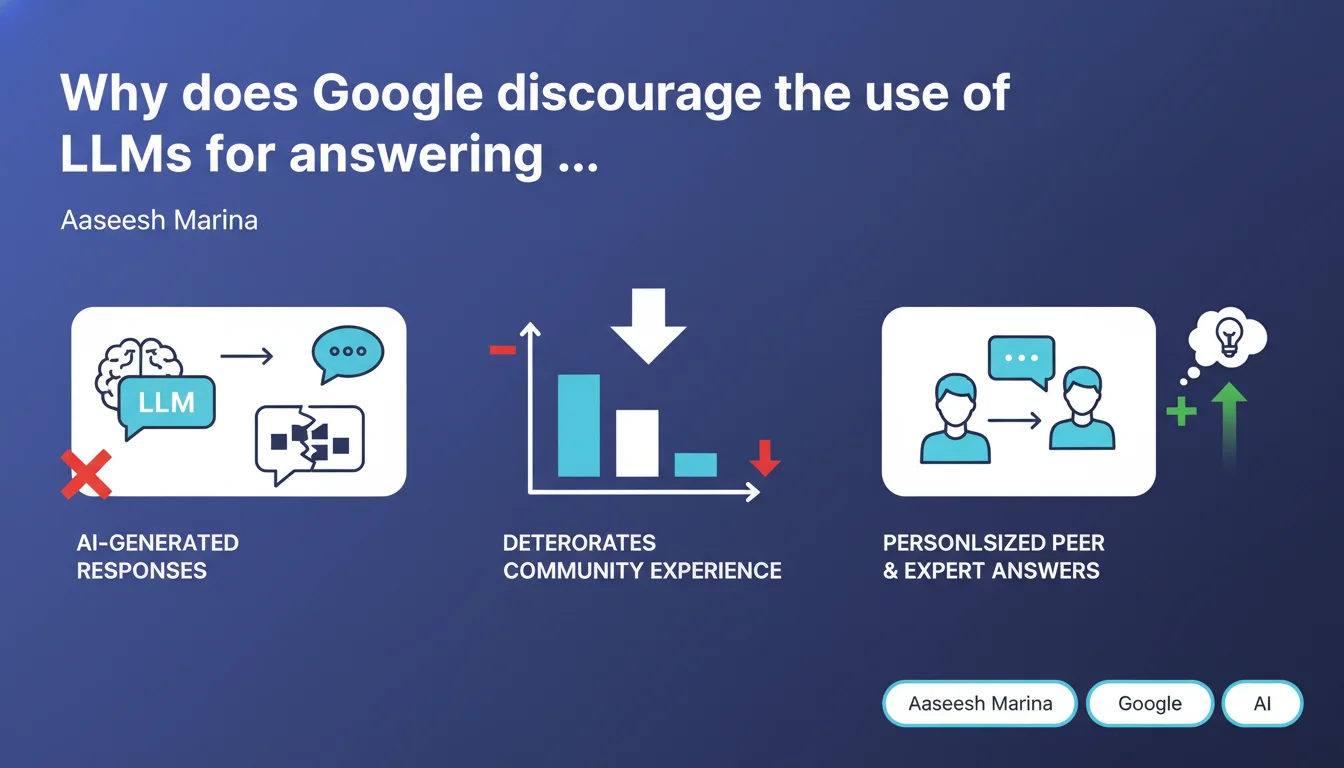
Google explicitly asks users not to generate answers via LLM in its support forums. The reason stated: this content deteriorates the community experience and provides no value compared to personalized human responses. A position that raises questions about Google's consistency regarding generative AI.
What you need to understand
What specific problem does Google identify with LLMs in forums?
Google points the finger at the degradation of user experience in its own support forums. AI-generated answers, even if factually correct, lack the context and nuance that active community members bring.
Concretely? A user asking a specific technical question expects an answer tailored to their exact situation, not a generic rephrasing of a ChatGPT prompt. The tone, empathy, concrete examples — everything that makes human exchange rich — disappears with AI.
Does this directive apply only to Google forums?
The statement explicitly targets Google's official help forums, not the entire web. It's an internal community policy, not a global SEO directive.
That said, the underlying message is transparent: Google values authentic human expertise in support spaces. An important distinction for anyone thinking about their content strategy on similar platforms.
What's the difference between this and "acceptable" AI content according to Google?
Google has repeatedly stated that AI-generated content is not inherently problematic for SEO. What matters: the value delivered to the end user.
In forums, this value is precisely absent. A standard LLM response never beats the experience of an expert who understands the specific context of the problem posed. That's where the red line is drawn.
- Google forums require personalized and contextual responses, not AI templates
- Google clearly distinguishes useful AI content (acceptable) from generic AI content (undesirable)
- The directive concerns the quality of community experience, not a global ranking signal
- Human expertise remains the gold standard for technical support spaces
SEO Expert opinion
Is this position consistent with Google's stance on AI?
Let's be honest: there's a glaring paradox. On one hand, Google is massively deploying generative AI in its own products (SGE, Bard, automatic summaries). On the other, it asks users to avoid these same tools in its forums.
The nuance lies in usage. Google doesn't condemn AI itself, but its lazy application that dilutes the quality of exchanges. An LLM response in a forum is like serving a frozen meal in a fine dining restaurant — technically edible, but not what you came for.
Should we expect SEO penalties for AI content on other platforms?
[To be verified] — Google has never confirmed an AI detection system used as a direct penalty signal. Official statements remain fuzzy on this precise point.
What we observe in the field: generic, repetitive AI content without added value performs poorly. Not because it's detected as AI, but because it fails to meet E-E-A-T quality criteria. The source of content matters less than its actual relevance.
What lesson should you take for your SEO content strategy?
The message is clear: AI is a tool, not a strategy. Using ChatGPT to structure an article? Perfect. Publishing raw output directly without human review or enrichment? SEO suicide.
Sites that do best combine AI's efficiency for volume with human expertise for differentiation. This hybridization is what creates value — and it's exactly what Google rewards, forums or not.
Practical impact and recommendations
What should you do if you manage a community or support forum?
First step: explicitly ban unsupervised AI responses in your community guidelines. Make it clear, with concrete examples of what is and isn't acceptable.
Second focus: encourage quality human contributions. Reward active members who take the time to personalize their answers. Moderation should prioritize depth over volume.
How do you adapt your content strategy in light of this declaration?
If you're using AI to generate content, now is the time to strengthen the human expertise layer. Review, enrich, add specific examples, nuances, real-world experience.
Audit your existing content: identify pieces that sound too generic or impersonal. These are your first candidates for enriched rewrites. Modern SEO rewards differentiation, not standardized mass production.
- Establish clear guidelines on acceptable AI use in your community spaces
- Implement active moderation to detect and filter generic AI responses
- Train your contributors to enrich AI outputs with their personal expertise
- Regularly audit your content to spot genericity patterns typical of unsupervised AI
- Prioritize quality over volume: 10 expert responses beat 100 identical AI responses
- Integrate proof of expertise elements (concrete cases, screenshots, real tests) that AI alone cannot produce
❓ Frequently Asked Questions
Google pénalise-t-il les sites qui publient du contenu généré par IA ?
Cette directive s'applique-t-elle aux forums autres que ceux de Google ?
Peut-on utiliser l'IA pour préparer une réponse avant de la personnaliser ?
Comment Google détecte-t-il qu'une réponse a été générée par IA ?
Cette déclaration change-t-elle quelque chose pour le SEO classique ?
🎥 From the same video 7
Other SEO insights extracted from this same Google Search Central video · published on 21/02/2024
🎥 Watch the full video on YouTube →
💬 Comments (0)
Be the first to comment.