
Official statement
Other statements from this video 7 ▾
- □ Google favorise-t-il vraiment les gros sites avec un support SEO privilégié ?
- □ Les PBN sont-ils vraiment tous considérés comme du spam par Google ?
- □ Google surveille-t-il les forums d'aide pour détecter le spam ?
- □ Comment Google collecte-t-il réellement les signalements de spam web ?
- □ Pourquoi Google déconseille-t-il l'utilisation des LLM dans les forums d'aide ?
- □ Le feedback des Product Experts influence-t-il vraiment la documentation Google et Search Console ?
- □ Pourquoi le SEO technique n'a-t-il pas les mêmes priorités selon les marchés ?
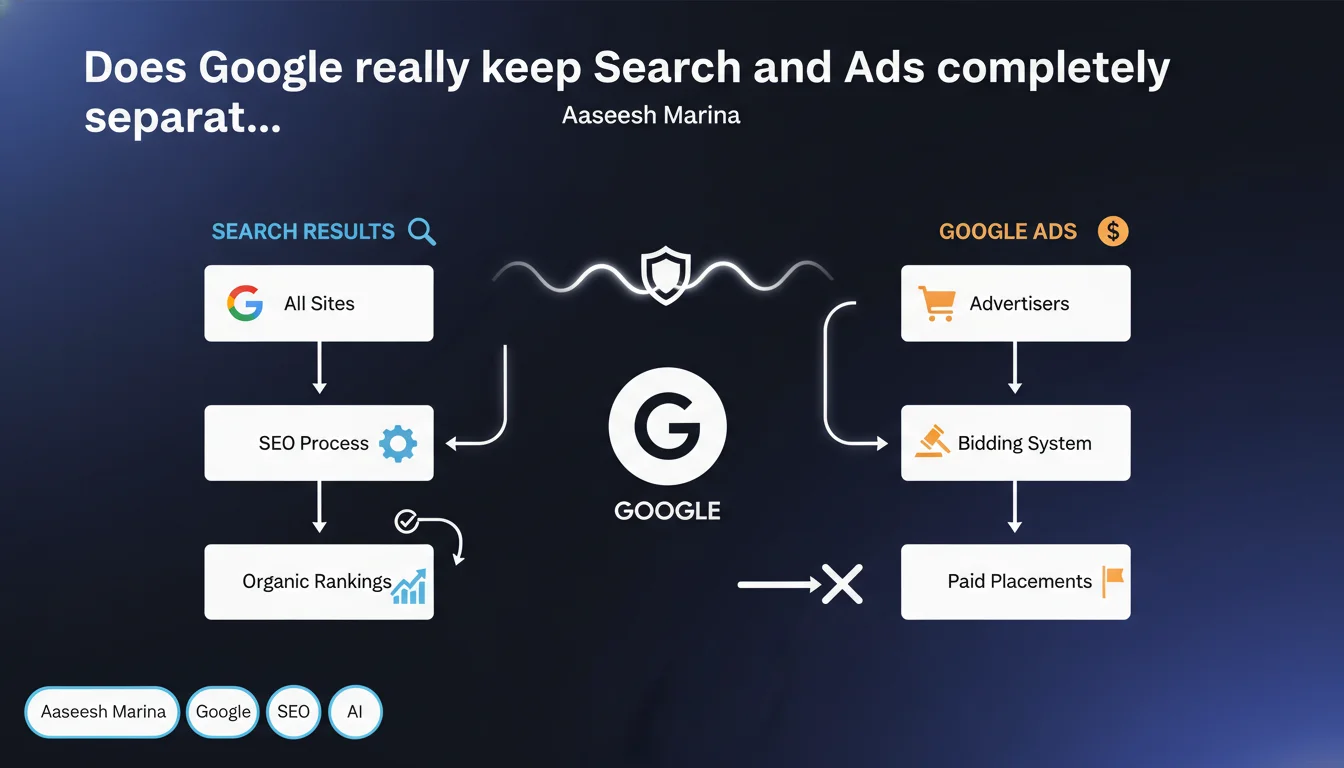
Google claims a total separation between its Search and Ads teams: being an advertising client provides no natural search ranking advantage. All sites, whether they spend millions on ads or nothing at all, go through the same SEO support channels. A statement aimed at reassuring about engine fairness — but one that deserves to be tested against real-world observations.
What you need to understand
This statement comes at a time when Google is regularly accused of conflicts of interest between its advertising activities and its search engine. The underlying question: does an advertiser who invests massively in Google Ads benefit from preferential treatment on the SEO side?
Aaseesh Marina, head of Search policy at Google, responds with a categorical no. According to him, the Search and Ads teams operate in a completely watertight manner. No data circulates between them to influence organic ranking.
What does this separation actually mean in practice?
Google claims that advertising budgets have no impact on natural search rankings. Whether you're a big advertiser or have never spent a euro on Ads, your pages are evaluated according to the same algorithmic criteria. SEO support also follows the same channels for everyone.
In other words: no privileged direct line for premium customers. Major brands go through the same forums, Search Console, and public documentation as everyone else. Officially, at least.
Why does Google insist so much on this point?
Because the credibility of the search engine rests on perceived neutrality. If users think results are biased by commercial considerations, trust collapses — and with it, the value of the audience. Google therefore has every reason to maintain this separation, if only to preserve its business model.
This policy is also a response to regulators. Competition authorities closely scrutinize tech giants, and any evidence of favoritism based on advertising spending would become formidable ammunition in antitrust cases.
- Official separation: Search and Ads teams do not share data to influence organic ranking
- Unified support: all sites, Ads clients or not, have access to the same SEO support channels
- Credibility at stake: Google must preserve user trust in the neutrality of results
- Regulatory pressure: antitrust authorities closely monitor any form of favoritism
SEO Expert opinion
Is this statement consistent with real-world observations?
Let's be honest: reality is more nuanced than this official discourse. Several studies have shown correlations between SEO visibility and advertising spending — but be careful, correlation is not causation. Major brands that invest in Ads often also have substantial SEO budgets, competent technical teams, and natural brand awareness that generates backlinks.
On one specific point, however, Google is telling the truth: SEO support is indeed identical for everyone. Whether you're a small business or a CAC 40 giant, you don't get a privileged hotline. Even Google Ads representatives themselves redirect to public channels for any SEO question. I've seen clients with six figures monthly in Ads get directed to forums like everyone else.
What gray areas persist despite this claim?
The problem is that certain indirect interactions remain opaque. For example, data from Google Analytics or Search Console — used extensively by large advertisers — is it never crossed with advertising profiles? Google claims not, but [To be verified] to what extent these compartmentalizations withstand the reality of internal operations.
Another sensitive point: beta testing and pilot programs. Some big advertisers sometimes get early access to new Ads features. Does this create an indirect advantage in terms of understanding search trends? Probably, even if it's not a direct algorithmic boost.
Should this statement be taken at face value?
Yes and no. Technically, Search algos probably do not receive a signal like "this site spends X on Ads". Google would have everything to lose if such a mechanism were discovered during an antitrust case — and it would eventually leak, given the number of engineers who pass through the company.
But this doesn't mean you should be naive. Major brands benefit from structural advantages (brand awareness, mentions, natural backlinks) that are amplified by their ability to invest massively across all channels, Ads included. Technical separation does not prevent de facto synergy.
Practical impact and recommendations
What should you take away for your SEO strategy?
First point: stop believing that investing in Google Ads will boost your SEO. This urban legend persists, and it's costing you in illusions. If you launch an Ads campaign hoping your organic rankings will climb, you're going to be disappointed. Advertising budgets don't buy places in organic SERPs.
That said, Ads can have positive indirect effects: increased traffic that improves engagement signals, increased visibility that generates natural citations and backlinks, rapid keyword testing before optimizing for SEO. But these are secondary benefits, not a direct lever.
How to optimize without counting on preferential treatment?
Focus on technical and editorial fundamentals. Since everyone goes through the same support channels, your advantage lies in your ability to execute better than the competition: page load speed, clean architecture, quality content, intelligent link building.
Use Search Console intensively — it's the only official communication tool between Google and your site. If you have indexing issues or penalties, that's where you'll get answers, not through some hypothetical privileged contact.
- Abandon the idea that an Ads budget improves your SEO — the two are separated
- Exploit indirect synergies: keyword insights, brand awareness, traffic that generates positive signals
- Maximize Search Console usage, your only official communication channel with Google
- Invest in fundamentals: technical, content, authority — that's what makes the difference
- Don't count on privileged support, even if you spend big on advertising
❓ Frequently Asked Questions
Est-ce que dépenser en Google Ads améliore mon référencement naturel ?
Les gros annonceurs ont-ils un support SEO privilégié chez Google ?
Pourquoi certaines études montrent une corrélation entre Ads et visibilité SEO ?
Google peut-il croiser mes données Search Console avec mon profil Ads ?
Y a-t-il des avantages indirects à utiliser Google Ads pour le SEO ?
🎥 From the same video 7
Other SEO insights extracted from this same Google Search Central video · published on 21/02/2024
🎥 Watch the full video on YouTube →
💬 Comments (0)
Be the first to comment.