
Official statement
Other statements from this video 7 ▾
- □ Google sépare-t-il vraiment Search et Ads comme il le prétend ?
- □ Google favorise-t-il vraiment les gros sites avec un support SEO privilégié ?
- □ Google surveille-t-il les forums d'aide pour détecter le spam ?
- □ Comment Google collecte-t-il réellement les signalements de spam web ?
- □ Pourquoi Google déconseille-t-il l'utilisation des LLM dans les forums d'aide ?
- □ Le feedback des Product Experts influence-t-il vraiment la documentation Google et Search Console ?
- □ Pourquoi le SEO technique n'a-t-il pas les mêmes priorités selon les marchés ?
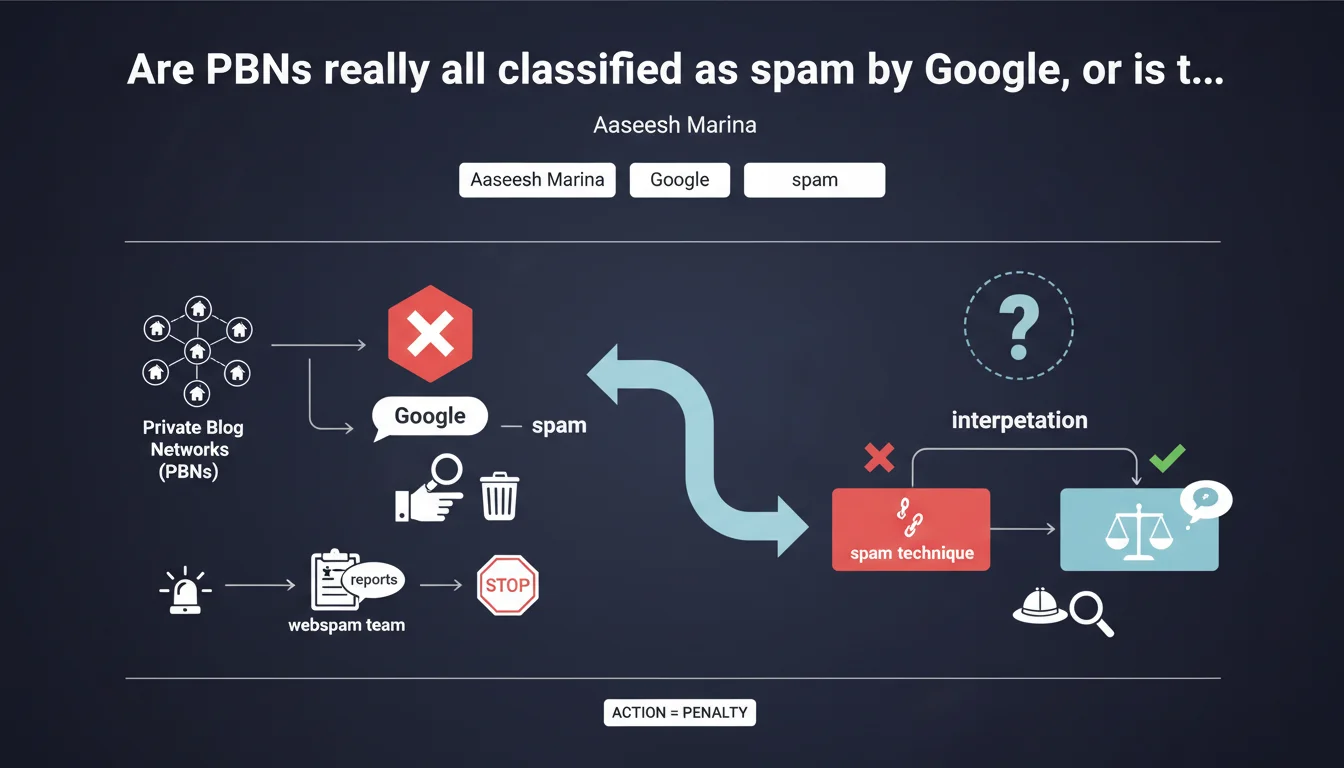
Google officially classifies Private Blog Networks (PBNs) as spam with no gray area. The webspam team actively solicits reports to dismantle these networks. For SEO practitioners, this confirms a real risk of manual or algorithmic penalties if your link strategy relies on this type of infrastructure.
What you need to understand
What exactly is a PBN and why does Google target it so aggressively?
A Private Blog Network is a collection of websites created solely to generate backlinks to a target site. The goal: artificially manipulate PageRank and popularity signals. Google considers this practice a direct violation of its webmaster guidelines, as it distorts fair competition.
Google's webspam team encourages reports, which shows a proactive desire to track these networks—not just through algorithms. That's a clear signal: the risk of manual penalties remains high.
Does this statement really bring anything new to the table?
Honestly, no. Google has been condemning PBNs for years. What's changing here is the public communication: Aaseesh Marina is openly reminding us that the webspam team remains active on this issue. It's still a warning, not a technical revolution.
The problem is that Google never clarifies what formally defines a PBN. No threshold, no clear criteria. Everything hinges on perceived intent: if your satellite sites exist only to push links, you're in their sights.
What are the specific signals that trigger spam classification?
Google detects PBNs through several indicators: technical footprint (same IP ranges, same servers, same CMS), low-quality content, absence of real organic traffic, suspicious link patterns (all network sites point to the same domain). A human can spot a PBN in minutes—Google's algorithms can too.
- Identical technical footprint across multiple network sites
- Generic or recycled content with no editorial value
- Absence of organic traffic or user signals
- Abnormally concentrated linking patterns toward one domain
- Masked or identical Whois information across multiple domains
SEO Expert opinion
Is this statement consistent with observed practices?
Yes, in principle. Manual penalties regularly fall on sites identified as participants in a PBN. But let's be honest: well-constructed link networks still escape detection in 2023-2024. Google's algorithm isn't omniscient, and manual teams only cover a fraction of cases.
The real disconnect is that Google never publicly distinguishes an amateur PBN (50 zombie sites hosted in the same location) from a network of coherent editorial sites, run by professionals who diversify IPs, CMS, content, and topics. In the latter category, the boundary becomes blurry—and Google knows it.
What nuances need to be added?
Not all site networks are PBNs in the strict sense. A media group that publishes quality content, generates organic traffic, and where certain sites link to each other is not a PBN—it's an editorial ecosystem. The difference lies in intent and real user value.
Google can't technically distinguish a legitimate network from a spam network if technical signals are well managed. That's why the webspam team solicits manual reports: algorithms alone aren't enough. [To verify]—Google publishes no data on the automatic detection rate for PBNs, nor on the volume of penalties applied.
In what cases does a site network escape spam classification?
If your satellite sites generate real organic traffic, publish original content regularly, attract natural external backlinks, and don't systematically link to your money site, you exit the strict PBN definition. At that point, you're managing an editorial portfolio—not a manipulation network.
Practical impact and recommendations
What should you do if you're currently running a PBN?
If your strategy relies on a classic PBN—satellite sites with no traffic, generic content, unidirectional links to your money site—you're playing with fire. Manual penalties can durably degrade your rankings, and cleanup takes months.
Two options: either you transform these sites into legitimate editorial projects (time and budget investment), or you gradually abandon them and pivot toward more sustainable link-building strategies. Disavowing your own links from the PBN can also limit damage if Google hasn't detected it yet—but that's just a band-aid.
What critical mistakes should you avoid when managing satellite sites?
The fatal error is a uniform technical footprint. If all your sites share the same server, same WordPress theme, same internal linking structure, Google will cluster them as a suspicious network. Diversifying infrastructure (hosting providers, CMS, templates) is the minimum.
Another trap: publishing filler content. A site with no audience, no engagement, no external backlinks is a red flag. If you can't justify a site's editorial existence, it shouldn't exist.
How can you verify your link strategy stays within guidelines?
Ask yourself this: could each site in your portfolio exist independently, without your money site in the equation? If the answer is no, you're technically in a PBN scheme. If the answer is yes, you're managing an ecosystem—but stay vigilant about Google signals.
- Verify technical diversification: hosting providers, IPs, CMS, themes
- Audit editorial quality: original content, organic traffic, external backlinks
- Analyze link patterns: avoid overly predictable or unidirectional schemes
- Monitor manual penalties in Google Search Console
- Disavow suspicious links if your network is compromised
Google's position is crystal clear: PBNs are spam, period. If your strategy relies on artificial site networks, the penalty risk is real and growing. Migrating to legitimate editorial link-building—quality guest blogging, media partnerships, viral content—becomes essential to secure your rankings long-term.
These strategic shifts often require specialized technical and editorial expertise. If you lack internal time or resources, partnering with a specialized SEO agency can accelerate the transition and help you avoid costly visibility mistakes.
❓ Frequently Asked Questions
Google peut-il vraiment détecter tous les PBN ?
Un réseau de sites thématiques liés entre eux est-il forcément un PBN ?
Faut-il désavouer les liens issus d'un PBN que j'ai moi-même créé ?
Peut-on récupérer d'une pénalité liée à un PBN ?
Les PBN fonctionnent-ils encore en termes de ranking ?
🎥 From the same video 7
Other SEO insights extracted from this same Google Search Central video · published on 21/02/2024
🎥 Watch the full video on YouTube →
💬 Comments (0)
Be the first to comment.