
Official statement
Other statements from this video 7 ▾
- □ Does Google really keep Search and Ads completely separate, or is this just PR?
- □ Does Google really give large sites privileged SEO support while smaller sites are left behind?
- □ Are PBNs really all classified as spam by Google, or is there room for interpretation?
- □ Does Google really monitor help forums to detect spam?
- □ Where does Google really get all those spam reports from?
- □ Why does Google discourage the use of LLMs for answering in its support forums?
- □ Why do SEO priorities shift so dramatically depending on which market you're targeting?
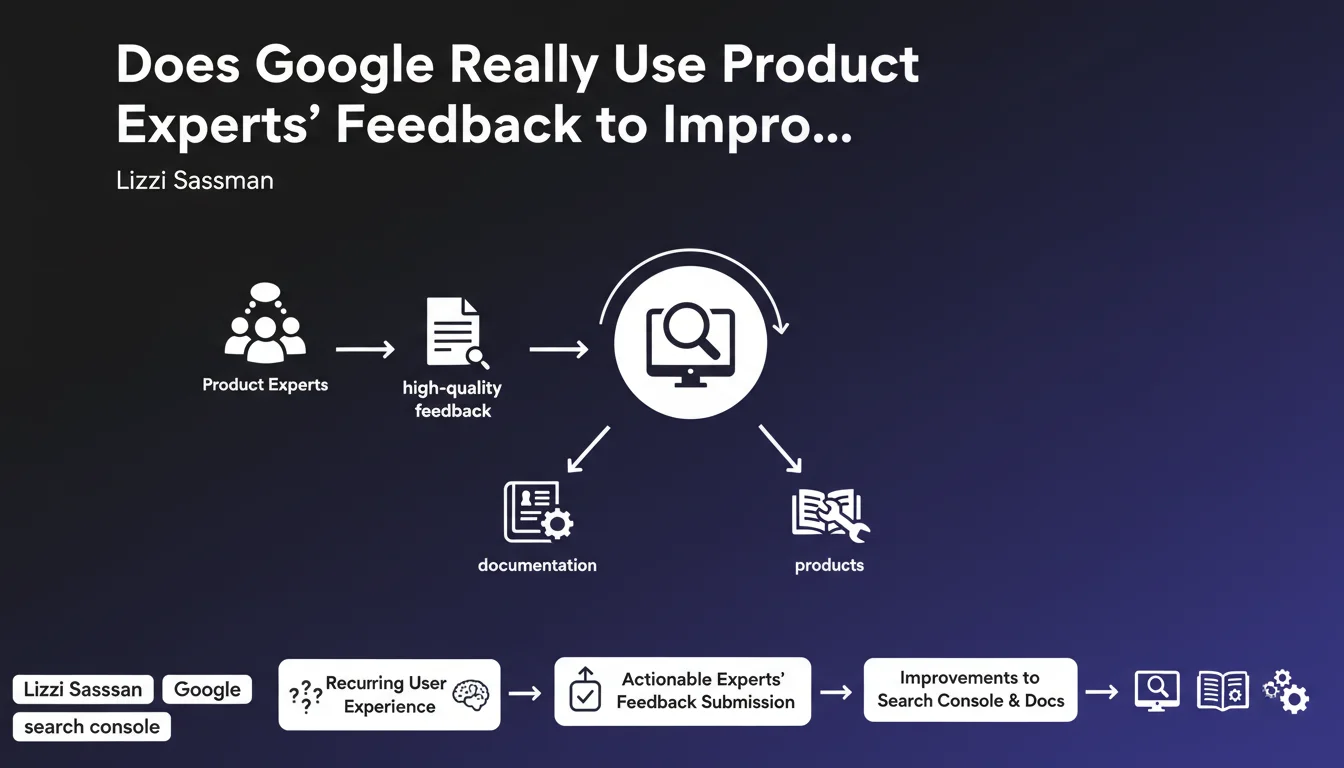
Google claims that Product Experts can submit actionable feedback based on their real-world experience with recurring user questions. This feedback is used to improve official documentation and tools like Search Console. A statement that validates the importance of practitioners' field experience in the evolution of SEO tools.
What you need to understand
Who exactly are these Product Experts that Google is talking about?
Product Experts constitute an official Google program that allows experienced users to actively participate in help communities. These experts answer questions in official forums and accumulate precise knowledge of the problems encountered by real users of Search Console and other tools.
Their positioning is strategic — they are in daily contact with the concrete difficulties faced by SEO professionals. This direct exposure to real-world use cases gives them a perspective that internal product teams don't always have.
What type of feedback is considered actionable?
Google emphasizes the notion of high-quality feedback based on direct experience. Concretely, this involves documented reports on recurring friction points: misunderstood features, ambiguous error messages, use cases not covered by existing documentation.
Actionable feedback distinguishes itself from simple complaints by its ability to precisely identify the problem and propose a measurable improvement angle.
How does this process impact documentation and products?
The impact manifests at two distinct levels. First, documentation improvements: clarification of confusing sections, addition of concrete examples, updating of outdated guides. Next, the evolution of the products themselves, notably Search Console.
This feedback loop suggests that tools are not static and that field experience genuinely influences product roadmaps — at least in theory.
- Product Experts are experienced users active in official Google forums
- Feedback must be actionable, documented, and based on recurring problems observed
- Improvements affect both documentation and tool features
- This process creates a feedback loop between field users and product teams
SEO Expert opinion
Is this statement consistent with what we observe in the field?
Partially. We do observe regular improvements to Google documentation, with clarifications that seem to address recurring community questions. Search Console also evolves, adding new features that correspond to field requests.
But let's be honest — the delay between feedback and implementation often remains long. Some bugs or limitations known for years still haven't been fixed. The question of the actual level of influence of these reports remains open. [To verify]: to what extent does this feedback really influence product priorities versus Google's internal objectives?
What nuance should be added to this claim?
Google speaks of "high-quality" feedback without precisely defining selection criteria. Not all feedback from Product Experts is equally valuable, and there is certainly an implicit filter on what actually reaches product teams.
Moreover, documentation improvements don't equate to solving underlying problems. Sometimes clarifying why a feature doesn't work as expected doesn't change the fact that it remains frustrating to use. And that's where it gets tricky.
What's Google's interest in communicating about this process?
This statement serves several objectives. It valorizes the Product Experts program, encourages active participation in official communities, and projects an image of listening to users. It's also a way to channel feedback into controlled circuits rather than dispersed ones.
From a strategic perspective, Google benefits from a free field feedback system, fed by motivated experts. Smart, but keep in mind that the final product agenda remains entirely controlled by Google.
Practical impact and recommendations
What should you concretely do as an SEO professional?
First action: actively participate in official Google forums Google Search Central and Product Experts communities if you identify recurring problems. Precisely document problematic use cases with screenshots, concrete examples, and measured impact.
Second action: follow updates to official documentation and Search Console. Improvements from this process can reveal best practices or clarify gray areas. Don't just consult the docs once — they evolve.
How can you maximize the usefulness of this feedback channel?
Structure your reports in a factual and reproducible manner. Good feedback contains: problem description, steps to reproduce, observed impact, frequency of occurrence, improvement suggestion if relevant.
Avoid generic complaints like "Search Console doesn't work well". Target specific points: "The coverage report doesn't clearly distinguish critical errors from warnings, which complicates prioritizing corrections."
What errors should you avoid when interpreting this statement?
Error #1: believing that all feedback will be considered. The volume of reports is huge, selection is drastic. Error #2: expecting Google to solve your specific problems through this channel — it's not direct technical support.
Error #3: neglecting other sources of information about Google's evolution (official announcements, field tests, SERP behavior observations) in favor of passively waiting for documentation to improve.
- Document precisely the recurring problems encountered in Search Console with supporting evidence
- Participate in official Google forums Google Search Central to contribute to collective feedback
- Follow documentation updates and Search Console feature releases regularly
- Structure your reports in a factual and reproducible manner with measured impact
- Don't rely on this channel as your sole means of obtaining support or answers
- Cross-reference official information with your field observations and actual tests
❓ Frequently Asked Questions
Les Product Experts sont-ils des employés de Google ?
Puis-je devenir Product Expert pour influencer directement les produits Google ?
Combien de temps faut-il entre un feedback Product Expert et une amélioration concrète ?
Ce canal de feedback remplace-t-il le support officiel Search Console ?
Google communique-t-il publiquement sur les feedbacks retenus et implémentés ?
🎥 From the same video 7
Other SEO insights extracted from this same Google Search Central video · published on 21/02/2024
🎥 Watch the full video on YouTube →
💬 Comments (0)
Be the first to comment.