
Official statement
Other statements from this video 14 ▾
- □ Comment Google comptabilise-t-il les impressions et clics dans les People Also Ask ?
- □ Les liens depuis un sous-domaine vers le domaine principal ont-ils moins de valeur en SEO ?
- □ Tous les liens dans Search Console sont-ils vraiment utiles pour votre SEO ?
- □ Les liens massifs en footer tuent-ils vraiment le contexte de votre site ?
- □ Faut-il désactiver les liens automatiques pour améliorer son SEO ?
- □ Le texte caché est-il encore un problème pour le SEO ?
- □ Pourquoi Google refuse-t-il d'indexer certaines de vos pages ?
- □ Quelques liens d'affiliation sans attribut peuvent-ils vraiment échapper à toute pénalité ?
- □ Pourquoi vos images n'apparaissent-elles jamais dans Google Images malgré un bon SEO ?
- □ Pourquoi Google insiste-t-il pour que les sitemaps ne soient jamais votre seul filet de sécurité ?
- □ Faut-il vraiment utiliser des canonicals sur vos pages de recherche interne filtrées ?
- □ Les Core Web Vitals peuvent-ils vraiment faire chuter votre positionnement de 48 places ?
- □ Pourquoi le validateur schema.org contredit-il les outils de Google ?
- □ Pourquoi Google ignore-t-il certains paramètres d'URL de langue ?
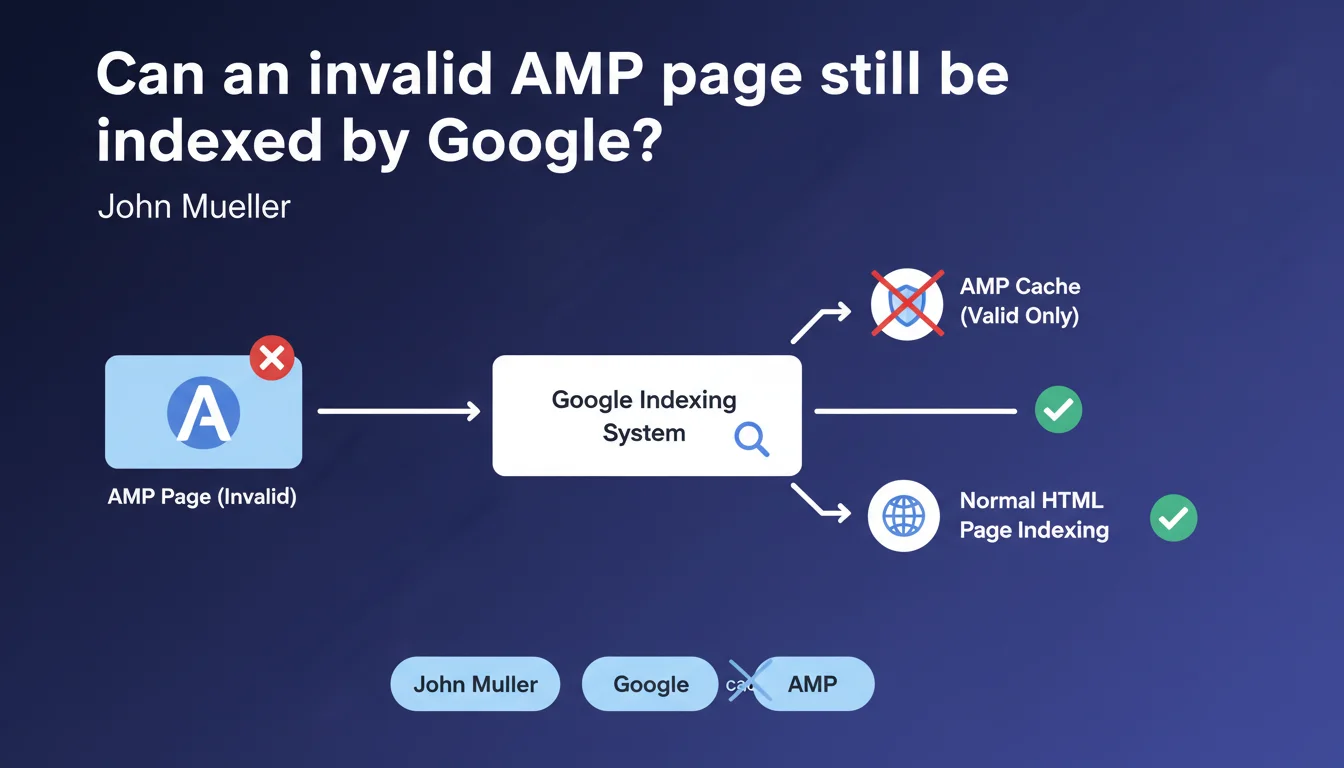
Google treats pure AMP pages like standard HTML pages. If they're valid, they benefit from AMP cache and specific SERP features. If invalid, they're still indexed normally — AMP invalidity doesn't block indexation.
What you need to understand
Pure AMP vs AMP as a supplement — what's the difference for indexation?
A pure AMP page refers to a website built entirely with the AMP framework, with no parallel classic HTML version. Google treats it like any standard web page. AMP validation then becomes a bonus, not a prerequisite for indexation.
If the page meets AMP specifications, Google can activate the AMP cache and display enriched visuals in results (Top Stories carousels, thumbnails). If it fails validation, it remains indexable as a standard HTML page — without AMP advantages, but without indexation penalty.
Why does Google maintain this flexibility?
The original goal of AMP was to improve mobile performance, not create a mandatory format. By treating invalid AMP pages as classic HTML, Google avoids penalizing sites that invested in AMP but encountered occasional technical errors.
It also simplifies migration: a site can switch to AMP progressively without risking a sharp drop in indexation if not all pages are immediately compliant.
What really triggers AMP features in the SERPs?
Three cumulative conditions: the page must be AMP-valid, served via HTTPS, and structured with appropriate structured data (Article, NewsArticle, etc.). Without validation, Google ignores AMP tags and indexes the content as standard HTML.
- A pure AMP page is treated as a normal HTML page by default
- AMP validation activates cache and specific search features
- AMP invalidity doesn't prevent indexation — but removes AMP advantages
- AMP errors don't result in algorithmic ranking penalties
SEO Expert opinion
Is this statement consistent with field observations?
Yes. We regularly observe pure AMP sites with validation errors that remain indexed and ranked normally. Google Search Console reports AMP issues in a dedicated tab, but these alerts don't impact the global indexation status of the page.
However — and this is where it gets tricky — an invalid AMP page loses all AMP benefits: no cache, no Top Stories carousel, no lightning icon. It becomes a standard HTML page, often less performant than a non-AMP optimized version.
What nuances should be made?
Mueller speaks of pure AMP pages, not hybrid configurations where a classic HTML page coexists with an alternate AMP version (rel=amphtml). In that case, Google favors the HTML version for indexation and offers AMP to mobile users if it's valid.
Another point: "indexed normally" doesn't mean "ranked ideally". An invalid AMP page may suffer from Core Web Vitals issues or mobile compatibility problems if broken AMP code generates display errors. [To verify]: the real impact of critical AMP errors on UX metrics and therefore ranking remains unclear in this statement.
In which cases does this rule become a trap?
If you build an entirely AMP site counting on AMP advantages (speed, cache, Top Stories visibility), invalidity makes the investment pointless. You end up with a restrictive framework without any of the benefits.
Practical impact and recommendations
Should you immediately fix all detected AMP errors?
It depends on your objective. If you're targeting Top Stories carousels or AMP cache, yes — validation is mandatory. If your pure AMP site mainly serves to publish standard content without ambitions for special features, AMP errors don't prevent indexation.
That said, an invalid AMP page often remains less performant than a well-optimized classic HTML page. Before letting errors slide, ask yourself whether AMP actually brings anything to your strategy.
What strategy should you adopt for an existing pure AMP site?
Audit your pages in Google Search Console, AMP tab. Identify blocking errors (unauthorized JavaScript, forbidden tags, missing attributes). If the error rate is high and you see no traffic from AMP features, consider a migration to optimized standard HTML.
If you want to stick with AMP, prioritize fixing errors on high-potential editorial pages (news, evergreen content). Drop it for secondary pages where AMP changes nothing about traffic.
How do you verify that your site is benefiting from AMP?
- Test each page with Google's official AMP validation tool
- Check in Search Console whether your AMP pages generate impressions from carousels or special features
- Compare Core Web Vitals of your AMP pages vs your classic HTML pages — AMP should be significantly superior
- Analyze click-through rate from SERPs: if AMP doesn't improve CTR, it's useless
- Monitor AMP errors in Search Console and prioritize fixing those affecting your strategic pages
❓ Frequently Asked Questions
Une page AMP invalide est-elle pénalisée en termes de positionnement ?
Peut-on mélanger des pages AMP valides et invalides sur un même site ?
Si mon site est entièrement en AMP mais invalide, dois-je tout refaire ?
Les erreurs AMP impactent-elles les Core Web Vitals ?
Faut-il supprimer AMP si je ne vise pas les carrousels actualités ?
🎥 From the same video 14
Other SEO insights extracted from this same Google Search Central video · published on 05/03/2022
🎥 Watch the full video on YouTube →
💬 Comments (0)
Be the first to comment.