
Official statement
Other statements from this video 14 ▾
- □ Comment Google comptabilise-t-il les impressions et clics dans les People Also Ask ?
- □ Les liens depuis un sous-domaine vers le domaine principal ont-ils moins de valeur en SEO ?
- □ Tous les liens dans Search Console sont-ils vraiment utiles pour votre SEO ?
- □ Une page AMP invalide peut-elle quand même être indexée par Google ?
- □ Les liens massifs en footer tuent-ils vraiment le contexte de votre site ?
- □ Faut-il désactiver les liens automatiques pour améliorer son SEO ?
- □ Le texte caché est-il encore un problème pour le SEO ?
- □ Pourquoi Google refuse-t-il d'indexer certaines de vos pages ?
- □ Quelques liens d'affiliation sans attribut peuvent-ils vraiment échapper à toute pénalité ?
- □ Pourquoi Google insiste-t-il pour que les sitemaps ne soient jamais votre seul filet de sécurité ?
- □ Faut-il vraiment utiliser des canonicals sur vos pages de recherche interne filtrées ?
- □ Les Core Web Vitals peuvent-ils vraiment faire chuter votre positionnement de 48 places ?
- □ Pourquoi le validateur schema.org contredit-il les outils de Google ?
- □ Pourquoi Google ignore-t-il certains paramètres d'URL de langue ?
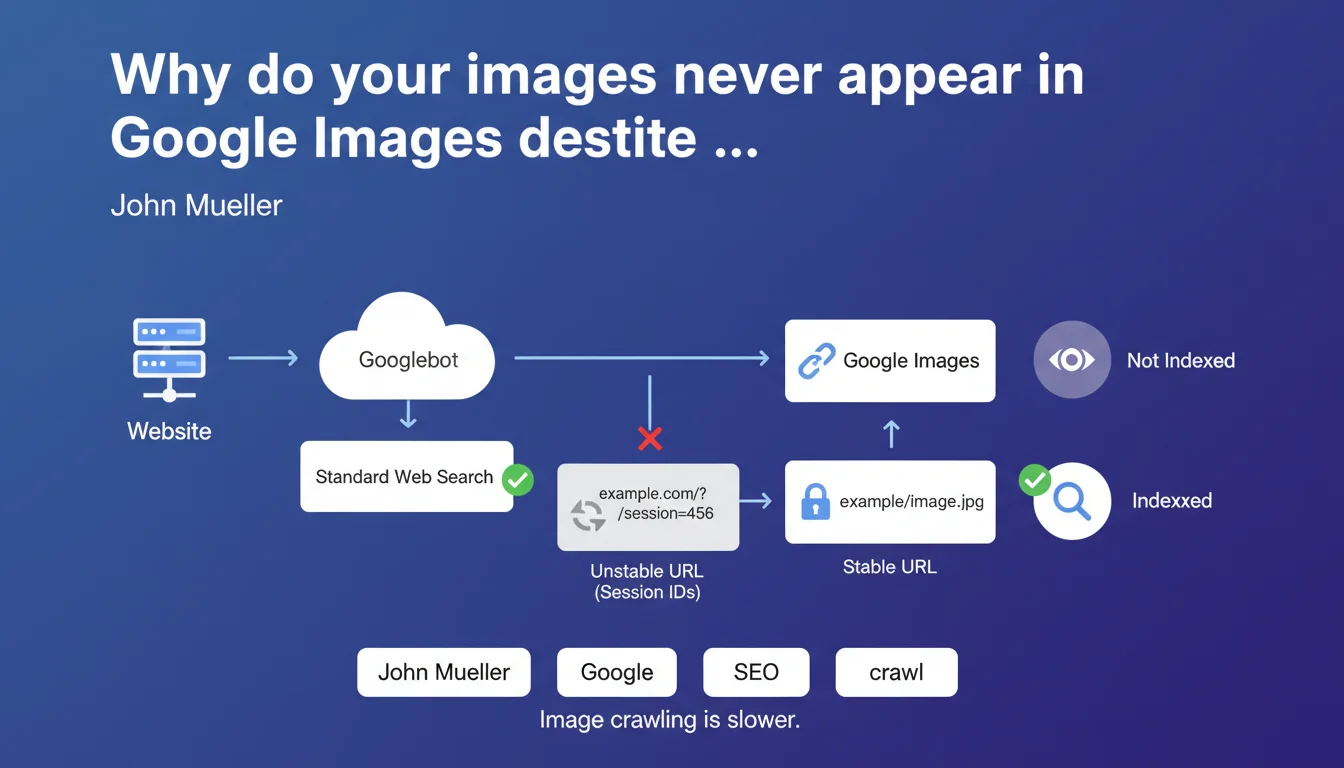
Google can only index your images in Google Images if they have stable URLs. If the URL changes with each crawl — for example due to session IDs or dynamic parameters — indexation will systematically fail. For standard web search, this constraint does not apply.
What you need to understand
Why is URL stability an absolute prerequisite for image indexing?
Google's image crawling process operates on a much slower cycle than text content crawling. When Googlebot returns to index an image, it must find exactly the same URL as it found on its first visit. If the URL has changed in the meantime, Google treats it as a new resource and starts the process from scratch.
In practice, if your CMS or CDN generates URLs like /image.jpg?sessionid=abc123 that change with each visit, Google will never be able to complete indexation. The image remains in a perpetual queue, never appearing in Google Images results.
What's the difference between image indexation and standard web search?
John Mueller clarifies that this requirement applies only to Google Images — not standard web search. A page can rank perfectly well in text SERPs even if its images have unstable URLs. The image will be visible on the page, but it will never appear as an independent result in the Images tab.
This distinction is crucial for prioritizing your optimizations. If your target traffic comes primarily from text search, dynamic image URLs won't directly penalize your rankings. However, if you're relying on visual traffic — e-commerce, portfolios, galleries — it's a dealbreaker.
What mechanisms generate unstable URLs without you realizing it?
The usual suspects: session IDs automatically added by certain platforms, dynamic cache parameters (like ?v=timestamp), poorly configured CDN systems that generate temporary tokens, or server-side URL rewrites with random variables.
More insidious: some lazy loading systems or on-the-fly compression modify the final URL served to the browser. If the crawler receives a different URL than the one in the HTML source, indexation fails.
- Stable URLs mandatory to appear in Google Images
- No direct impact on text page rankings
- Session IDs and dynamic parameters: enemy number one of visual indexation
- Check CDN configuration and server-side caching systems
- Poorly implemented lazy loading can generate non-canonical URLs
SEO Expert opinion
Is this rule consistent with real-world observations?
Yes, absolutely. Indexation audits regularly show cases where thousands of images are never crawled in Images while the hosting pages rank correctly. The cause: dynamic URLs or temporary tokens. Google cannot chase a moving target with such infrequent crawling.
However — and this is where it gets tricky — Mueller doesn't specify what timeframe constitutes "slow crawling". Are we talking days? Weeks? It's impossible to quantify the risk precisely without internal benchmarking. [To verify]: crawl frequency varies enormously depending on domain authority and image volume.
What nuances should we add to this statement?
First nuance: a "stable" URL doesn't mean "immutable for life". If you change an image's URL once for legitimate reasons (redesign, migration), Google will eventually reindex the new URL. The problem occurs when the URL changes with each crawl randomly.
Second nuance: static parameters like ?width=800&format=webp generally pose no problem if they remain identical across crawls. It's the variability that kills, not the presence of query strings per se. But be careful: some CDNs add cache parameters that seem stable but change depending on the crawl datacenter. [To verify] with crawl tests from multiple Googlebot IPs.
In what cases does this recommendation become secondary?
If your business model doesn't depend on visual organic traffic, this constraint becomes a lower priority. A B2B site with a few generic illustrations has no ROI in optimizing for Google Images. However, once you're talking e-commerce fashion, home decor, recipes, or creative portfolios, it's a major traffic lever.
Practical impact and recommendations
How do you verify that your image URLs are truly stable?
First step: crawl your site twice a few days apart using Screaming Frog or equivalent tool. Export the image URLs and compare the two exports. If the paths change, you have a stability problem.
Second method: use the URL Inspection tool in Search Console. Look at the rendered HTML URL for a page containing images, then reload the page manually a few hours later. If the image URL has changed, Googlebot will experience the same issue.
What corrective actions should you implement immediately?
If your site adds session IDs to URLs, disable this functionality for static resources (images, CSS, JS). Most modern frameworks allow you to exclude certain file types from session mechanisms.
For CDNs with temporary tokens, configure signed URLs with long validity periods (several months minimum) or, better yet, switch to stable public URLs for indexable images. Keep short tokens only for sensitive or private assets.
If you use a dynamic caching or compression system, ensure the final URL remains identical regardless of when the crawl happens. Cache buster systems with timestamps should be disabled for images intended for indexation.
What should you check on the technical infrastructure side?
- Crawl the site twice a few days apart and compare image URLs
- Check CMS configuration: disable session IDs for static resources
- Audit CDN configuration: eliminate temporary tokens or extend their validity period
- Test HTML rendering via Search Console and reload multiple times to verify stability
- Examine server logs to detect patterns of changing URLs served to Googlebot
- Implement canonical URLs for images if multiple versions exist (formats, sizes)
- Monitor indexation in Google Images via Search Console (Performance report, Images filter)
❓ Frequently Asked Questions
Une image avec URL instable peut-elle quand même apparaître dans les résultats web classiques ?
Les paramètres d'URL comme ?width=800 empêchent-ils l'indexation des images ?
Comment savoir si mes images sont indexées dans Google Images ?
Peut-on utiliser des URLs signées avec des CDN tout en restant indexable ?
Faut-il créer un sitemap XML spécifique pour les images ?
🎥 From the same video 14
Other SEO insights extracted from this same Google Search Central video · published on 05/03/2022
🎥 Watch the full video on YouTube →
💬 Comments (0)
Be the first to comment.