
Official statement
Other statements from this video 14 ▾
- □ Les liens depuis un sous-domaine vers le domaine principal ont-ils moins de valeur en SEO ?
- □ Tous les liens dans Search Console sont-ils vraiment utiles pour votre SEO ?
- □ Une page AMP invalide peut-elle quand même être indexée par Google ?
- □ Les liens massifs en footer tuent-ils vraiment le contexte de votre site ?
- □ Faut-il désactiver les liens automatiques pour améliorer son SEO ?
- □ Le texte caché est-il encore un problème pour le SEO ?
- □ Pourquoi Google refuse-t-il d'indexer certaines de vos pages ?
- □ Quelques liens d'affiliation sans attribut peuvent-ils vraiment échapper à toute pénalité ?
- □ Pourquoi vos images n'apparaissent-elles jamais dans Google Images malgré un bon SEO ?
- □ Pourquoi Google insiste-t-il pour que les sitemaps ne soient jamais votre seul filet de sécurité ?
- □ Faut-il vraiment utiliser des canonicals sur vos pages de recherche interne filtrées ?
- □ Les Core Web Vitals peuvent-ils vraiment faire chuter votre positionnement de 48 places ?
- □ Pourquoi le validateur schema.org contredit-il les outils de Google ?
- □ Pourquoi Google ignore-t-il certains paramètres d'URL de langue ?
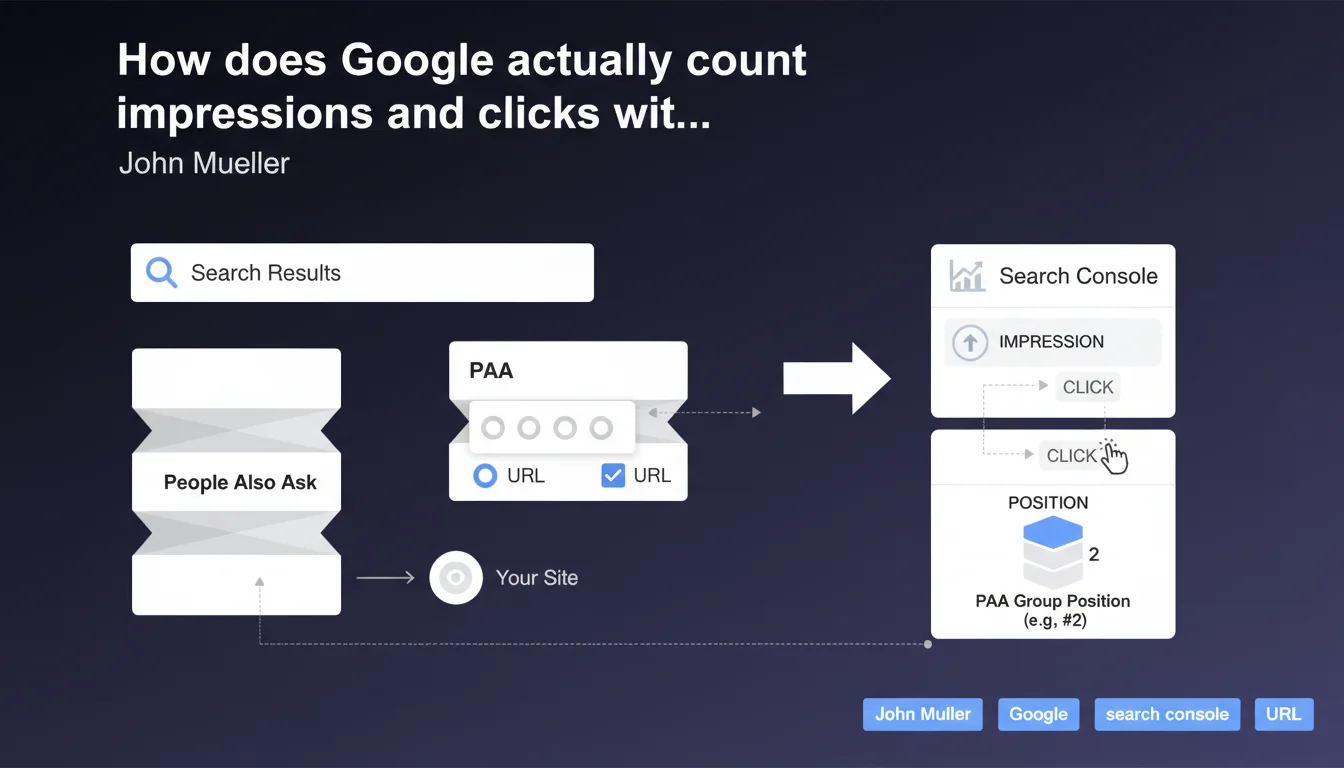
When a user expands a People Also Ask question and a URL from your site appears, Google records an impression in Search Console. A click counts as a standard click. The position assigned is that of the PAA block on the SERP, not your URL's position within that block.
What you need to understand
What exactly is an impression in the PAA context?
A PAA impression is triggered the moment the user clicks to expand a question and your URL appears in the results of that question. Unlike standard organic results that generate an impression as soon as they appear on screen, PAA requires user action.
This distinction changes the game for performance analysis. PAA impressions reflect active user engagement with the SERP, not passive exposure. Your content only becomes visible after an initial filter: interest in the question.
Why does the displayed position correspond to the PAA block rather than your internal ranking?
Google assigns all results from an expanded PAA question the position of the PAA block itself on the results page. If that block appears in position 3, all URLs that display within that question — whether they're first, second, or fifth — inherit this position 3.
This metric becomes difficult to exploit for comparing your performance across different PAA questions or for evaluating your "real" ranking. You could consistently appear last in every question yet still show a flattering average position if the PAA blocks are well-placed.
How does this mechanism impact Search Console analysis?
PAA data blends with standard organic impressions without clear distinction in Search Console's standard interface. Result: your CTR can appear abnormally low on certain queries without you understanding why.
High impressions with few clicks can signal strong PAA presence — where the user reads the answer directly in Google without clicking. This pattern requires qualitative analysis of your queries: are you mostly visible in PAA blocks that comprehensively answer the question, making clicks optional?
- PAA impression = user expands the question AND your URL appears
- Position displayed = PAA block's position on the SERP, not your ranking within the question
- Potentially diluted CTR by PAA impressions that rarely generate clicks
- No native distinction between organic impressions and PAA in Search Console
SEO Expert opinion
Does this position metric have real operational value?
Let's be honest: this aggregated position is misleading. It hides your real performance within PAA blocks. You could consistently dominate the top spot in every expanded question or languish at the bottom — the Search Console metric would be identical.
For serious auditing, you need to cross-reference this data with third-party tools that capture PAA blocks and their content. [To verify] through regular crawls or advanced rank tracking solutions capable of disaggregating PAA positions. Google doesn't facilitate this granularity, which limits the strategic exploitation of this data.
Does the impression trigger at opening really change the game?
Yes, and it's crucial for understanding certain traffic anomalies. A query can generate hundreds of standard organic impressions (simple display) but only a few PAA impressions (active expansion). The impressions-to-clicks ratio becomes then difficult to compare.
This also means a URL well-positioned in a rarely-expanded PAA will have ridiculous impressions, even if the query has significant search volume. It's not a relevance or ranking problem — it's a user behavior problem regarding this specific SERP.
Can you really isolate PAA performance in Search Console?
Not directly through the native interface. You can suspect strong PAA presence when you observe abnormally low CTR on informational queries with many impressions and a good average position (say 2-4).
Some practitioners export Search Console data and cross-reference it with regular SERP scrapes to identify which queries trigger which PAA blocks. It's tedious, but it's the only way to get a clear picture. [To verify] that Google doesn't enrich this granularity in the future — for now, nothing is planned publicly.
Practical impact and recommendations
What should you concretely monitor in Search Console?
Spot queries with high impression volume, low average position (3-6) and abnormally low CTR (< 2%). This often signals PAA presence where users find their answer without clicking.
Also analyze sudden impression fluctuations on informational queries: Google frequently adds or removes PAA blocks depending on context. A drop in impressions may signal your URL was ejected from a popular PAA, not necessarily standard organic degradation.
How do you optimize to maximize clicks from PAA blocks?
Adapt your title tags and meta descriptions so they remain attractive even in a PAA context. The user has already seen an answer excerpt — your snippet should promise deeper insight or a complementary angle.
Structure your content to partially answer the question in the first 150 words (what Google will extract) but encourage clicking to get full context, examples, and data. Don't give everything away in the visible excerpt.
What interpretation mistakes should you absolutely avoid?
Never directly compare the CTR of a page appearing in PAA blocks with that of a page in standard organic results. These are two radically different exposure mechanisms. A PAA page with 1% CTR can be perfectly performing if the consultation context favors reading directly in Google.
Also avoid concluding that a "good average position" in Search Console means optimal visibility. If that position comes mostly from PAA blocks in position 3, but your URL only appears in 5th position within each expanded question, your real visibility is poor.
- Export Search Console data regularly and filter by informational queries
- Cross-reference with a rank tracking tool capable of capturing PAA blocks
- Identify queries with high impression volume + low CTR + average position 2-5
- Manually or automatically scrape relevant SERPs to validate PAA presence
- Adjust snippets to promise added value beyond the visible excerpt
- Monitor impression fluctuations to detect PAA additions/removals
- Segment performance analysis: standard organic vs suspected PAA
❓ Frequently Asked Questions
Pourquoi mon CTR est-il très faible alors que ma position moyenne est bonne ?
Est-ce que toutes les URLs d'une question PAA ont la même position dans Search Console ?
Comment identifier précisément quelles requêtes génèrent des impressions PAA ?
Une chute d'impressions sur une requête informationnelle signifie-t-elle forcément une perte de classement ?
Faut-il optimiser différemment pour apparaître dans les PAA ?
🎥 From the same video 14
Other SEO insights extracted from this same Google Search Central video · published on 05/03/2022
🎥 Watch the full video on YouTube →
💬 Comments (0)
Be the first to comment.