
Official statement
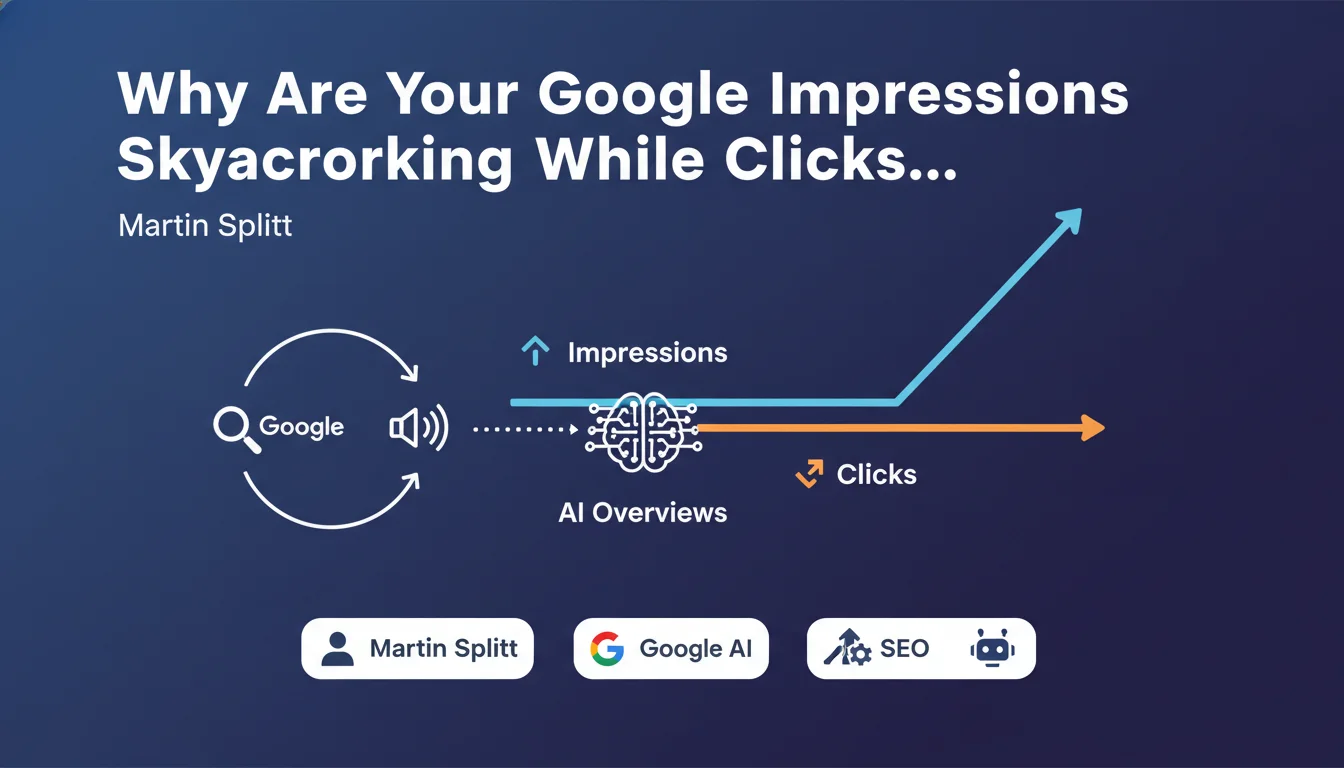
During the Google Search Central Live 2025 event in Warsaw, Martin Splitt confirmed this observation by presenting a graph that perfectly illustrates this disconnect. He explained that if your content appears in AI-enhanced answers, your impressions will likely increase, but clicks may stagnate or decline. However, he nuances this: those rare clicks would be more qualified and more likely to generate a conversion, even if that conversion occurs outside the traditional search journey, which complicates attribution.
Martin Splitt nevertheless acknowledges that some interpretations lack context and that his observations sometimes rely primarily on personal impressions. He anticipates, however, that conversion tracking will become more complex as AI transforms the search experience.
What you need to understand
Google officially acknowledges the existence of the phenomenon dubbed "The Great Decoupling" by Darwin Santos. This term describes a major rupture between two historically correlated metrics: impressions and clicks.
With the massive rollout of AI Overviews (AI-generated answers directly in the SERPs), websites appear in more results without necessarily receiving more traffic. The AI answers users' questions directly, reducing the need to click.
Martin Splitt, representing Google, presented data confirming this trend during an official event. He specifies, however, that the clicks obtained would be more qualified, with better conversion potential, even though the user journey becomes more difficult to track.
- Impressions increase significantly when your content feeds AI Overviews
- Click-through rate (CTR) stagnates or decreases proportionally
- Generated clicks show better intent and quality
- Conversion attribution becomes more complex with these new journeys
- Google acknowledges that some interpretations still lack consolidated data
SEO Expert opinion
This official confirmation validates what many SEO practitioners have been observing for several months in their analytics. The correlation between visibility and traffic is progressively breaking down, forcing a complete rethinking of traditional organic search KPIs.
Google's argument about better click quality deserves to be nuanced. While it's true that users who click after consulting an AI Overview may be better informed, this doesn't always mathematically compensate for the volumetric traffic loss, particularly for sites monetized through advertising or whose model relies on volume.
Martin Splitt's admission regarding his "personal impressions" and the lack of context on certain data is revealing: even Google is still navigating blindly on the real impacts of this transformation. The most affected sectors are those offering simple factual answers (recipes, definitions, basic tutorials) while in-depth expertise or transactional content resists better.
Practical impact and recommendations
Facing this new reality confirmed by Google, here are the priority actions to implement to adapt your SEO strategy:
- Audit your Search Console data to identify queries where your impressions increase but your CTR drops drastically
- Reorient your content strategy toward complex, nuanced, or expert topics that AI cannot simply summarize
- Develop high-value content: case studies, in-depth analyses, proprietary data, expert opinions
- Strengthen your conversion tracking with multi-touch attribution models to capture indirect journeys
- Optimize your meta descriptions and titles to maximize CTR on remaining clicks (they are more valuable)
- Integrate clear differentiation elements: exclusive data, interactive tools, original visuals
- Diversify your traffic sources: don't put all your eggs in the organic Google basket (newsletter, social media, partnerships)
- Monitor your engagement and conversion metrics rather than raw traffic volume
- Test rich formats (videos, infographics, calculators) less easily summarizable by AI
- Reassess your keyword strategy by favoring transactional and complex informational queries
💬 Comments (0)
Be the first to comment.