
Official statement
Other statements from this video 14 ▾
- □ How does Google actually count impressions and clicks within People Also Ask blocks?
- □ Do links from a subdomain to the main domain carry less SEO value?
- □ Can an invalid AMP page still be indexed by Google?
- □ Are massive footer links really killing your site's context?
- □ Should you disable automatic links to boost your SEO performance?
- □ Is hidden text still a problem for SEO in 2024?
- □ Why does Google refuse to index some of your pages?
- □ Can a handful of untagged affiliate links really escape Google penalties?
- □ Why do your images never appear in Google Images despite solid SEO performance?
- □ Why does Google insist that sitemaps should never be your only safety net?
- □ Should you really be using canonicals on your filtered internal search pages?
- □ Can Core Web Vitals Really Tank Your Rankings by 48 Positions?
- □ Why does the schema.org validator contradict Google's tools?
- □ Does Google really ignore language URL parameters without warning?
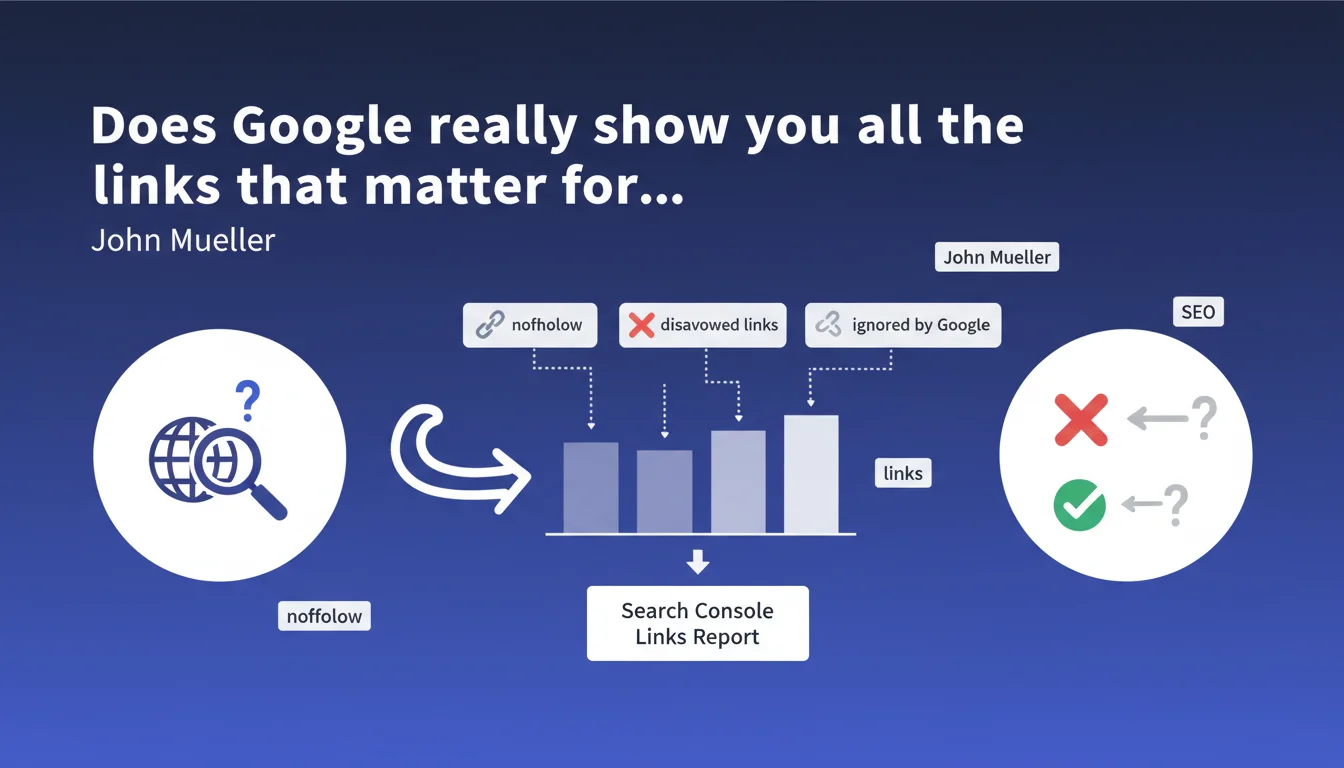
The Search Console links report displays all links known by Google, including those with no impact on your rankings: nofollow links, disavowed links, or simply ignored ones. The presence of a link in this report guarantees neither its relevance nor its usefulness for your search visibility.
What you need to understand
What does the Search Console links report really show you?
This report lists every single link discovered by Google pointing to your site, without any qualitative distinction. This means a high-quality backlink from a recognized media outlet appears at the same level as a spam link you've disavowed or a nofollow link from an obscure forum.
Google makes no filtering in the display. The report is a comprehensive view of your link landscape, not an evaluation of their SEO value. This is a crucial distinction that many practitioners still overlook.
Why does Google display links with no SEO value?
The logic is straightforward: maximum transparency. Google wants to show you everything it sees, even what it subsequently ignores in its ranking algorithms. A disavowed link is still technically detected by crawlers, even if it's neutralized at the popularity calculation level.
This approach also helps identify spam patterns or negative SEO attacks. If you suddenly see hundreds of suspicious links, you can react before a Google manual review examines your profile.
What's the difference between detection and consideration?
A link can be present in Search Console for three distinct reasons: it's indexed and valued, it's indexed but ignored (nofollow, irrelevant context), or it's neutralized (disavowed). Only the first category actually influences your domain authority.
The problem is that Search Console doesn't tell you which category each link falls into. You must do this sorting yourself by cross-referencing with your disavow files and analyzing link attributes.
- The report displays all links discovered by Google, without qualitative filtering
- Nofollow links, disavowed links, and ignored links appear at the same level as active links
- The presence of a link guarantees no impact on rankings
- No SEO value indication is provided in the interface
- This report primarily serves link profile monitoring, not performance evaluation
SEO Expert opinion
Is this statement consistent with real-world observations?
Absolutely. We've seen for years that Search Console lists clearly toxic links already disavowed, or thousands of nofollow backlinks with zero measurable effect on rankings. It's frustrating for anyone trying to quickly assess backlink quality.
The problem is that this exhaustiveness muddies strategic reading. A client discovering 50,000 links in their report might believe they have an exceptional profile, when 95% of these links are worthless. You systematically need to use third-party tools (Ahrefs, Majestic, Semrush) to get qualitative evaluation.
Why doesn't Google offer a quality filter?
Let's be honest: Google has all the data needed to score each link. But publicly displaying this rating would mean revealing part of the algorithm. Spammers would immediately have the keys to optimize their artificial link schemes.
There's also a legal dimension: if Google officially labels a link as "bad," it exposes itself to disputes. By staying neutral — "we show you everything, you judge" — it protects itself. [To verify]: no official documentation confirms this hypothesis, but it aligns with Google's general policy on partial transparency.
In what cases is this report still useful despite these limitations?
For monitoring negative SEO attacks, it's irreplaceable. A sudden explosion in detected link volume is an immediate warning signal. Even if these links have no value, their proliferation can attract a manual reviewer's attention.
Second use: identifying disavowal opportunities. Even though a nofollow link theoretically has no impact, certain toxic contexts (hacked sites, massive spam networks) justify preventive disavowal. The Search Console report lets you cross-reference this data with your cleanup files.
Practical impact and recommendations
How do you correctly interpret the displayed link volume?
Never trust the raw number. A site with 500 quality links consistently outperforms a site with 50,000 mediocre links. Start by exporting the entire report and segmenting the data: dofollow links, unique referring domains, distribution by site type.
Then cross-reference with your third-party tools to obtain a quality index per domain (Trust Flow, Domain Rating, etc.). Only after this dual analysis can you evaluate the real health of your backlink profile.
Should you disavow nofollow links appearing in the report?
In most cases, no. A nofollow link is already ignored by Google at the popularity transfer level. Disavowing it is redundant. Reserve your disavow file for toxic dofollow links you can't remove manually.
Exception: if you notice a massive spam network pointing to you with nofollow links, and this pattern could be interpreted as an attempt at manipulation, preventive disavowal may be justified. But this is rare.
What monitoring routine should you establish?
Check the report at least once monthly to detect abnormal variations. A sudden 20% increase in a few days warrants investigation. Automate export via the Search Console API if you manage multiple sites.
Systematically compare with your third-party tools. If Search Console shows 10,000 links but Ahrefs only 3,000, Google is detecting spam that other crawlers don't index. It's a weak signal but an interesting one.
- Export the full report and segment by attribute (dofollow/nofollow)
- Cross-reference with a third-party tool to score the quality of each referring domain
- Never trust the raw volume displayed in the interface
- Monitor monthly variations to detect attacks or unexpected gains
- Only disavow toxic dofollow links you can't remove manually
- Document your disavowals to avoid duplicates when updating your file
- Set up automatic alerts if your link volume varies by more than 15% in a week
❓ Frequently Asked Questions
Un lien nofollow dans Search Console a-t-il un impact SEO ?
Pourquoi certains liens désavoués apparaissent-ils encore dans le rapport ?
Comment savoir quels liens ont vraiment de la valeur dans ce rapport ?
Faut-il s'inquiéter d'un volume élevé de liens dans Search Console ?
Le nombre de liens dans Search Console correspond-il à celui d'Ahrefs ou Majestic ?
🎥 From the same video 14
Other SEO insights extracted from this same Google Search Central video · published on 05/03/2022
🎥 Watch the full video on YouTube →
💬 Comments (0)
Be the first to comment.