
Official statement
Other statements from this video 11 ▾
- □ Is Google really replacing traditional blue links with enriched features—and what does that mean for your organic visibility?
- □ Does Google really remove search features based on clicks alone?
- □ Does Google really prioritize user satisfaction, or is maximizing ad revenue the hidden agenda?
- □ Does Google really measure your page's satisfaction through repeated searches?
- □ How does Google decide which features are worth evaluating in its algorithm?
- □ Does Google really sacrifice SEO features just to cut infrastructure costs?
- □ Is Google really demanding more and more work from website owners indefinitely?
- □ Should you really be happy when Google removes SEO features?
- □ Does Google really roll out algorithm changes all at once, or are they tested gradually on live traffic?
- □ Does Google really have to publicly announce every SEO feature it removes?
- □ Does Google really limit search results to just one per domain?
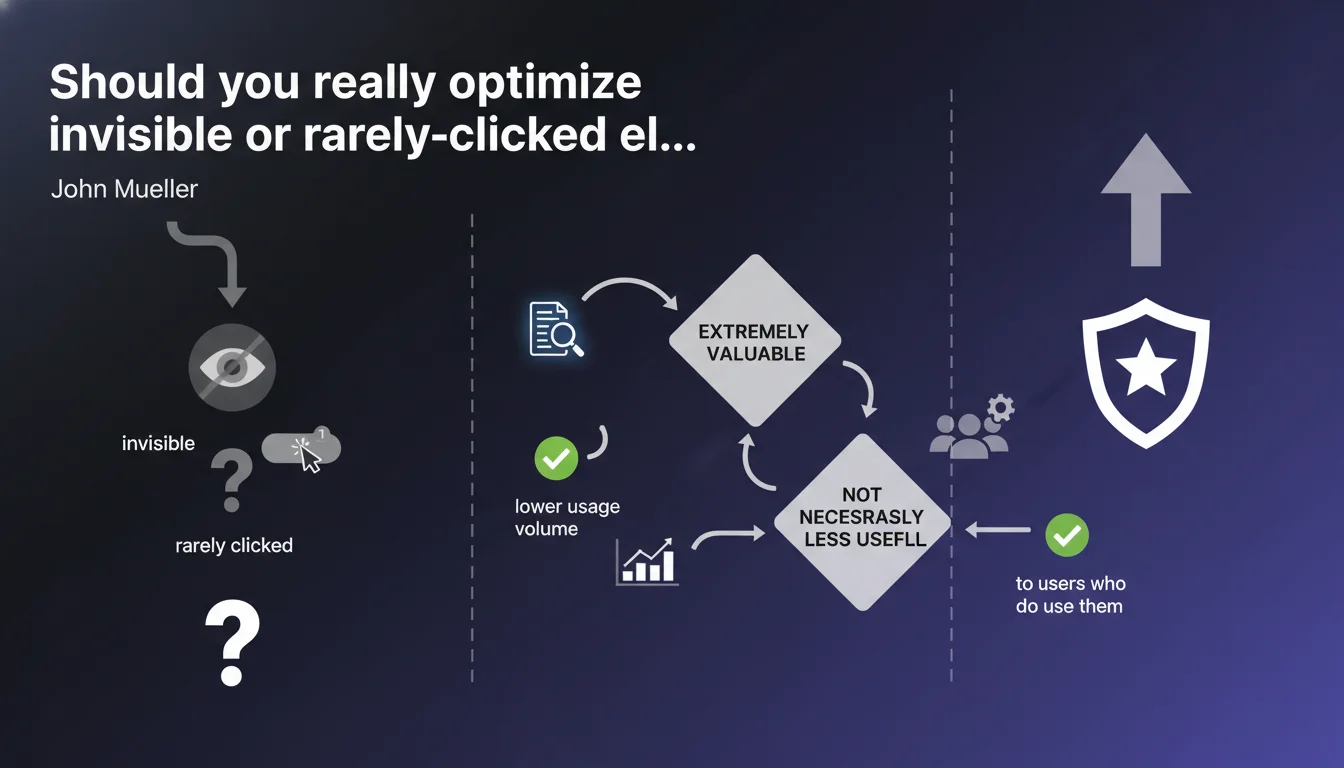
Google asserts that low-visibility or rarely-used page features are no less valuable for that reason. Even if a section generates minimal interactions, it can deliver significant value to users who need it. Concrete takeaway: don't sacrifice your page's functional richness for the sake of raw engagement metrics.
What you need to understand
Why does Google defend low-visibility elements?
Mueller is responding here to a recurring concern: optimization focused on click-through rates and heatmap hotspots. Many SEO practitioners, influenced by UX analytics, tend to remove or deprioritize everything that sits below the fold or generates minimal measurable interactions.
Google's message is clear — an element with few clicks isn't necessarily useless. It can address a niche need, serve a specific user journey, or function as an informational safety net. A page's value doesn't boil down to its hotspots alone.
What's the algorithmic logic behind this position?
Google evaluates the overall quality of a page, not just the areas generating the most clicks. Comprehensive content, even with less-consulted sections, can outperform minimalist content ultra-optimized for engagement. The algorithm seeks to reward completeness and the ability to address different levels of user need.
Concretely, a detailed FAQ at the bottom of a page, a "Technical Specifications" section, or rarely-used advanced filters can improve how your page is perceived as a reference resource — even if 90% of visitors never scroll that far.
What does this change for content architecture?
This declaration challenges the obsession with above-the-fold content and ultra-minimalist optimization techniques. It validates the "rich, structured content" approach over "short content hyperfocused on engagement metrics".
- Low-visibility or rarely-clicked elements don't penalize your page if they provide functional value
- Comprehensiveness and depth can outweigh raw engagement in algorithmic evaluation
- Google values a page's ability to address diverse needs, even minority ones
- Don't sacrifice informational richness for superficial UX metrics
SEO Expert opinion
Is this statement consistent with what we observe in practice?
Yes and no. In practice, we do see that pages rich in "dormant" content — like exhaustive technical guides with rarely-consulted advanced sections — often outperform their simplified equivalents. Dwell time and satisfaction signals are generally better on comprehensive content.
But — and this is where it gets sticky — this logic only works if the architecture remains coherent. A footer bloated with useless links, invasive promotional widgets, or self-referential modules get no free pass just because they're "low-visibility." Google knows how to distinguish between useful sections and filler.
What nuances should we add to this claim?
Mueller doesn't specify the typology of elements in question, and that's a problem. Are we talking about editorial content, interactive features, navigation links, third-party modules? The answer changes depending on the case.
A technical specifications table at the bottom of a product page? Probably valued. A sidebar crammed with social media widgets or auto-generated "related articles"? [To be verified] — nothing proves Google extends the same goodwill to these elements. The distinction between "low-visibility but useful" and "low-visibility and useless" remains blurry.
Another point: this statement says nothing about crawl budget costs. An excess of low-relevance content, even well-intentioned, can dilute relevance signals and complicate Googlebot's work. Balance is still needed.
In which cases does this rule not apply?
Let's be honest: this statement doesn't justify blindly keeping every underperforming element. If a section generates zero interaction and provides no measurable informational value, it's still a cleanup candidate. The argument "Google says it's useful" doesn't hold if real usage shows otherwise.
Typical cases where you should still cut: invasive ad modules that tank Core Web Vitals, duplicate or auto-generated content with no added value, redundant navigation elements that create semantic noise. Mueller's rule applies to functionally justified elements — not technical or marketing artifacts.
Practical impact and recommendations
What should you actually do with this information?
First action: audit your removal decisions based solely on heatmaps or click rates. If you've cut sections because they were "rarely viewed," check whether they offered informational or functional value to a user segment. In some cases, their absence may have undermined your pages' perceived completeness.
Second reflex: don't rely exclusively on engagement metrics to judge a section's relevance. A detailed FAQ might be rarely clicked but reassuring — it builds trust without generating measurable interaction. Same logic for comparison tables, technical appendices, embedded glossaries.
Which mistakes should you avoid when optimizing content?
Classic mistake: systematically removing everything below the fold on the grounds that "no one scrolls down there." That's a superficial reading of analytics. The problem isn't always position, but relevance and discoverability of the information.
Another trap: confusing "low-visibility element" with "poorly integrated element." Useful content that's poorly structured, poorly titled, or poorly accessible will remain underused. Before deleting it, test better visibility, menu anchoring, or section title reformulation.
Finally, never sacrifice technical performance in the name of comprehensiveness. A content-rich module that loads 2 MB of scripts or causes layout shift remains a drag — even if it offers theoretical value.
How do you verify that your pages are leveraging this principle effectively?
- Identify rarely-viewed sections via analytics and assess their real functional value (not just their click rate)
- Test the impact of removing these sections on satisfaction metrics (bounce rate, session time, assisted conversions)
- Ensure that "useful but invisible" elements are truly accessible (anchors, table of contents, internal search)
- Optimize HTML structure so Google understands the hierarchy and relevance of each section (semantic markup, structured data)
- Monitor Core Web Vitals: rich content should never justify performance degradation
- Document your editorial choices — if a section is kept despite low usage, note why (niche need, SEO value, perceived completeness)
❓ Frequently Asked Questions
Un élément en bas de page a-t-il le même poids SEO qu'un élément visible immédiatement ?
Faut-il conserver des fonctionnalités peu utilisées si elles alourdissent la page ?
Comment savoir si un élément peu cliqué est vraiment utile ?
Google valorise-t-il les pages longues et exhaustives par rapport aux pages courtes ?
Les FAQ en bas de page sont-elles encore utiles pour le SEO ?
🎥 From the same video 11
Other SEO insights extracted from this same Google Search Central video · published on 07/11/2023
🎥 Watch the full video on YouTube →
💬 Comments (0)
Be the first to comment.