
Official statement
Other statements from this video 11 ▾
- □ Pourquoi Google multiplie-t-il les fonctionnalités enrichies au détriment des liens bleus classiques ?
- □ Google retire-t-il des fonctionnalités de recherche uniquement en fonction des clics ?
- □ Faut-il vraiment optimiser les éléments invisibles ou peu cliqués sur une page ?
- □ Google mesure-t-il la satisfaction de vos pages via les recherches répétées ?
- □ Comment Google choisit-il les fonctionnalités à prioriser dans son algorithme ?
- □ Google sacrifie-t-il certaines fonctionnalités SEO pour des raisons de coût technique ?
- □ Google peut-il continuer d'exiger toujours plus de travail aux propriétaires de sites ?
- □ Faut-il se réjouir quand Google retire des fonctionnalités SEO ?
- □ Comment Google déploie-t-il réellement ses changements d'algorithme ?
- □ Google est-il obligé d'annoncer publiquement le retrait de toutes ses fonctionnalités SEO ?
- □ Google limite-t-il vraiment ses résultats à un seul par domaine ?
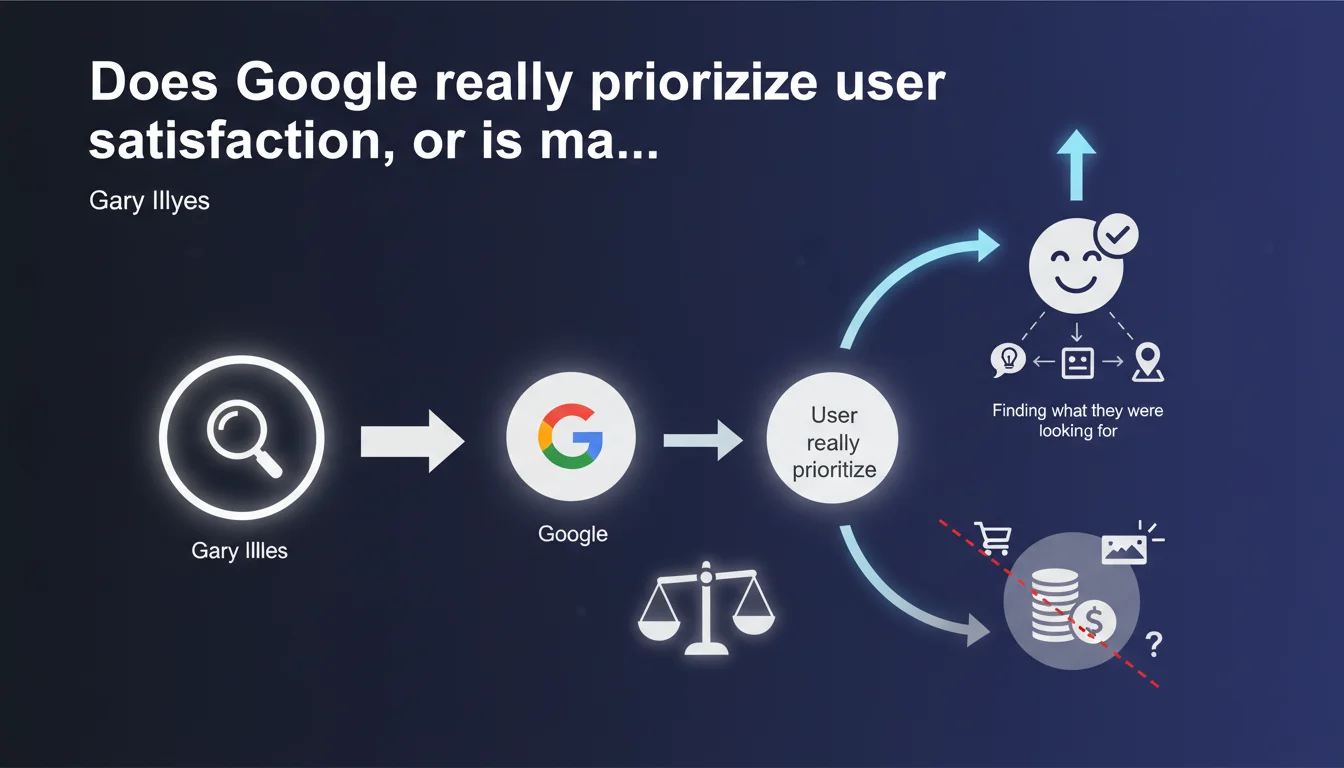
Gary Illyes claims that Google's ultimate goal is user satisfaction: helping internet users find what they're looking for. A seductive principle in theory, but one that deserves to be tested against the reality of today's SERPs, caught between ads, featured snippets, and zero-click results.
What you need to understand
What does "user satisfaction" really mean to Google?
User satisfaction according to Google is measured by a simple criterion: did the internet user find what they were looking for? Whether it's a chocolate cake recipe or technical information on a niche topic, the goal is for the user to leave satisfied with their search experience.
This definition seems crystal clear. But it hides a formidable complexity: how does Google determine that a user is satisfied? Through behavioral signals: time spent on the page, rate of return to the SERPs, multiple clicks or immediate end of search.
Why does this statement remain deliberately vague?
Gary Illyes doesn't specify the exact metrics used to measure this satisfaction. Dwell time? Pogo-sticking? Click-through rate? Navigation depth? Nothing concrete.
This vagueness is no accident. Google protects its algorithms, but more importantly, the notion of satisfaction varies depending on the type of query. A short informational search is completely different from a complex transactional intent.
How does this vision influence the ranking algorithm?
If user satisfaction is the ultimate goal, then Google favors content that answers quickly and precisely the search intent. Goodbye to catch-all pages stuffed with keywords. Hello to structured, scannable content that gets straight to the point.
This explains the rise of featured snippets, quick answers, embedded videos. Google tries to reduce friction between the query and the answer — even at the risk of keeping the user in its ecosystem without ever clicking through to a third-party site.
- User satisfaction = central criterion declared by Google to evaluate search results relevance
- Google uses behavioral signals to estimate this satisfaction, without disclosing precise metrics
- This approach favors content that is fast, clear and directly aligned with search intent
- Featured snippets and enriched results are concrete manifestations of this strategy
SEO Expert opinion
Is this statement consistent with real-world practices?
In theory, yes. In practice, it's more nuanced. Google claims to want to satisfy users, but current SERPs show four ads at the top of the page, a featured snippet that directly answers the question, then organic results relegated below the fold. Where is the content editor's satisfaction in this equation? [To verify] that the satisfaction objective isn't a euphemism for "maximize time spent in the Google ecosystem."
Zero-click results are exploding: according to some studies, over 50% of searches end without a click to an external site. Google satisfies the user... by keeping them in-house. Hard to believe the objective is purely altruistic when you look at the rise of Google Ads and "People Also Ask" sections that capture attention.
What nuances should be added to this official discourse?
User satisfaction is not a binary concept. It depends on the context of the query: a navigational search ("Facebook login") has different expectations than an informational search ("how to optimize a website?"). Google adapts its criteria based on intent, but this adaptation remains opaque.
Another crucial point: the satisfaction measured by Google is not that of the content creator, but that of the internet user. If a user finds their answer in a featured snippet without clicking, Google considers the mission accomplished. For the site that produced the original content, it's a different story.
In what cases does this rule not really apply?
On queries with strong commercial intent, user satisfaction takes a back seat to monetization. Ads occupy visible space, and organic results only satisfy the user if... they scroll far enough. Let's be honest, Google is an advertising company before it's a philanthropic search engine.
Practical impact and recommendations
What should you actually do to align your content with this objective?
First step: understand the real intent behind each keyword you're targeting. Don't just look at search volume. Analyze the SERPs: does Google display a featured snippet? Videos? Related questions? This tells you the expected format to satisfy the user.
Next, structure your content for quick and efficient reading. Clear headings, short paragraphs, bullet points, comparison tables. The user must find their answer in less than 30 seconds. If your page reads like a novel, you're losing the user satisfaction battle.
What mistakes should you avoid so as not to disappoint Google (and the user)?
Stop over-optimizing for keywords at the expense of clarity. A page stuffed with artificial keyword repetition is the opposite of user satisfaction. Google spots these tactics and penalizes — maybe not immediately, but it eventually happens.
Another classic mistake: promise an answer in the title and drown the reader in generic content before getting to the point. If your H1 says "How to do X?", the answer must appear in the first 100 words, not after three vague introductory paragraphs.
How can you verify that your site meets this satisfaction criterion?
Check your behavioral metrics in Google Analytics and Search Console. High bounce rate? Very short average time on page? Low pages per session? All signals that the user isn't finding what they're looking for.
Compare your performance with competitors in the SERPs. Look at featured snippets: if they're capturing your traffic, it's because Google judges their format more satisfying. Get inspired, adapt, test.
- Analyze the intent behind each keyword you're targeting by studying current SERPs
- Structure content for quick reading: headings, lists, tables, short paragraphs
- Answer the question in the first 100 words, without unnecessary detours
- Monitor behavioral metrics (bounce rate, time on page, navigation depth)
- Avoid keyword over-optimization at the expense of clarity and flow
- Test different content formats to identify what generates the most engagement
Optimizing for user satisfaction means rethinking your entire editorial strategy: from intent analysis to content structuring, through rigorous performance tracking. It's a complex undertaking that requires cross-functional skills in writing, UX, data, and technical SEO.
If these optimizations seem time-consuming or difficult to manage in-house, the support of a specialized SEO agency may prove worthwhile. An outside perspective, proven methodologies, and personalized monitoring often unlock rapid and lasting visibility gains.
❓ Frequently Asked Questions
Google mesure-t-il vraiment la satisfaction utilisateur ou se base-t-il uniquement sur des signaux comportementaux ?
Un contenu long est-il nécessairement moins satisfaisant qu'un contenu court ?
Les featured snippets nuisent-ils au trafic organique tout en prétendant satisfaire l'utilisateur ?
Comment savoir si mon contenu satisfait réellement l'utilisateur selon les critères de Google ?
Google privilégie-t-il vraiment la satisfaction utilisateur sur les requêtes commerciales ?
🎥 From the same video 11
Other SEO insights extracted from this same Google Search Central video · published on 07/11/2023
🎥 Watch the full video on YouTube →
💬 Comments (0)
Be the first to comment.