
Official statement
Other statements from this video 11 ▾
- □ Pourquoi Google multiplie-t-il les fonctionnalités enrichies au détriment des liens bleus classiques ?
- □ Google retire-t-il des fonctionnalités de recherche uniquement en fonction des clics ?
- □ Faut-il vraiment optimiser les éléments invisibles ou peu cliqués sur une page ?
- □ Google cherche-t-il vraiment à satisfaire l'utilisateur ou à maximiser ses revenus publicitaires ?
- □ Comment Google choisit-il les fonctionnalités à prioriser dans son algorithme ?
- □ Google sacrifie-t-il certaines fonctionnalités SEO pour des raisons de coût technique ?
- □ Google peut-il continuer d'exiger toujours plus de travail aux propriétaires de sites ?
- □ Faut-il se réjouir quand Google retire des fonctionnalités SEO ?
- □ Comment Google déploie-t-il réellement ses changements d'algorithme ?
- □ Google est-il obligé d'annoncer publiquement le retrait de toutes ses fonctionnalités SEO ?
- □ Google limite-t-il vraiment ses résultats à un seul par domaine ?
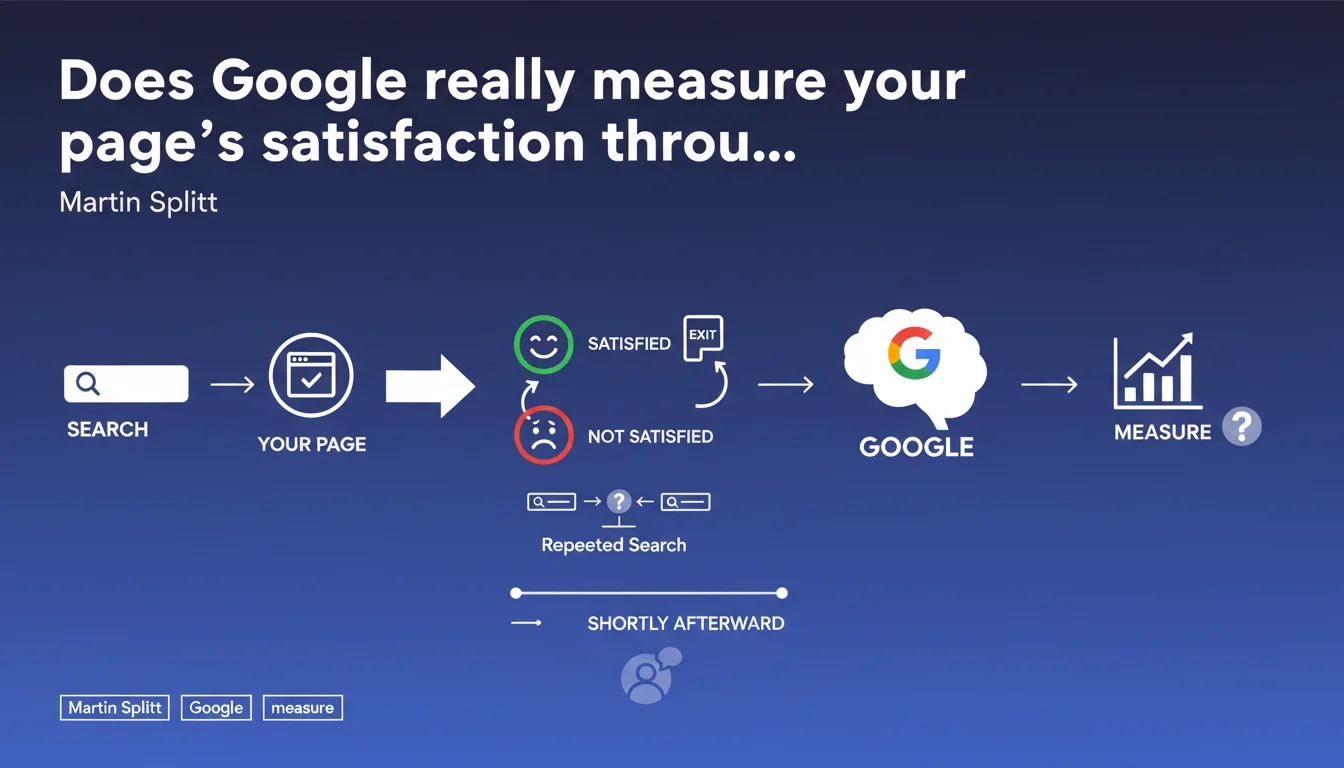
Google observes whether a user needs to reformulate their query shortly after an initial search to evaluate whether displayed results truly match their intent. A repeated search with similar intent potentially signals a failure of the functionality or content presented. This 'repeated search' signal thus serves to measure user satisfaction and can influence rankings.
What you need to understand
What does Google mean by 'repeated searches'?
When a user performs a search, reviews results, then comes back searching for something similar or complementary within a short time frame, Google considers this a dissatisfaction signal. The logic: if the first set of results had truly answered the intent, the user wouldn't have needed to reformulate.
This mechanism doesn't only concern traditional organic pages. Martin Splitt discusses it here in the context of SERP features (featured snippets, knowledge panels, quick answers, etc.). If a user sees an enriched excerpt but returns searching for the same information differently, Google can infer that the feature didn't fulfill its role.
Why does Google use this criterion?
Google constantly seeks to measure user satisfaction to refine its algorithm. Clicks, time spent on a page, bounce rate are known behavioral signals — but rapid query reformulation is a particularly strong indicator of failure.
If a user clicks on your result then immediately returns to type a variation of their question, this can signal that your content didn't provide the expected answer. Google thus tests the effectiveness of its editorial choices (which result to place in position 1, which feature to display) by observing these behaviors at scale.
Does this signal directly impact ranking?
Splitt remains vague on this point — as usual. He speaks of 'satisfaction measurement' for a feature, not explicitly a ranking factor. But let's be honest: if Google detects that a result systematically generates repeated searches, it's logical that this signal would influence positioning over time.
It's probably not an isolated factor that makes or breaks a ranking, but rather an element of a broader set of behavioral signals that Google aggregates to evaluate a page's or feature's relevance. The algorithm seeks to detect patterns: content that regularly triggers rapid reformulation will likely rank lower than a competitor satisfying intent immediately.
- Repeated search = dissatisfaction signal for Google
- Used to evaluate the effectiveness of SERP features (featured snippets, etc.)
- Can indirectly influence organic ranking if the pattern repeats
- Google measures this signal at scale, not from single sessions
- The goal: refine results to better match initial intent
SEO Expert opinion
Is this statement consistent with real-world observations?
Yes, absolutely. For years, SEO professionals have observed that pages that retain users (low pogo-sticking, high visit duration) perform better in the SERPs. The concept of 'repeated search' is simply another way of naming this phenomenon: the user who bounces back quickly to reformulate their query clearly didn't find what they were looking for.
What's interesting here is that Splitt explicitly confirms Google uses this signal to evaluate its own features. If a featured snippet generates many reformulations, Google might decide to remove or replace it. This means that even if you're in position 0, your content must be immediately satisfying — otherwise Google can remove you in favor of a competitor.
What nuances should be noted?
Splitt doesn't specify what timeframe Google considers as 'shortly after'. A reformulation 10 seconds later doesn't have the same meaning as a similar search 2 hours later. The ambiguity remains — and it's frustrating for those seeking to optimize precisely.
Another point: some search intents are naturally iterative. A user comparing products will logically chain several similar queries. Google must therefore have mechanisms to distinguish legitimate exploratory search from a true dissatisfaction signal. [To verify]: how does the algorithm make this distinction in practice? We lack concrete data.
In what cases does this rule not apply?
For complex informational queries, users may legitimately consult multiple sources before finding satisfaction. Google likely knows that certain topics (medical, legal, technical) require thorough research. The 'repeated search' signal must therefore be weighted according to query type.
Similarly, if a user clicks on your page, spends 5 minutes there, then returns searching for additional information, it's not necessarily a negative signal. Google might interpret this as a multi-step search, not as a failure of your content. It all depends on the overall behavioral context.
Practical impact and recommendations
What should you do concretely to limit repeated searches?
The goal is simple: answer immediately and completely to search intent. If users find everything they're looking for on your page, they have no reason to return to Google to reformulate their query. This involves clear content structure, a direct answer from the introduction, and well-organized supplements.
Analyze your pages that generate traffic but little engagement. If you observe high bounce rate combined with low visit duration, it's probably because your content doesn't satisfy intent. Google detects this too — and it can explain ranking stagnation despite a strong link profile.
What mistakes should you avoid?
Don't fall into the SEO clickbait trap: a catchy title that promises an answer but delivers vague or off-topic content. You'll generate clicks, but users will leave immediately to search elsewhere. Google will record this pattern and gradually penalize you.
Also avoid endless introductions that bury the answer in fluff. If someone searches 'how to reset an iPhone', they want the procedure in 3 lines, not a 5-paragraph history of Apple. The longer you delay the answer, the more the user risks returning to Google.
How can you verify your content satisfies intent?
Use Google Search Console to cross-reference CTR with engagement rate (if you've properly configured GA4). A page with good CTR but low engagement is suspicious. Then dig into behavioral data: average time, pages per session, scroll events.
Also test your pages in private browsing to see what results Google displays around you. If you're in a featured snippet but users still click on other results, your excerpt isn't sufficient. Expand it or rephrase to better capture intent.
- Place the main answer in the introduction, without detours
- Structure content with clear subheadings to facilitate visual scanning
- Add complementary information to cover related intents
- Analyze bounce rate and visit time in Search Console and GA4
- Test your pages in private browsing to verify relevance vs competitors
- Optimize featured snippets so they completely answer the question
- Monitor frequent reformulations in your internal search logs (if available)
❓ Frequently Asked Questions
Google pénalise-t-il directement les pages qui génèrent des recherches répétées ?
Quel délai Google considère-t-il comme 'peu de temps après' pour une recherche répétée ?
Ce signal s'applique-t-il uniquement aux fonctionnalités SERP ou aussi aux résultats organiques classiques ?
Comment savoir si mon site génère beaucoup de recherches répétées ?
Les recherches exploratoires (comparaisons de produits, etc.) sont-elles considérées comme des recherches répétées négatives ?
🎥 From the same video 11
Other SEO insights extracted from this same Google Search Central video · published on 07/11/2023
🎥 Watch the full video on YouTube →
💬 Comments (0)
Be the first to comment.