
Official statement
What you need to understand
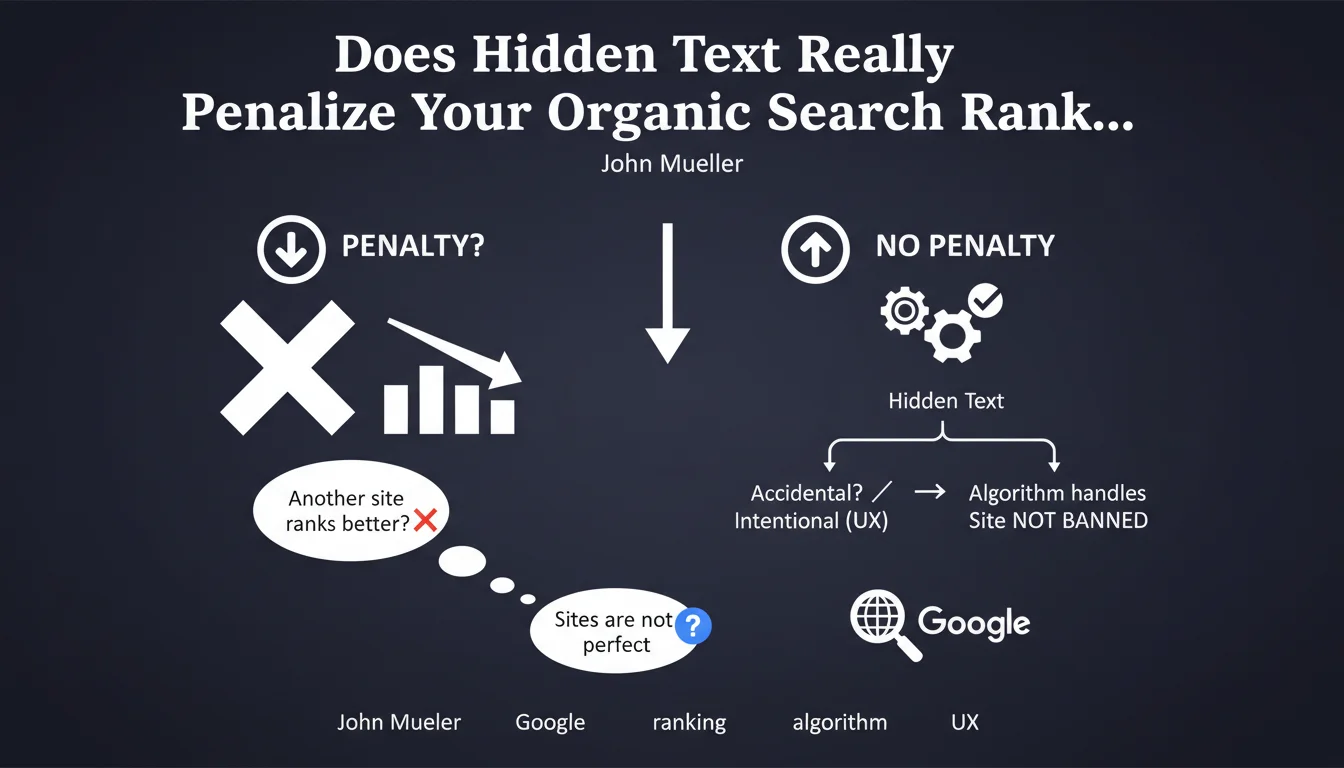
Google has officially clarified its position regarding hidden text on web pages. Contrary to a persistent misconception in the SEO community, the presence of masked text does not automatically constitute a penalty factor.
The nuance is crucial: a competing site will not outrank you solely because it uses hidden text. Similarly, your site will not be banned from Google simply for incorporating textual elements that are not immediately visible.
Google acknowledges that many sites contain hidden text accidentally or intentionally, often for legitimate user experience reasons. The algorithms are designed to handle these imperfections pragmatically.
- Hidden text is not a positive or negative ranking criterion in itself
- The algorithms assess the intent behind content masking
- Overall site quality takes precedence over technical imperfections
- The context and reason for masking are determining factors
- A technically imperfect site can outrank a technically perfect site
SEO Expert opinion
This statement reflects a mature evolution in Google's algorithmic approach. In fifteen years of experience, I've observed that penalties are never triggered by a single isolated factor, but by a cluster of manipulation indicators.
Google's position is consistent with what we see in the field. Sites using accordions, tabs, or dropdown menus rank excellently, even though these elements technically hide content. Intent matters more than pure technique.
However, an important nuance: if hidden text explicitly aims to keyword stuff or deceive users, spam detection algorithms may intervene. The boundary between legitimate UX optimization and manipulation remains the discriminating criterion.
Practical impact and recommendations
This clarification allows for a more relaxed approach to interface choices without systematically fearing a penalty. Here are the concrete actions to implement:
- Use modern UX solutions (accordions, tabs, dropdown menus) without fear for your SEO
- Ensure that hidden content genuinely serves the user experience, not just SEO
- Verify that hidden content remains consistent with the visible content on the page
- Absolutely avoid white text on white background or obvious masking techniques
- Document your architectural choices: each masked element must have a clear UX justification
- Test the mobile version where collapsible content is an ergonomic standard
- Prioritize overall content quality rather than focusing on this technical detail
- Regularly audit your site to identify any text accidentally hidden by CSS errors
In summary: Hidden text is only problematic when it clearly serves to manipulate algorithms. Focus your efforts on creating quality content and an optimal user experience.
Implementing these best practices requires a deep understanding of the technical and semantic signals that Google interprets. Balancing SEO optimization, user experience, and technical compliance can prove delicate to calibrate. For a tailored strategy that maximizes your visibility while respecting these evolving guidelines, support from a specialized SEO agency can help you confidently navigate these gray areas and prioritize high-impact optimizations.
💬 Comments (0)
Be the first to comment.