
Official statement
Other statements from this video 12 ▾
- □ Pourquoi Google indexe-t-il uniquement avec un user agent mobile ?
- □ Comment Google Search Console peut-elle vraiment diagnostiquer vos problèmes d'indexation mobile ?
- □ Faut-il vraiment utiliser un sitemap et Google Merchant Center pour être correctement indexé ?
- □ Pourquoi la vitesse mobile reste-t-elle le talon d'Achille de la plupart des sites web ?
- □ Pourquoi PageSpeed Insights combine-t-il données de laboratoire et données terrain ?
- □ Le rapport d'utilisabilité mobile de la Search Console est-il vraiment suffisant pour optimiser son site ?
- □ Le Mobile Friendly Test détecte-t-il vraiment les problèmes qui impactent votre SEO mobile ?
- □ Un design mobile simplifié suffit-il vraiment pour tous les écrans ?
- □ Pourquoi les différences mobile/desktop ruinent-elles votre stratégie e-commerce ?
- □ Le responsive web design est-il toujours la meilleure stratégie pour le SEO cross-device ?
- □ Faut-il vraiment afficher tout son contenu en version mobile pour bien se positionner ?
- □ Le défilement infini tue-t-il vraiment l'exploration de vos pages produits ?
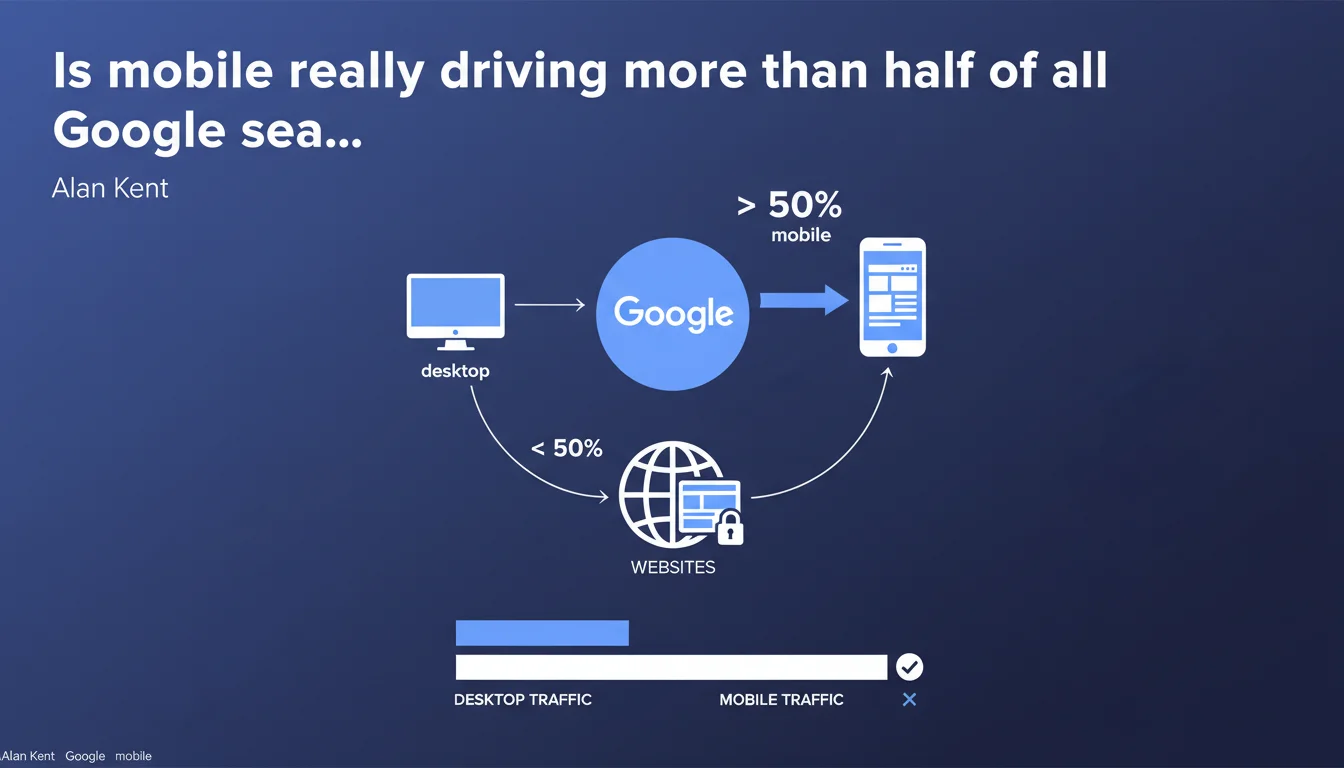
More than 50% of the traffic sent by Google to websites comes from mobile devices. This statement from Alan Kent confirms the dominance of mobile in search, making mobile optimization no longer optional but essential to capture the majority of potential traffic.
What you need to understand
What does this statistic reveal about user behavior?
The shift is definitive: more than one in two searches on Google happen from a smartphone or tablet. This figure includes the traffic that Google actually sends to websites, not just mobile queries alone.
This data has a direct implication — if your site isn't optimized for mobile, you're potentially losing more than half your audience before they even land on your pages. Mobile is no longer a secondary channel; it's the primary channel.
How does Google treat mobile and desktop differently?
Since the shift to mobile-first indexing, Google uses your site's mobile version as the priority for indexing and ranking. If your mobile version is broken, that's the version Googlebot analyzes first.
In practice? Content missing or hidden on mobile, broken navigation, catastrophic load times — all of this directly impacts your overall search visibility, even for desktop searches.
What's the difference between mobile traffic and mobile optimization?
Be careful not to confuse traffic volume with user experience quality. Just because 50% of traffic comes from mobile doesn't mean those users convert as well as desktop users.
Mobile optimization goes far beyond basic responsive design: load speed, touch-friendly interface, simplified user journey, non-intrusive ad formats. A site that's "mobile-friendly" according to Google can still fall short on actual user experience.
- More than 50% of Google traffic comes from mobile — that's the majority of your potential audience
- Mobile-first indexing: Google indexes and ranks your site primarily through its mobile version
- Mobile optimization goes beyond responsive design: performance, UX, user journey are critical
- A non-optimized mobile site loses visibility across all devices, including desktop
SEO Expert opinion
Is this statement consistent with real-world observations?
Yes, and it's actually understating what we see in certain sectors. In B2C niches (fashion e-commerce, food, local services), mobile can represent 70 to 80% of organic traffic. In B2B, desktop remains dominant, but mobile is steadily gaining share.
What Google doesn't say is that this mobile traffic often converts less effectively — unless the experience is flawless. A higher bounce rate on mobile isn't inevitable; it's a symptom of UX friction.
What nuances should be applied to this statistic?
This figure is a global average — it masks enormous variations by sector and geography. A B2B SaaS site with long decision cycles might see only 30% mobile traffic. A recipe website? 85%.
Additionally, "mobile traffic" doesn't mean "searches conducted exclusively on mobile." Many users start their search on mobile, then switch to desktop to complete their action (purchase, signup, complex form). [To verify]: Google doesn't clarify how it tracks these cross-device journeys.
When does this rule not fully apply?
Highly specialized sectors: professional software, trading platforms, design tools. There, desktop remains dominant because the use case demands a larger screen. But even in these niches, ignoring mobile is a mistake — if only for early-stage research.
Another case: sites with complex functionality (3D configurators, analytics dashboards). Mobile might remain marginal, but Google will still prioritize indexing your mobile version. You need a minimum viable experience, even if it's not your main conversion channel.
Practical impact and recommendations
What should you prioritize checking on your mobile site?
Start with the Core Web Vitals: LCP, FID (or INP now), CLS. These mobile performance metrics are ranking signals — and they're often disastrous on mobile if you haven't optimized images, scripts, and third-party resources.
Next, test the actual mobile experience: touch navigation, button sizes, readability without zoom, intrusive popups. Google Search Console (Mobile Usability section) flags blocking errors, but that's not enough — have real users test it.
What mistakes should you avoid at all costs?
Don't hide essential content on mobile under the guise of "simplification." Since mobile-first indexing, if content only exists on desktop, Google won't see it. This includes text hidden behind poorly implemented accordions.
Another trap: intrusive interstitials (full-screen popups on load). Google explicitly penalizes this practice on mobile. If you need to capture emails, use less aggressive formats (sticky banner, exit-intent on scroll).
How do you ensure mobile optimization actually pays off?
Segment your analytics: mobile vs desktop traffic, conversion rate, pages per session, average duration. If your mobile traffic is high but nobody converts, that's a UX signal, not an SEO problem.
Also test your complete conversion path on mobile. Forms that are too long, complicated payment, slow checkout load — all friction points that kill conversion despite good ranking.
- Audit Core Web Vitals specifically on mobile (PageSpeed Insights, CrUX)
- Verify touch usability: button size, spacing, clickable areas
- Ensure all essential content is visible on mobile (no hidden non-indexable content)
- Eliminate intrusive popups on page load
- Test forms and conversion paths under real conditions (3G/4G network)
- Compare conversion rates mobile vs desktop to identify friction points
- Use Google Search Console to catch mobile usability errors
❓ Frequently Asked Questions
Le mobile-first indexing signifie-t-il que Google ignore la version desktop ?
Mon site est responsive, suis-je conforme aux exigences mobile de Google ?
Dois-je créer une version mobile séparée (m.monsite.com) ?
Comment savoir si mon site a des problèmes d'ergonomie mobile ?
Le trafic mobile convertit-il aussi bien que le desktop ?
🎥 From the same video 12
Other SEO insights extracted from this same Google Search Central video · published on 02/06/2022
🎥 Watch the full video on YouTube →
💬 Comments (0)
Be the first to comment.