
Official statement
Other statements from this video 12 ▾
- □ Pourquoi le mobile représente-t-il désormais plus de la moitié du trafic de recherche ?
- □ Pourquoi Google indexe-t-il uniquement avec un user agent mobile ?
- □ Comment Google Search Console peut-elle vraiment diagnostiquer vos problèmes d'indexation mobile ?
- □ Pourquoi la vitesse mobile reste-t-elle le talon d'Achille de la plupart des sites web ?
- □ Pourquoi PageSpeed Insights combine-t-il données de laboratoire et données terrain ?
- □ Le rapport d'utilisabilité mobile de la Search Console est-il vraiment suffisant pour optimiser son site ?
- □ Le Mobile Friendly Test détecte-t-il vraiment les problèmes qui impactent votre SEO mobile ?
- □ Un design mobile simplifié suffit-il vraiment pour tous les écrans ?
- □ Pourquoi les différences mobile/desktop ruinent-elles votre stratégie e-commerce ?
- □ Le responsive web design est-il toujours la meilleure stratégie pour le SEO cross-device ?
- □ Faut-il vraiment afficher tout son contenu en version mobile pour bien se positionner ?
- □ Le défilement infini tue-t-il vraiment l'exploration de vos pages produits ?
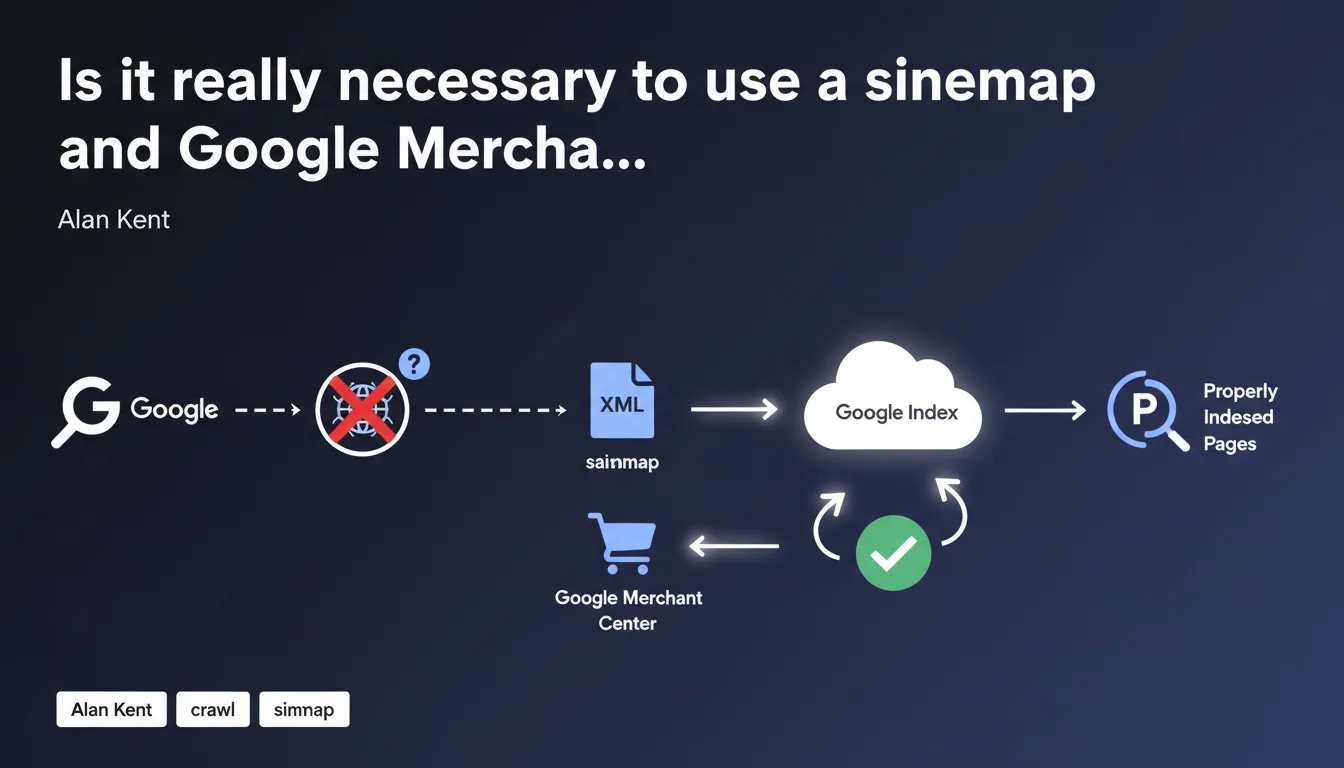
Google recommends using an XML sitemap or Google Merchant Center feed to guarantee discovery of all your pages, especially products. The goal: avoid relying solely on traditional crawling to ensure no URL escapes indexation. A recommendation that raises the question of Google's organic crawl efficiency.
What you need to understand
Why does Google insist on these alternative discovery paths?
Alan Kent's statement reveals a reality often overlooked: Google does not guarantee discovering all your pages through crawling alone. The bot follows links, certainly, but with limited crawl budget and algorithmic priorities that may exclude certain URLs.
The XML sitemap and Google Merchant Center act as safety nets. They provide Google with a comprehensive list of your important URLs, regardless of your internal link architecture. For e-commerce sites in particular, this becomes critical.
What's the difference between sitemap and Google Merchant Center in this context?
The XML sitemap remains the universal tool: all pages, all types of sites. Google Merchant Center specifically targets product pages with enriched structured data (price, availability, images).
Google Merchant Center goes beyond a simple sitemap: it transmits exploitable metadata for Google Shopping and rich results. But it doesn't replace the sitemap for other page types (categories, editorial content, etc.).
Does this recommendation reveal a weakness in crawling?
Let's be honest — if Google had to perfectly crawl all sites via internal links, this recommendation would be unnecessary. The fact that Alan Kent states it explicitly suggests that organic crawling regularly fails to discover all pages.
Deep sites, complex pagination, failing internal linking: these are situations where crawling misses URLs. The sitemap compensates for these structural limitations.
- The XML sitemap ensures Google knows all your important URLs, even poorly linked ones
- Google Merchant Center enriches discovery for products with structured data
- These tools don't replace good internal linking — they complement it
- The very existence of this recommendation reveals the practical limits of link-based crawling
SEO Expert opinion
Is this statement consistent with field observations?
Absolutely. We regularly observe that pages perfectly accessible via internal linking remain absent from the index for weeks or even months. The sitemap accelerates discovery in a measurable way.
However, one point remains unclear: Google doesn't specify what weight it gives to URLs discovered via sitemap compared to organic crawling. Is a URL found only via sitemap at a disadvantage? [To verify] — public data is lacking to settle this.
What nuances should be added to this recommendation?
An exhaustive sitemap isn't always relevant. Including 100,000 low-value URLs dilutes the signal and may waste crawl budget on non-strategic pages. Selection matters as much as exhaustiveness.
Google Merchant Center, for its part, imposes strict constraints: feed format compliance, near real-time data updates, conformity with Google Shopping policies. Misconfigured, it can generate errors that penalize product visibility.
In what cases is this recommendation insufficient?
The sitemap doesn't solve indexability problems. A page discovered via sitemap but blocked by a noindex tag or canonical to another URL will never be indexed. The sitemap facilitates discovery, not indexation.
Similarly, Google Merchant Center doesn't compensate for weak or duplicate product content. If your product sheets are nearly identical, submitting them via GMC doesn't change the fundamental quality problem.
Practical impact and recommendations
What should you do concretely to optimize discovery?
Create a clean XML sitemap containing only canonical, indexable, and strategic URLs. Exclude low-value pages, duplicates, unnecessary facet filters.
For e-commerce sites, configure an automated Google Merchant Center feed that updates with each catalog change (price, stock, new sheets). Data freshness directly impacts performance in Google Shopping.
Monitor Search Console to identify discovered but unindexed URLs. If Google finds your pages via sitemap but doesn't index them, the problem lies elsewhere: quality, duplication, internal competition.
What mistakes should you avoid when managing your sitemaps?
Never submit URLs with 404 errors or 301/302 redirects. Google wastes time crawling non-existent resources, degrading your crawl reputation.
Avoid gigantic sitemaps (> 50,000 URLs per file). Split into multiple thematic files and use a sitemap index to orchestrate them.
Don't duplicate URLs between sitemap and Google Merchant Center feed with contradictory data. If the price differs between the two sources, Google will be suspicious.
- Audit your current sitemap: remove all non-canonical, blocked, or error URLs
- Segment your sitemaps by content type (products, categories, blog, static pages)
- Automate sitemap generation to avoid discrepancies with the actual site
- Configure Google Merchant Center if you have a product catalog (even a small one)
- Monitor Search Console "Sitemaps" and "Coverage" reports weekly
- Test freshness: a new URL added to the sitemap should be crawled within 48-72 hours
❓ Frequently Asked Questions
Un sitemap garantit-il l'indexation de toutes les URLs qu'il contient ?
Google Merchant Center est-il obligatoire pour un site e-commerce ?
Peut-on soumettre plusieurs sitemaps pour un même site ?
À quelle fréquence faut-il mettre à jour son sitemap ?
Faut-il inclure les pages de pagination dans le sitemap ?
🎥 From the same video 12
Other SEO insights extracted from this same Google Search Central video · published on 02/06/2022
🎥 Watch the full video on YouTube →
💬 Comments (0)
Be the first to comment.