
Official statement
Other statements from this video 12 ▾
- □ Pourquoi le mobile représente-t-il désormais plus de la moitié du trafic de recherche ?
- □ Pourquoi Google indexe-t-il uniquement avec un user agent mobile ?
- □ Comment Google Search Console peut-elle vraiment diagnostiquer vos problèmes d'indexation mobile ?
- □ Faut-il vraiment utiliser un sitemap et Google Merchant Center pour être correctement indexé ?
- □ Pourquoi la vitesse mobile reste-t-elle le talon d'Achille de la plupart des sites web ?
- □ Pourquoi PageSpeed Insights combine-t-il données de laboratoire et données terrain ?
- □ Le rapport d'utilisabilité mobile de la Search Console est-il vraiment suffisant pour optimiser son site ?
- □ Le Mobile Friendly Test détecte-t-il vraiment les problèmes qui impactent votre SEO mobile ?
- □ Un design mobile simplifié suffit-il vraiment pour tous les écrans ?
- □ Le responsive web design est-il toujours la meilleure stratégie pour le SEO cross-device ?
- □ Faut-il vraiment afficher tout son contenu en version mobile pour bien se positionner ?
- □ Le défilement infini tue-t-il vraiment l'exploration de vos pages produits ?
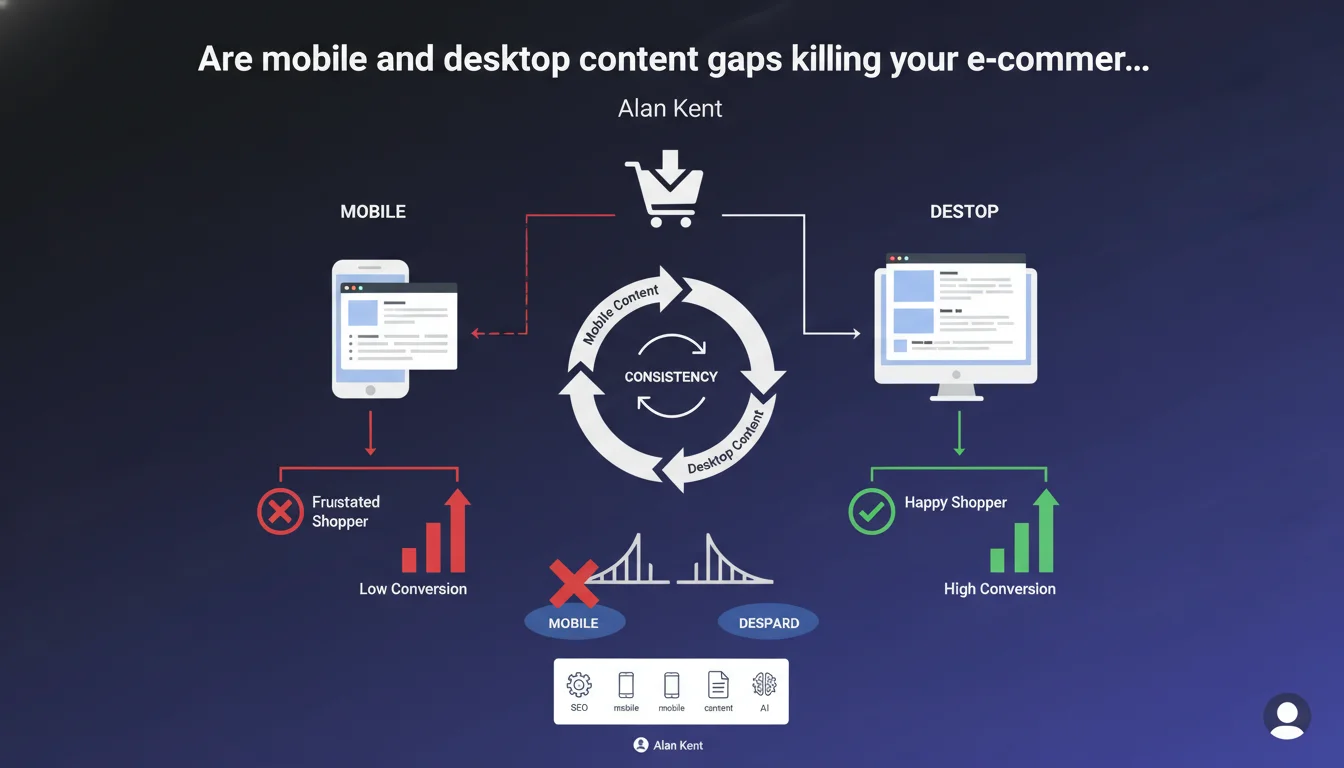
Google insists on strict consistency between mobile and desktop versions of an e-commerce site. Content or feature gaps disrupt user experience and negatively impact rankings under mobile-first indexing. Maintaining complete parity between the two versions is no longer optional.
What you need to understand
What does "consistency" between mobile and desktop really mean?
Alan Kent is talking about content and feature differences. Concretely, this targets sites that hide complete product sheets on mobile, conceal long descriptions, remove CTAs, or oversimplify navigation.
Under mobile-first indexing, Google crawls and prioritizes the mobile version. If that version is stripped down, your ranking potential collapses—even for desktop searches. The message is clear: what doesn't exist on mobile doesn't exist for Google.
Why this focus on e-commerce sites?
Shoppers compare, add to cart, abandon, and return from another device. Content inconsistency breaks this journey: the user can't find the product they saw on desktop, or discovers missing options on mobile.
Google wants to avoid contradictory signals: a spiked bounce rate on mobile because critical info is hidden, while the desktop version would convert. This pollutes metrics and degrades overall experience.
- Mobile-first indexing prioritizes the mobile version: any content reduction is penalizing
- Cross-device journeys are the norm in e-commerce—inconsistencies break conversion
- Google measures user engagement: mobile/desktop gaps generate negative signals
- Strict parity becomes a quality criterion, not a technical option
SEO Expert opinion
Is this rule new or just a reminder?
Let's be honest: it's not a revelation. Since the shift to mobile-first indexing, Google has been hammering this message. But Alan Kent's phrasing specifically targets e-commerce sites, the sector where mobile compromises remain frequent.
Many platforms still sacrifice content on mobile for fear of cluttering the screen. Tactical error: what was tolerated five years ago no longer is. Google doesn't cut corners for sites playing on two levels.
What nuances should we apply to this guideline?
"Consistency" doesn't mean pixel-perfect identity. Layout can differ: accordions, collapsed menus, touch-optimized carousels. What matters is that text content, images, links, and structured data remain identical.
Where it gets tricky—and Kent doesn't say this—is with complex features. A desktop 3D configurator vs. a simplified mobile version: technically different, but if the business objective is met, Google won't penalize you. [To verify]: there is no official threshold for "acceptable difference".
Edge cases: when is uniformity impossible?
Native apps vs. mobile sites, PWAs with offline functionality, AR experiences exclusive to mobile: all gray areas. Google then recommends coherent annotations (alternate, canonical) and clear documentation in Search Console.
But don't expect Google to detail these exceptions. The official line stays binary: maximum parity. The rest falls on your interpretation—and your field testing.
Practical impact and recommendations
What should you audit first on an e-commerce site?
Systematically compare mobile and desktop versions across representative pages: product sheets, categories, filter pages, checkout. Use tools like Screaming Frog in mobile/desktop mode or HTML comparators.
Verify that critical content blocks are identical: product descriptions, technical specs, customer reviews, structured data (Product, Review, Offer). An accordion closed by default on mobile remains indexable—missing content does not.
What mistakes must you absolutely avoid?
Never hide text via display:none or visibility:hidden on mobile if that content is visible on desktop. Google considers this unintentional cloaking. Prefer native HTML accordions or aria-expanded attributes.
Avoid mobile popups that block access to main content: Google tolerates them less on mobile and they degrade Core Web Vitals. If you must use them, ensure they are easily dismissible and don't obstruct indexable content.
- Compare mobile/desktop HTML renderings with a crawler configured for mobile user-agent
- Verify that Product/Review structured data is identical across both versions
- Test faceted navigation: do mobile filters generate the same canonical URLs?
- Ensure product images are served with identical alt and title attributes
- Confirm that CTAs and add-to-cart buttons are present and functional on mobile
- Audit mobile load times: slowly-loading content can be ignored by Google
❓ Frequently Asked Questions
Puis-je utiliser des accordéons sur mobile pour alléger l'affichage sans perdre du référencement ?
Mon site responsive est-il automatiquement conforme à cette exigence de cohérence ?
Les filtres de catégorie doivent-ils générer les mêmes URLs sur mobile et desktop ?
Google pénalise-t-il si mes temps de chargement mobile sont plus lents que desktop ?
Comment vérifier que Google voit bien la même chose sur mobile et desktop ?
🎥 From the same video 12
Other SEO insights extracted from this same Google Search Central video · published on 02/06/2022
🎥 Watch the full video on YouTube →
💬 Comments (0)
Be the first to comment.