
Official statement
Other statements from this video 18 ▾
- □ Does canonical alone really prevent syndicated content from appearing in Discover, or do you actually need to add noindex?
- □ Does Google really penalize multiple domains targeting the same market, or is this just another SEO myth?
- □ Are your JavaScript library vulnerabilities causing your Google rankings to plummet?
- □ Can you really prevent Google from crawling certain parts of a webpage?
- □ Is it really worth your time submitting an XML sitemap to Google?
- □ Why isn't schema.org compliance enough to guarantee Google rich results?
- □ Do HSTS headers really impact your SEO performance?
- □ Does Google really reprocess your sitemap on every crawl?
- □ Does Google really care about the difference between HTML and XML sitemaps? Here's what John Mueller revealed
- □ Does Google really ignore structured data that contains parsing errors?
- □ Does index bloat really exist at Google?
- □ How can you permanently block Googlebot from crawling your website?
- □ Does Google really issue official SEO certifications?
- □ Do multiple navigation menus really hurt your SEO?
- □ Are host groups really a sign of cannibalization you need to fix?
- □ Can you really disavow toxic backlinks by targeting their IP address in Google's tool?
- □ Should you remove the NOODP meta tag from your Blogger sites?
- □ How do you get a video thumbnail in Google search results: what does Google really mean by 'main content'?
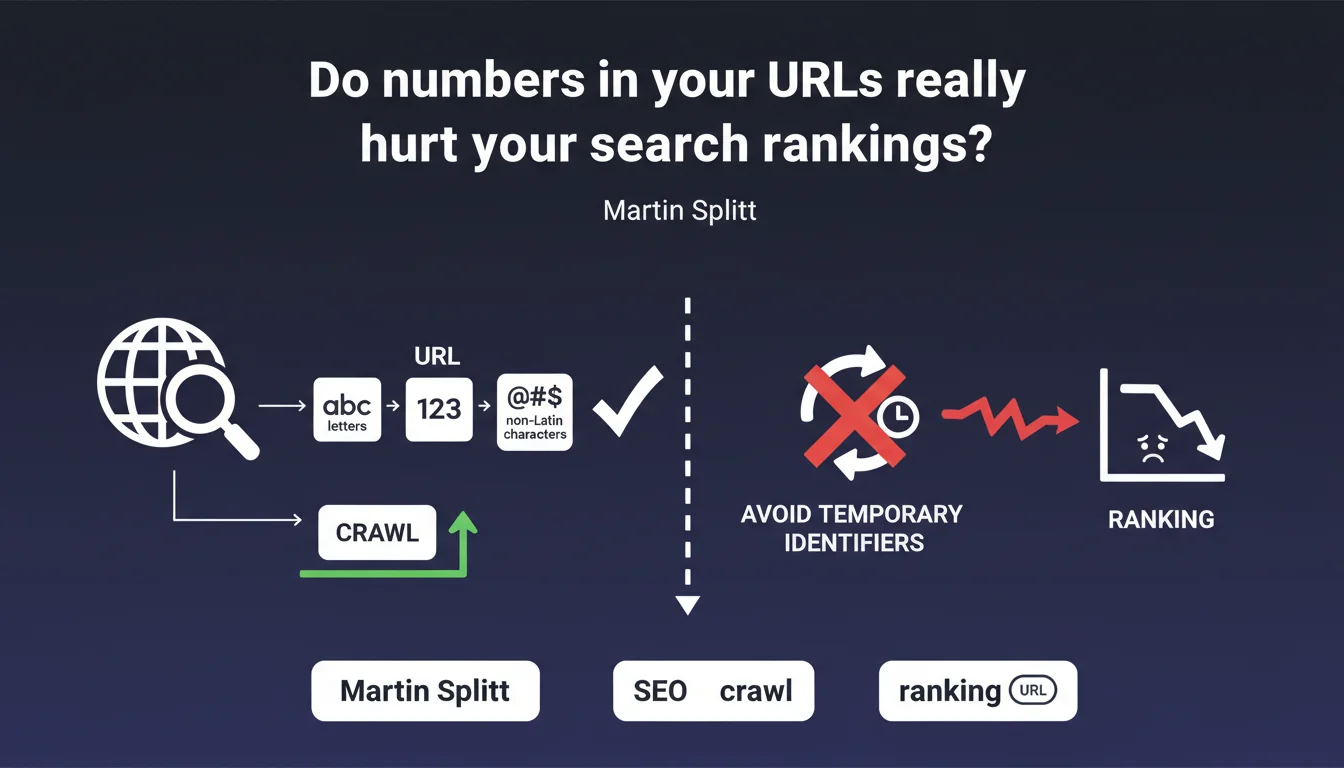
Google confirms that numbers in URLs have no negative impact on SEO. You can safely use digits, letters, non-Latin characters, or Unicode symbols without worry. The only real issue: temporary identifiers that change with each visit and complicate crawler access.
What you need to understand
Why is Google clarifying this about numbers in URLs?
Many SEO professionals continue to avoid digits in their URLs out of fear of negative impact. This belief has persisted for years, fueled by vague recommendations and contradictory interpretations.
Google sets the record straight: numbers pose no problems whatsoever for search rankings. Whether it's a product identifier (product-123), a date (article-2023-05), or any alphanumeric combination, the search engine has no issue with it.
So what actually causes problems then?
The only case to avoid: temporary session identifiers that change with each visit. Typical example: /product?sessionid=xyz789abc. These dynamic URLs create an infinite multiplication of identical pages, which dilutes your crawl budget and prevents proper indexation.
Non-Latin characters and Unicode symbols are also accepted. Granted, they'll be percent-encoded in the final URL (e.g., %E9 for é), but this doesn't harm SEO.
- Numbers in URLs are completely neutral for SEO
- Letters, digits, non-Latin characters, and Unicode symbols are all acceptable
- Only changing temporary identifiers create a real crawling problem
- The logical structure and consistency of your URLs matter more than their composition
SEO Expert opinion
Is this position consistent with what we observe in real-world practice?
Yes, absolutely. E-commerce sites with numeric product references rank just as well as others. Blogs using dates in their slugs (format /2023/05/article) suffer no penalties whatsoever.
Rather, the confusion often stems from a common misconception: people confuse readability for users with technical SEO impact. A URL like /product-running-shoes is more meaningful than /p-12345 for humans, but technically, Google handles both without issue.
What nuances should we add to this statement?
Google says "avoid temporary identifiers," but doesn't specify at what point duplication becomes problematic. [To verify]: Will a site with 10% sessionID URLs be penalized as much as one with 80%? No quantified data available.
Another point—and it's critical: even if numbers don't harm pure SEO, a cryptic URL hurts your click-through rate. No one wants to click on /p?id=987654 over /trail-shoes-men in search results. Indirect SEO impact exists.
In what cases doesn't this rule fully apply?
If your CMS generates URLs with dates or IDs by default, you're not obligated to rewrite everything. But if you have a choice, prioritize semantic clarity for your users.
For multilingual sites, be careful with non-Latin characters: they work, but encoding can significantly lengthen the visible URL and hurt memorability. Weigh the pros and cons based on your audience.
Practical impact and recommendations
What should you do concretely with your current URLs?
If your URLs already contain numbers (product IDs, dates, references), don't change anything. You won't gain anything by rewriting them and risk losing link equity if redirects are mishandled.
For new content, ask yourself: will this URL be understandable at a glance? If yes, keep it. If not, add a descriptive slug even if you keep a numeric ID.
What mistakes should you absolutely avoid?
Never generate session identifiers in the main URL of your indexable pages. Use cookies or POST parameters to manage user sessions.
Also avoid URLs that change based on user journey. Example: /product?ref=123&source=newsletter then /product?ref=123&source=google. Same content, different URLs = unnecessary duplication.
- Audit your URLs to detect non-canonicalized session or tracking parameters
- Configure URL parameters in Google Search Console to flag those to ignore
- Use rel="canonical" on URL variations pointing to the same content
- Favor descriptive slugs even if you include numbers (e.g., /trail-shoes-ref-1234)
- Test your URLs with GSC's URL inspection tool to verify they're crawlable
- If migrating URLs, implement clean 301 redirects and test them thoroughly
Numbers in your URLs won't penalize you. Focus on structural consistency, user readability, and eliminating temporary identifiers. If you manage a complex site with thousands of URLs or are planning a redesign, these optimizations require detailed analysis of your architecture. In such cases, working with a specialized SEO agency can help you avoid costly mistakes and ensure implementation that aligns with best practices.
❓ Frequently Asked Questions
Dois-je réécrire mes URLs qui contiennent des chiffres pour améliorer mon SEO ?
Les URLs avec dates (ex: /2023/05/article) sont-elles pénalisées ?
Qu'est-ce qu'un identifiant temporaire à éviter dans les URLs ?
Peut-on utiliser des caractères accentués ou non-latins dans les URLs ?
Une URL courte sans chiffres se classe-t-elle mieux qu'une URL longue avec des chiffres ?
🎥 From the same video 18
Other SEO insights extracted from this same Google Search Central video · published on 07/06/2023
🎥 Watch the full video on YouTube →
💬 Comments (0)
Be the first to comment.