
Official statement
Other statements from this video 18 ▾
- □ Canonical seul ne suffit pas pour bloquer le contenu syndiqué dans Discover : faut-il vraiment ajouter noindex ?
- □ Deux domaines pour un même pays : où commence vraiment la manipulation ?
- □ Les failles JavaScript de vos bibliothèques font-elles chuter votre positionnement Google ?
- □ Peut-on vraiment empêcher Google de crawler certaines parties d'une page HTML ?
- □ Faut-il encore perdre du temps à soumettre son sitemap XML ?
- □ Pourquoi les données structurées Schema.org ne suffisent-elles pas toujours pour obtenir des résultats enrichis Google ?
- □ Les en-têtes HSTS ont-ils vraiment un impact sur votre référencement ?
- □ Google retraite-t-il vraiment votre sitemap à chaque crawl ?
- □ Sitemap HTML vs XML : pourquoi Google insiste-t-il sur leur différence de fonction ?
- □ Les données structurées avec erreurs sont-elles vraiment ignorées par Google ?
- □ Les chiffres dans vos URLs pénalisent-ils vraiment votre référencement ?
- □ L'index bloat existe-t-il vraiment chez Google ?
- □ Comment bloquer définitivement Googlebot de votre site ?
- □ Google délivre-t-il vraiment des certifications SEO officielles ?
- □ Plusieurs menus de navigation nuisent-ils vraiment au SEO ?
- □ Peut-on désavouer des backlinks toxiques en ciblant leur adresse IP ?
- □ Faut-il supprimer la balise meta NOODP de vos sites Blogger ?
- □ Comment obtenir une vignette vidéo dans les SERP : qu'entend Google par « contenu principal » ?
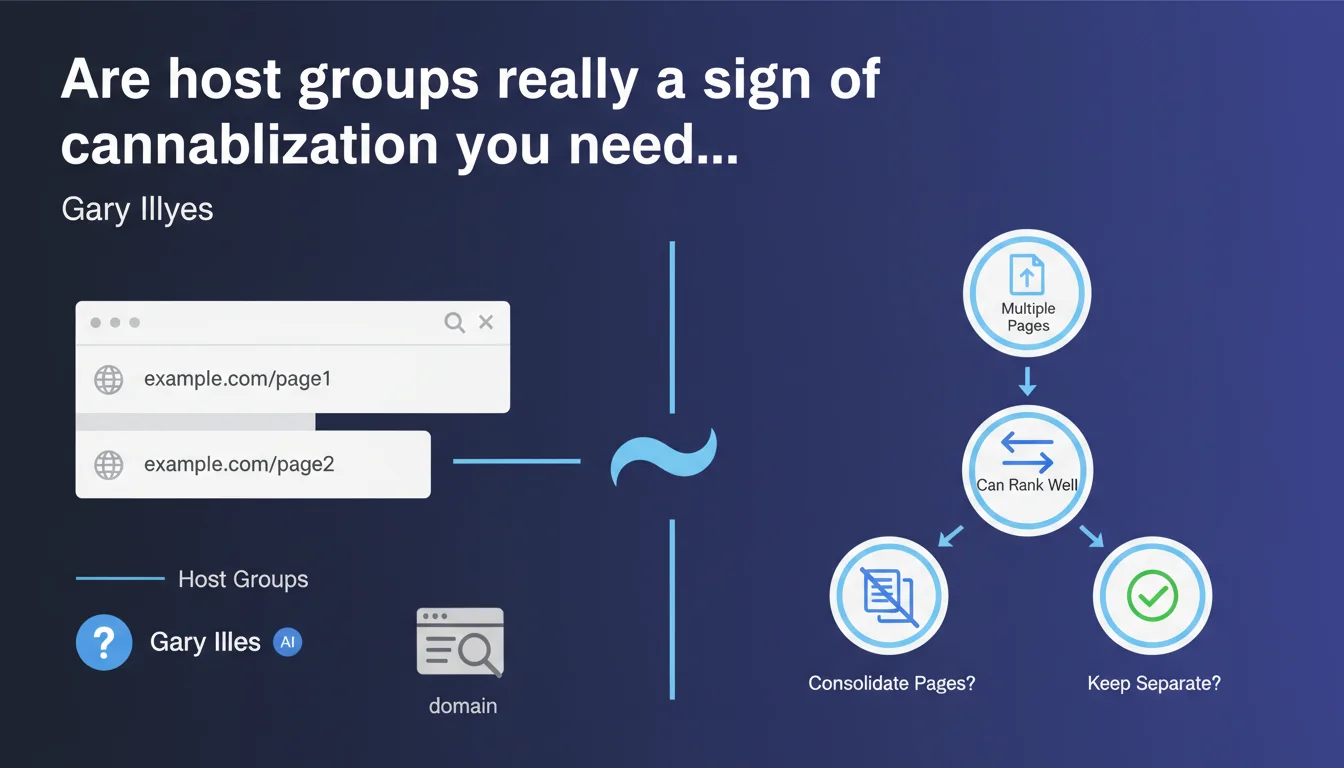
When two results from your domain appear in the SERPs with the second slightly indented, Google calls them host groups. According to Gary Illyes, this signals that multiple pages are eligible to rank for the same query — and you should consider consolidating them. But this oversimplified interpretation deserves to be challenged.
What you need to understand
Gary Illyes clarified a recurring visual behavior in SERPs: the indentation of the second result from the same domain. This format, called host groups, is often misinterpreted by SEO practitioners.
Contrary to what you might think, it's not a penalty. It's simply how Google displays multiple pages from the same site that all legitimately match the user's search intent.
Does this phenomenon always indicate cannibalization?
Not necessarily. Host groups signal that multiple URLs from your domain answer the query intent — but that doesn't mean they're damaging each other competitively.
Google simply chooses to diversify the sources displayed rather than monopolize page 1 with a single domain. If your two pages cover different angles of the same topic, the indentation is normal and healthy.
Why does Google recommend consolidation?
Illyes' recommendation assumes that two similar pages dilute your topical authority. If your content heavily overlaps without offering differentiated value, you're dispersing your relevance signals.
In this case, merging the pages allows you to concentrate SEO signals (backlinks, engagement, semantic depth) on a single stronger URL. But this logic only applies if the pages are actually redundant.
- Host groups are not a penalty, but a visual display of multiple results from the same domain
- They indicate that Google considers multiple of your pages relevant for a given query
- Consolidation is only worthwhile if the pages overlap semantically without offering a distinct angle
- If each page covers a legitimate sub-topic, maintaining the fragmented structure can be strategic
SEO Expert opinion
Is this recommendation always valid?
Let's be honest: the consolidation guidance is valid in 70% of cases, but not universal. Many niche sites and media outlets deliberately use a granular architecture — and it works perfectly.
A classic example: an e-commerce site with very similar product pages (colors, sizes). If these variants appear in a host group for a generic query, merging them would be counterproductive. The user might be looking to compare these variants.
Another observed case: news sites or blogs covering an event across multiple articles (update, analysis, interview). Host groups allow the user to choose the angle they're interested in. Consolidating would destroy this editorial richness.
What signals help you decide between consolidation and keeping pages separate?
First reflex: analyze user behavior via Search Console. If both pages have decent CTR and reasonable session duration, it means each answers a nuance of intent. Merging them risks frustrating part of your audience.
Second indicator: the distribution of backlinks. If each page attracts links from different contexts, that's a strong signal they have their own editorial legitimacy. [To verify]: we don't have official data on the actual impact of consolidation on overall ranking — Google remains vague about measurable gains.
When is consolidation contraindicated?
When pages serve different search intents, even if they use similar keywords. For example: "how to choose an electric bike" vs "best electric bike 2023" — both may appear in a host group for "electric bike", but merging would be a mistake.
Same for multilingual or multi-geographic sites: seeing two versions (en-US and en-GB) in a host group is normal. Consolidating would destroy your local targeting strategy.
Practical impact and recommendations
How do you diagnose if your host groups need consolidation?
Start by identifying all occurrences through targeted manual search on your strategic queries. Note the pairs of pages that consistently appear together with indentation.
Next, compare their content using a semantic similarity tool (e.g. diffchecker, or content analysis plugins). If the overlap rate exceeds 60-70% without differentiated added value, consolidation is justified.
Also check engagement metrics: session duration, bounce rate, conversions. If one page performs significantly better, it should absorb the other — not the reverse.
What method should you use to consolidate without breaking your SEO?
Never delete abruptly. Merge content by keeping the best of each page: unique sections, converting copy, rich media elements. The final URL should be the one with the better history (backlinks, age, metrics).
Redirect the absorbed URL with a 301 permanent redirect — and monitor for 3 months. If you see traffic drop not offset elsewhere, it may mean you've eliminated a search intent nuance Google valued.
Update your internal linking: all links pointing to the old URL should be changed to point directly to the new one. This avoids redirect chains and preserves your internal PageRank.
What if your host groups are legitimate and should stay separate?
Optimize the semantic differentiation between pages. Strengthen specific angles, adjust title/meta to target distinct intent nuances. Google needs to understand each page has its reason for existing.
Also work on contextual internal linking between these pages: link them with anchors that make their complementarity explicit. This helps Google understand they're not competitors, but complementary.
- Identify your host groups through manual search on your priority queries
- Compare content of relevant pages (overlap rate, unique added value)
- Analyze engagement and conversion metrics for each page
- If consolidating: merge onto the strongest URL, 301 the other, clean up internal links
- If keeping separate: strengthen semantic differentiation and contextual linking between pages
- Monitor ranking and traffic evolution for 90 days post-action
Host groups aren't a bug — they're a signal of opportunity. Either you consolidate to concentrate your SEO power, or you differentiate to capture multiple intent nuances.
The choice depends on your analysis of user intent and the real value provided by each page. Making the right call between these two paths requires fine expertise in search behavior and technical mastery of content migrations. If you're unsure about the strategy for your specific case, working with a specialized SEO agency can help you avoid costly mistakes and leverage this signal to your advantage.
❓ Frequently Asked Questions
Les host groups pénalisent-ils le référencement de mon site ?
Dois-je systématiquement consolider les pages qui apparaissent en host group ?
Comment vérifier si mes pages en host group se cannibalisent vraiment ?
Quelle URL garder si je décide de consolider deux pages en host group ?
Les host groups concernent-ils aussi les sites multilingues ?
🎥 From the same video 18
Other SEO insights extracted from this same Google Search Central video · published on 07/06/2023
🎥 Watch the full video on YouTube →
💬 Comments (0)
Be the first to comment.