
Official statement
Other statements from this video 18 ▾
- □ Canonical seul ne suffit pas pour bloquer le contenu syndiqué dans Discover : faut-il vraiment ajouter noindex ?
- □ Deux domaines pour un même pays : où commence vraiment la manipulation ?
- □ Les failles JavaScript de vos bibliothèques font-elles chuter votre positionnement Google ?
- □ Peut-on vraiment empêcher Google de crawler certaines parties d'une page HTML ?
- □ Faut-il encore perdre du temps à soumettre son sitemap XML ?
- □ Pourquoi les données structurées Schema.org ne suffisent-elles pas toujours pour obtenir des résultats enrichis Google ?
- □ Les en-têtes HSTS ont-ils vraiment un impact sur votre référencement ?
- □ Google retraite-t-il vraiment votre sitemap à chaque crawl ?
- □ Sitemap HTML vs XML : pourquoi Google insiste-t-il sur leur différence de fonction ?
- □ Les données structurées avec erreurs sont-elles vraiment ignorées par Google ?
- □ Les chiffres dans vos URLs pénalisent-ils vraiment votre référencement ?
- □ L'index bloat existe-t-il vraiment chez Google ?
- □ Comment bloquer définitivement Googlebot de votre site ?
- □ Plusieurs menus de navigation nuisent-ils vraiment au SEO ?
- □ Les host groups indiquent-ils vraiment une cannibalisation à corriger ?
- □ Peut-on désavouer des backlinks toxiques en ciblant leur adresse IP ?
- □ Faut-il supprimer la balise meta NOODP de vos sites Blogger ?
- □ Comment obtenir une vignette vidéo dans les SERP : qu'entend Google par « contenu principal » ?
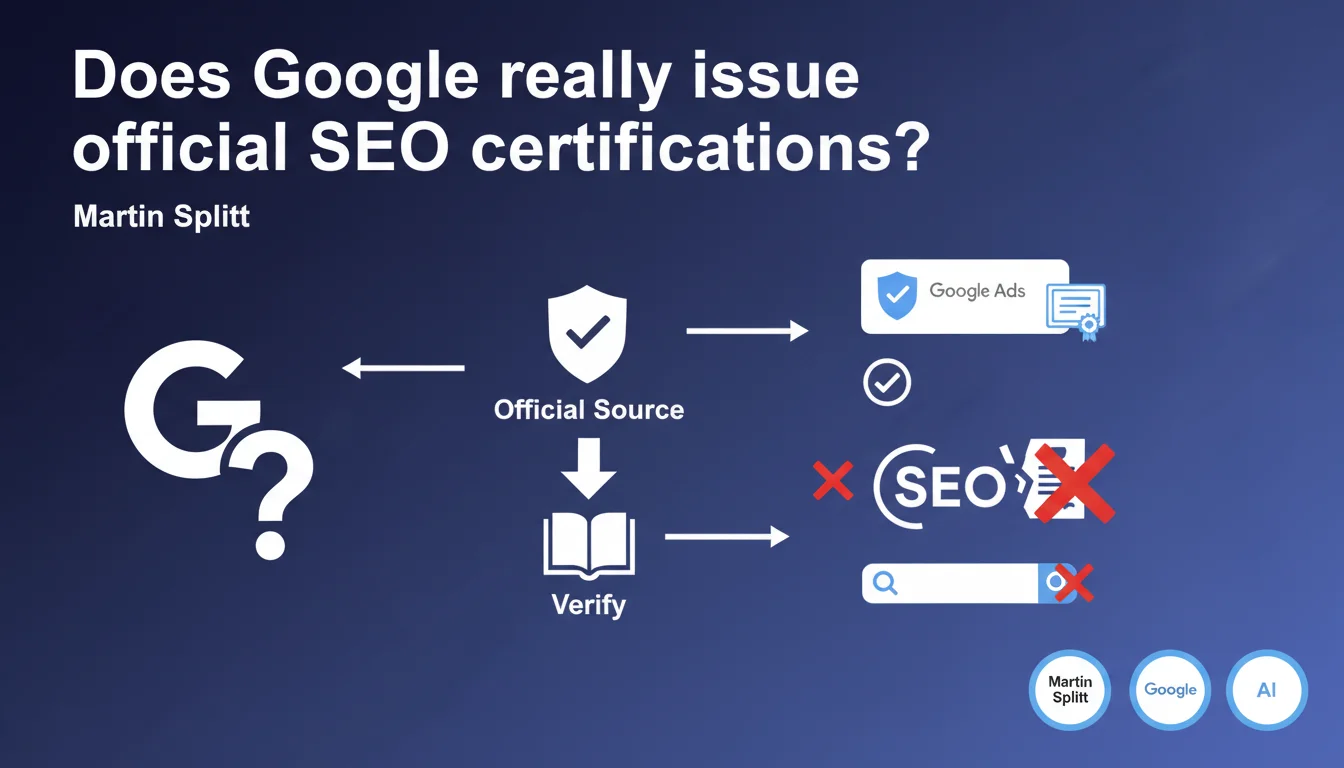
Google does not offer any official SEO certification or badge. While certifications exist for Google Ads or Analytics, nothing like that exists for organic search. Be wary of training programs or agencies that claim to hold a Google-validated SEO badge — it's pure fiction.
What you need to understand
Why is Google making this clarification?
The market is flooded with training programs promising a Google SEO certification. The problem? It simply doesn't exist. Martin Splitt makes this clear: Google certifies certain advertising products (Google Ads, Google Analytics), but not SEO.
This confusion often arises because Google offers free resources (Search Central, technical documentation) and some training organizations capitalize on this to sell badges with no real value.
What's the difference between product certification and SEO certification?
Google Ads certifications validate mastery of a specific paid tool, with standardized exams. SEO, on the other hand, relies on constantly evolving practices, multiple signals, and interpretations — it's hard to imagine a multiple-choice exam that would truly cover the profession.
Google doesn't want to endorse a single approach to SEO. Every site has its own specifics, every market its own constraints. A single certification would be reductive, even misleading.
How do you recognize a fake certification?
If a service provider touts an official Google SEO badge, verify the source. Google lists its certifications on dedicated pages (Skillshop for Ads, for example). Anything not listed there is self-proclaimed.
Some organizations create their own internal certifications — nothing illegal about it, but it holds no value with Google. Don't confuse quality training with official validation.
- No official Google SEO certification exists to date
- Google certifications concern only specific products (Ads, Analytics)
- Always verify the source on official Google pages before believing any claim
- A self-proclaimed badge offers no guarantee of genuine competence
SEO Expert opinion
Is this statement consistent with observed practices?
Absolutely. In the field, you regularly see service providers waving phantom certifications to reassure uninformed clients. Google has never endorsed this kind of practice — for good reason: SEO is a profession of diagnosis and adaptation, not a fixed checklist.
The problem is that this lack of official certification leaves the door wide open for scams. Faced with an opaque market, some clients seek easy guarantees — and fake certifications fill that void.
Should we conclude that all SEO training is useless?
Not at all. Quality training provides real skills, a thinking framework, hands-on experience. What matters is the educational content, not the logo at the end of the course.
The best SEO training programs are often those that openly admit they don't hold any official Google seal — because they don't need one to prove their value.
What risks do clients face if they rely on these badges?
Hiring an agency based on a made-up badge risks landing you with outdated or dangerous practices. True SEO experts justify their expertise through client cases, measurable results, constant monitoring — not a PDF certificate.
A service provider who waves a non-existent certification either doesn't know the subject or is deliberately lying. Either way, run.
Practical impact and recommendations
How do you assess an SEO service provider's competence without official certification?
Ask for concrete case studies, audits they've already conducted, detailed explanations of their methodology. A good SEO expert can explain their approach, their choices, the technical compromises they make. A poor one recites generalities and hides behind a badge.
Also check their active monitoring: do they follow Google updates, official statements, community tests? SEO moves fast — an expert relying on fixed knowledge misses the essentials.
What mistakes should you avoid when choosing SEO training?
Don't be impressed by a flashy badge on the landing page. Instead, look at who's teaching, what the program content is, and what feedback former participants have given. Good SEO training is often the kind that acknowledges its limits.
Beware of promises of magic formulas or secret techniques. Google doesn't reveal all its algorithms, true, but SEO fundamentals are documented, accessible, and require no trade secrets.
What should you do if a service provider claims to hold a Google SEO certification?
Ask for the official source. If the person mentions an internal badge, vague partnership, or third-party training, that's a red flag. Google does not validate any third-party SEO program.
When in doubt, consult Google's certification pages directly or ask on specialized forums. The French-speaking SEO community is responsive and quickly calls out abuses.
- Demand concrete proof of results (case studies, reports, verifiable testimonials)
- Check the service provider's presence in the SEO community (articles, conferences, contributions)
- Request a detailed explanation of the methodology used
- Ignore any badge or certification supposedly from Google if it's not listed on Skillshop or Search Central
- Favor training that clearly displays its content and instructors
- Be skeptical of promises of guaranteed results or secret techniques
❓ Frequently Asked Questions
Google propose-t-il une certification SEO officielle ?
Comment vérifier si une certification SEO est légitime ?
Un badge SEO auto-proclamé a-t-il de la valeur ?
Faut-il éviter toutes les formations SEO qui proposent un certificat ?
Pourquoi Google ne crée-t-il pas de certification SEO ?
🎥 From the same video 18
Other SEO insights extracted from this same Google Search Central video · published on 07/06/2023
🎥 Watch the full video on YouTube →
💬 Comments (0)
Be the first to comment.