
Official statement
Other statements from this video 18 ▾
- □ Does canonical alone really prevent syndicated content from appearing in Discover, or do you actually need to add noindex?
- □ Does Google really penalize multiple domains targeting the same market, or is this just another SEO myth?
- □ Are your JavaScript library vulnerabilities causing your Google rankings to plummet?
- □ Can you really prevent Google from crawling certain parts of a webpage?
- □ Is it really worth your time submitting an XML sitemap to Google?
- □ Why isn't schema.org compliance enough to guarantee Google rich results?
- □ Do HSTS headers really impact your SEO performance?
- □ Does Google really reprocess your sitemap on every crawl?
- □ Does Google really care about the difference between HTML and XML sitemaps? Here's what John Mueller revealed
- □ Does Google really ignore structured data that contains parsing errors?
- □ Do numbers in your URLs really hurt your search rankings?
- □ Does index bloat really exist at Google?
- □ How can you permanently block Googlebot from crawling your website?
- □ Does Google really issue official SEO certifications?
- □ Do multiple navigation menus really hurt your SEO?
- □ Are host groups really a sign of cannibalization you need to fix?
- □ Can you really disavow toxic backlinks by targeting their IP address in Google's tool?
- □ How do you get a video thumbnail in Google search results: what does Google really mean by 'main content'?
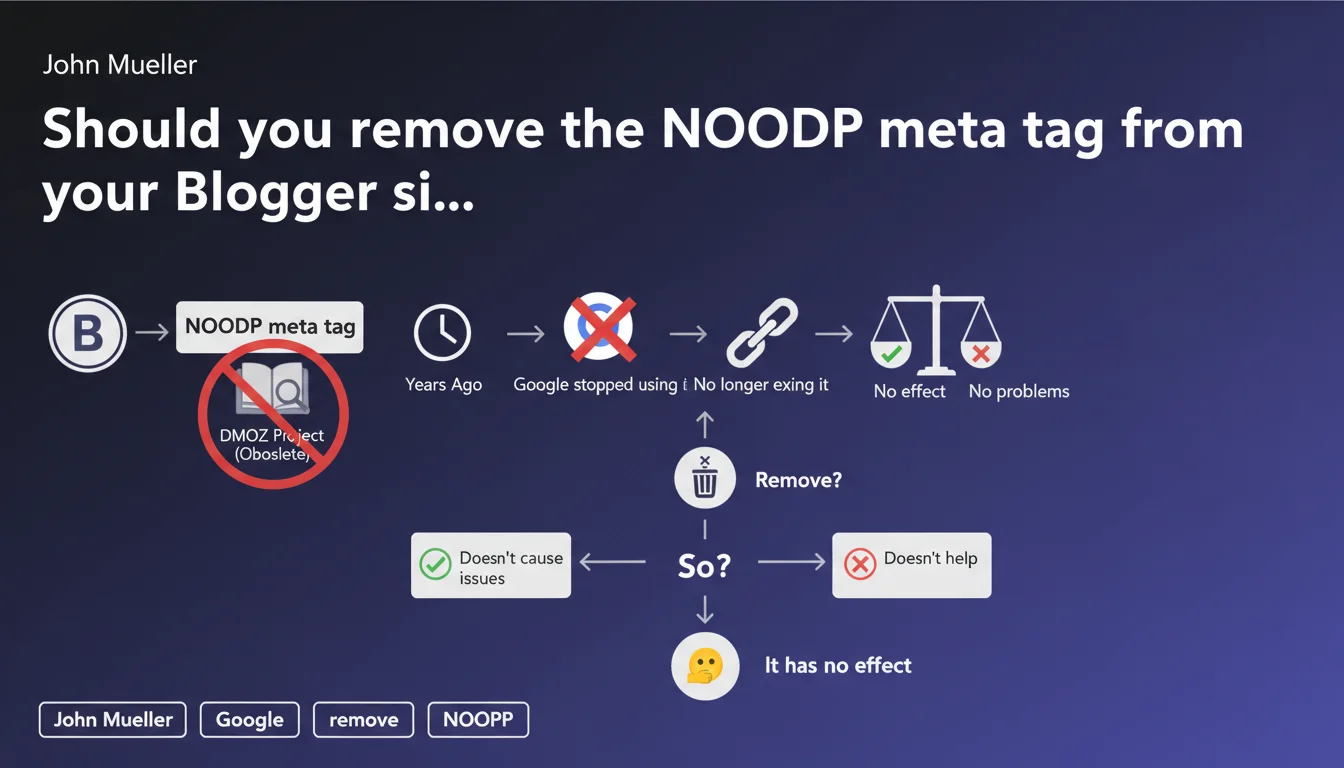
The NOODP meta robots tag has had no effect for years. Google ignores it completely because it referred to the DMOZ project, which has been shut down for a long time. You can leave it or remove it — it makes absolutely no difference to your SEO.
What you need to understand
Why does this tag still exist on so many websites?
The NOODP tag (No Open Directory Project) dates back to an era when Google sometimes used descriptions from the DMOZ (collaborative web directory) to generate meta descriptions in the SERPs. Webmasters wanted to control what appeared there.
Blogger integrated it by default into its templates. The result: millions of blogs still carry this relic, and nobody really cares anymore.
What was DMOZ and why did Google use it?
The DMOZ (Directory Mozilla) was a giant directory maintained by volunteer editors. Google would sometimes pull site descriptions from it when it couldn't find a satisfactory one on the page itself.
The project shut down, and Google stopped using this data well before that happened. The NOODP tag became obsolete in practice.
Does Google still use this tag today?
No. Absolutely not. Google doesn't even read it anymore — it's completely ignored by the search engine.
In practical terms? You can keep the tag on your site without any risk, but it does nothing whatsoever. It's dead code.
- NOODP referred to the DMOZ project, which closed years ago
- Google no longer uses this directive and hasn't for a long time
- The tag is present by default on many Blogger templates
- No SEO impact — neither positive nor negative — whether you keep or remove it
- Google completely ignores this instruction now
SEO Expert opinion
Is this statement consistent with real-world observations?
Yes, completely. We see no difference in SERP behavior depending on whether this tag is present or absent. Technical SEO audits sometimes flag it as "obsolete," but that's more cosmetic cleanup than anything else.
Let's be honest: nobody has cared about this tag for years. Only aging Blogger templates continue to generate it automatically.
Are there any cases where this tag could cause problems?
No. That's precisely what Mueller confirms — it has no effect, so it can't hurt anything. Even if your CMS generates it across the board, it won't impact your crawl budget or indexation.
The only potential "problem" would be cluttering your HTML code with useless directives. But we're talking about a single line here — nothing worth making a fuss over.
Is it really worth the effort to remove it?
It depends on how obsessive you are about clean code. If you're doing a redesign or cleaning up your templates, you might as well remove it while you're at it.
But if it's buried in an old Blogger theme you never touch? Honestly, spend your time elsewhere. This tag doesn't cost you anything.
Practical impact and recommendations
What should I do if this tag is present on my site?
Nothing urgent. If you're redesigning your theme or cleaning up your code, take the opportunity to remove it. Otherwise, leave it alone — it won't hurt anything.
For Blogger sites, check whether your template includes it. If you switch to a more modern theme, it will probably disappear on its own.
How can I check if my site uses this tag?
Inspect the source code of your pages (Ctrl+U or right-click → "View page source"). Look for <meta name="robots" content="noodp"> in the <head> section.
You can also use a crawler like Screaming Frog to scan your entire site and identify affected pages all at once.
What mistakes should you avoid with meta robots tags?
Confusing NOODP with the directives that still matter: noindex, nofollow, noarchive, nosnippet. Google still respects those — and a mistake can cost you dearly.
Don't waste time hunting down obsolete tags while accidental noindex tags are blocking important pages from being indexed.
- Inspect the
<head>of your pages to spot the NOODP tag - If present, remove it when you next update your template (no rush)
- Focus on the meta robots directives that actually matter: noindex, nofollow, noarchive
- Make sure your CMS isn't automatically generating obsolete tags in its new templates
- Take the opportunity to audit all your meta robots tags and eliminate dead code
❓ Frequently Asked Questions
La balise NOODP a-t-elle un impact SEO en 2025 ?
Dois-je retirer la balise NOODP de mon site Blogger ?
Pourquoi cette balise existe-t-elle encore sur tant de sites ?
Qu'est-ce que le projet DMOZ auquel cette balise fait référence ?
Y a-t-il d'autres balises meta robots obsolètes à surveiller ?
🎥 From the same video 18
Other SEO insights extracted from this same Google Search Central video · published on 07/06/2023
🎥 Watch the full video on YouTube →
💬 Comments (0)
Be the first to comment.