
Official statement
Other statements from this video 18 ▾
- □ Does canonical alone really prevent syndicated content from appearing in Discover, or do you actually need to add noindex?
- □ Does Google really penalize multiple domains targeting the same market, or is this just another SEO myth?
- □ Are your JavaScript library vulnerabilities causing your Google rankings to plummet?
- □ Can you really prevent Google from crawling certain parts of a webpage?
- □ Is it really worth your time submitting an XML sitemap to Google?
- □ Why isn't schema.org compliance enough to guarantee Google rich results?
- □ Does Google really reprocess your sitemap on every crawl?
- □ Does Google really care about the difference between HTML and XML sitemaps? Here's what John Mueller revealed
- □ Does Google really ignore structured data that contains parsing errors?
- □ Do numbers in your URLs really hurt your search rankings?
- □ Does index bloat really exist at Google?
- □ How can you permanently block Googlebot from crawling your website?
- □ Does Google really issue official SEO certifications?
- □ Do multiple navigation menus really hurt your SEO?
- □ Are host groups really a sign of cannibalization you need to fix?
- □ Can you really disavow toxic backlinks by targeting their IP address in Google's tool?
- □ Should you remove the NOODP meta tag from your Blogger sites?
- □ How do you get a video thumbnail in Google search results: what does Google really mean by 'main content'?
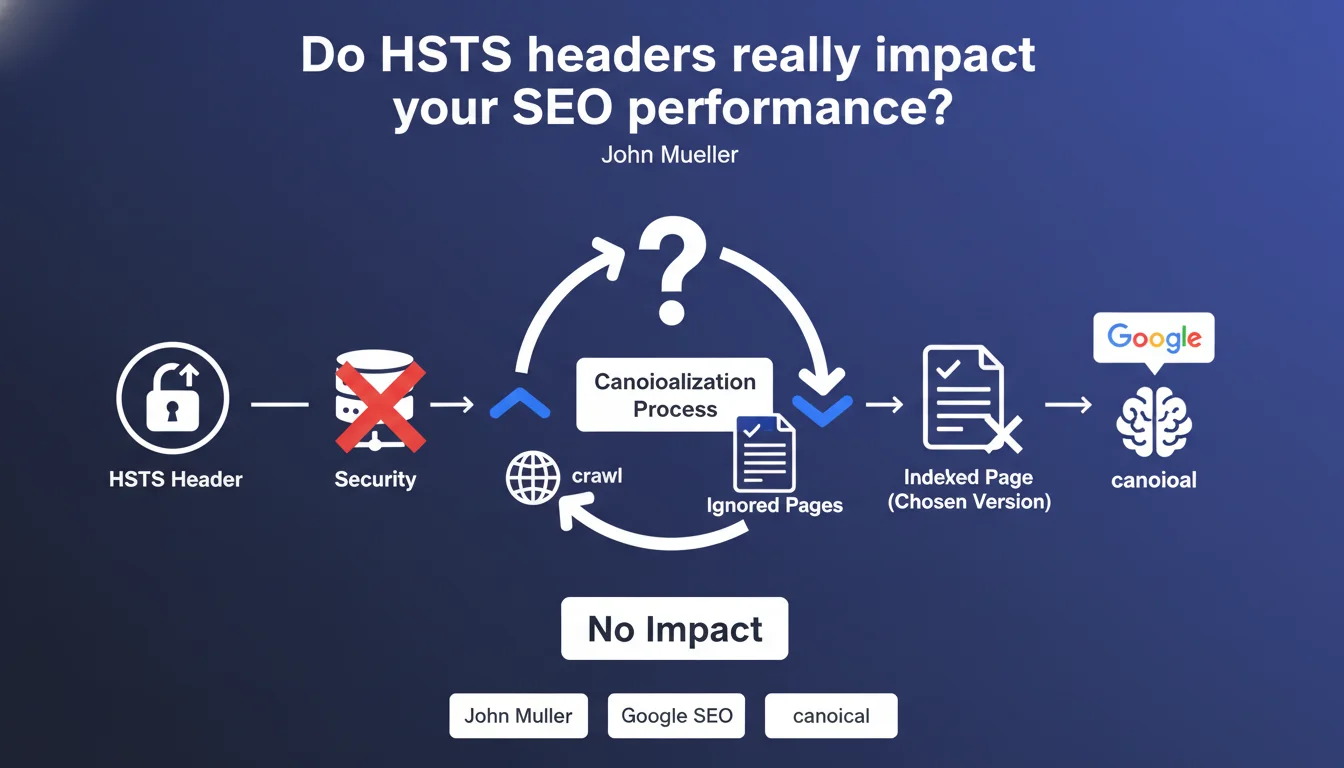
Google confirms that HSTS headers do not influence rankings. The search engine relies on its canonicalization process to determine which version of a page to index, independently of these security headers. In other words: HSTS protects your users, but doesn't boost your positions.
What you need to understand
This statement from John Mueller puts an end to persistent confusion in the SEO community. Some practitioners believed that implementing HSTS headers (HTTP Strict Transport Security) could constitute a quality signal for Google, similar to switching to HTTPS.
Let's be honest: this misunderstanding came from logical extrapolation. Google favors HTTPS, HSTS strengthens HTTPS security, so HSTS should be a plus for SEO. Except it isn't.
What is HSTS concretely?
HSTS is a security mechanism that forces browsers to always use HTTPS to access your site, even if the user types "http://" in the address bar. Once a browser has received this header, it remembers this directive for the specified duration (typically several months).
The objective? To eliminate downgrade attacks, where a hacker intercepts the connection before the redirect to HTTPS. It's additional armor, not an SEO signal.
So how does Google choose which version to index?
Google uses its canonicalization process, a complex system that analyzes many signals: 301/302 redirects, canonical tags, sitemaps, internal links, and even the consistency of URLs across your link ecosystem.
HSTS headers simply don't enter into this equation. Google crawls, detects your HTTPS redirects, and indexes the secure version because that's what your redirects tell it to do — not because a header says "hey, force HTTPS".
Why is Google clarifying this now?
Probably because SEO tools and audits were promoting HSTS as an "SEO recommendation," creating a false priority in technical backlogs. Google is setting the record straight: HSTS is for user security, period.
- HSTS headers are not a ranking factor
- Google relies on canonicalization to choose which HTTP or HTTPS version to index
- Your 301 redirects to HTTPS remain the primary signal for Google
- HSTS remains important for user security, but that's a separate matter
- Don't confuse "good security practice" with "SEO leverage"
SEO Expert opinion
Is this statement consistent with what we observe in the field?
Absolutely. I've audited hundreds of sites with and without HSTS over the past few years, and no correlation has ever emerged between the presence of this header and organic performance. Sites implementing HSTS don't gain positions, those without it don't lose any.
What really counts is the consistency of your HTTPS migration: clean redirects, updated internal links, canonical pointing to HTTPS, HTTPS-only sitemap. HSTS comes after — it's a security varnish, not an SEO foundation.
Should you still implement HSTS?
Yes, but for the right reasons. If you manage a site with sensitive data (e-commerce, member areas, forms), HSTS protects your users against real attacks. It's a defense layer recommended by modern security standards.
But don't sell it as an "SEO optimization" to your clients or management. It's dishonest and undermines your credibility when you defend true technical priorities. The problem is that many SEO tools continue to score HSTS as an "SEO point" in their automated audits.
What's the real priority if you're not on HTTPS yet?
If your site is still on pure HTTP (it still happens), the absolute priority is complete HTTPS migration: valid SSL certificate, systematic 301 redirects, update all assets (images, CSS, JS) to HTTPS, and verify that Google indexes the HTTPS URLs correctly.
Once that's clean and stable, you can add HSTS. But honestly, if you have to choose between fixing inconsistent canonicals and implementing HSTS, choose canonicals. [To be verified]: some report that Google might soon use advanced security signals (potentially including HSTS) to evaluate overall site "trustworthiness," but nothing official to date.
Practical impact and recommendations
What should you concretely do with HSTS?
Implement HSTS for security, not for SEO. If your site is already on HTTPS with clean redirects, adding the HSTS header is simple: "Strict-Transport-Security: max-age=31536000; includeSubDomains; preload". Test first with a short max-age (a few days) before moving to a year.
And be cautious with the includeSubDomains directive: it forces HTTPS on ALL your subdomains. If you have an old subdomain without HTTPS that you forgot about, your visitors won't be able to access it.
What errors should you avoid in your HTTPS/HSTS strategy?
The classic mistake: implementing HSTS before you have a stable HTTPS migration. You end up with blocked users if something breaks on the certificate or redirect side. HSTS is the cherry on the cake, not the cake itself.
Another trap: believing that HSTS will "force" Google to index your HTTPS URLs if your redirects are weak. No. Google follows your standard canonicalization signals. If you have HTTP canonicals pointing to HTTPS versions, or vice-versa, fix that first.
How do you verify your configuration is correct?
Use your browser's DevTools (Network tab) to inspect response headers. The Strict-Transport-Security header should appear on your HTTPS pages. Also test with tools like securityheaders.com to see if everything is in place.
On the SEO side, verify in Search Console that Google indexes your HTTPS URLs properly, not a mix of HTTP/HTTPS. If that's the case, the problem comes from your redirects or canonicals, not from missing HSTS.
- Verify that all your pages are accessible on HTTPS with a valid certificate
- Implement 301 permanent redirects from HTTP to HTTPS
- Ensure that your canonical tags point to HTTPS URLs
- Update your XML sitemap to contain only HTTPS URLs
- Implement HSTS once everything is stable (start with a short max-age)
- Test for the header presence with DevTools or a dedicated tool
- Don't rely on HSTS to fix canonicalization problems
HSTS is a security tool, not an SEO lever. Implement it to protect your users, but focus your SEO efforts on a clean HTTPS migration, coherent redirects, and flawless canonicalization.
These technical configurations may seem simple on paper, but their implications in production environments — especially on complex sites with multiple subdomains, CDNs, or hybrid architectures — require pointed expertise. If your technical ecosystem is layered and you want to avoid costly mistakes, support from an SEO agency specializing in migrations and technical audits can save you valuable time and secure your organic visibility.
❓ Frequently Asked Questions
HSTS peut-il nuire au SEO si mal configuré ?
Faut-il soumettre son site à la liste de preload HSTS de Google ?
Google traite-t-il différemment les sites avec HSTS activé lors du crawl ?
Si j'ai déjà des redirections 301 vers HTTPS, HSTS est-il redondant ?
Quel est le bon ordre : migration HTTPS puis HSTS, ou l'inverse ?
🎥 From the same video 18
Other SEO insights extracted from this same Google Search Central video · published on 07/06/2023
🎥 Watch the full video on YouTube →
💬 Comments (0)
Be the first to comment.