
Official statement
Other statements from this video 18 ▾
- □ Canonical seul ne suffit pas pour bloquer le contenu syndiqué dans Discover : faut-il vraiment ajouter noindex ?
- □ Deux domaines pour un même pays : où commence vraiment la manipulation ?
- □ Les failles JavaScript de vos bibliothèques font-elles chuter votre positionnement Google ?
- □ Peut-on vraiment empêcher Google de crawler certaines parties d'une page HTML ?
- □ Faut-il encore perdre du temps à soumettre son sitemap XML ?
- □ Les en-têtes HSTS ont-ils vraiment un impact sur votre référencement ?
- □ Google retraite-t-il vraiment votre sitemap à chaque crawl ?
- □ Sitemap HTML vs XML : pourquoi Google insiste-t-il sur leur différence de fonction ?
- □ Les données structurées avec erreurs sont-elles vraiment ignorées par Google ?
- □ Les chiffres dans vos URLs pénalisent-ils vraiment votre référencement ?
- □ L'index bloat existe-t-il vraiment chez Google ?
- □ Comment bloquer définitivement Googlebot de votre site ?
- □ Google délivre-t-il vraiment des certifications SEO officielles ?
- □ Plusieurs menus de navigation nuisent-ils vraiment au SEO ?
- □ Les host groups indiquent-ils vraiment une cannibalisation à corriger ?
- □ Peut-on désavouer des backlinks toxiques en ciblant leur adresse IP ?
- □ Faut-il supprimer la balise meta NOODP de vos sites Blogger ?
- □ Comment obtenir une vignette vidéo dans les SERP : qu'entend Google par « contenu principal » ?
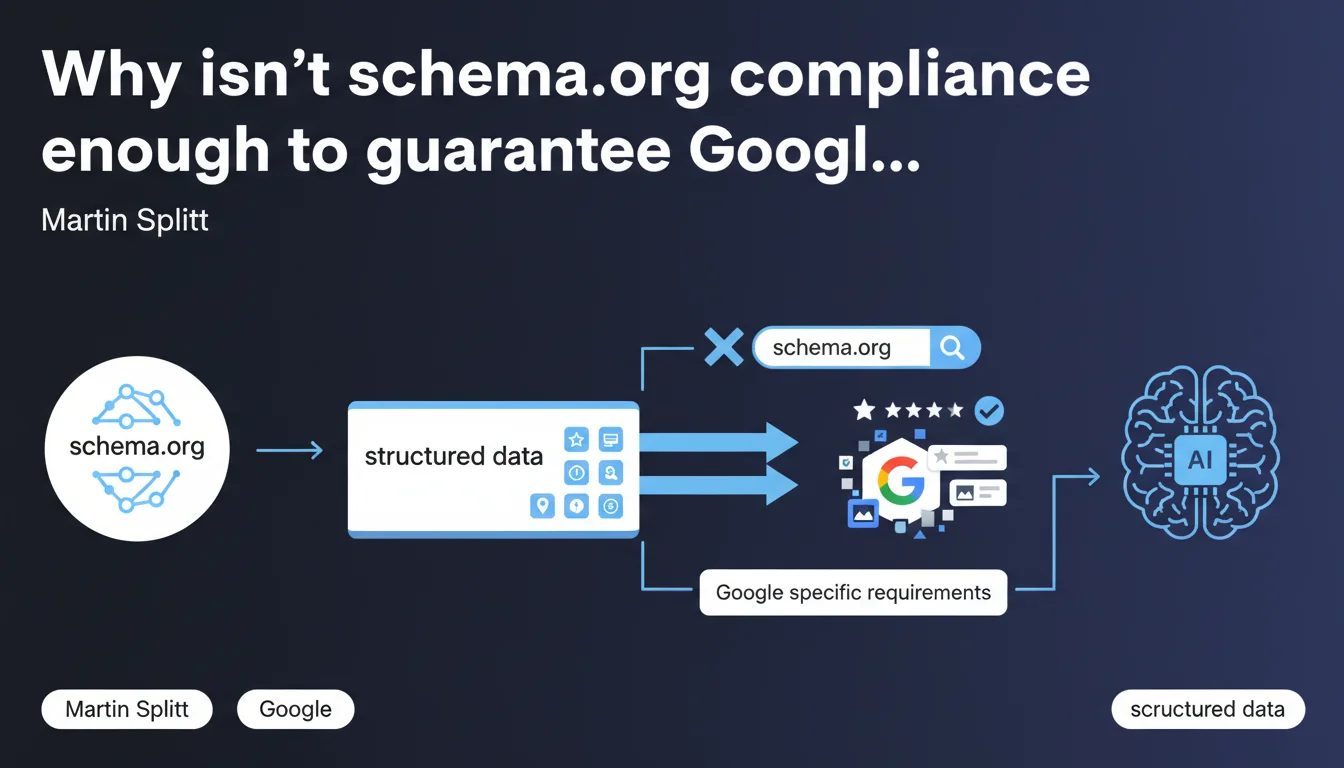
Schema.org provides an open and flexible framework for structuring data, but Google imposes its own additional criteria — often stricter — to display rich results. Complying with the Schema.org vocabulary does not guarantee eligibility for rich snippets: you must also meet Google's documented (or undocumented) requirements.
What you need to understand
What's the difference between Schema.org and Google's requirements?
Schema.org is a collaborative project initiated by Google, Bing, Yahoo, and Yandex. It defines a common vocabulary for marking up structured data: entity types (Article, Product, Event, etc.) and associated properties (name, description, price, etc.).
Google, for its part, sets additional rules for these data to trigger the display of rich results. For example, a Recipe schema valid according to Schema.org may be rejected by Google if certain mandatory properties are missing (high-resolution image, cooking time, etc.).
Why does Google add its own constraints?
Google aims to guarantee a consistent user experience. A poorly populated rich result degrades the SERP and undermines trust. By tightening criteria, Google filters out sloppy or deceptive implementations.
These requirements are documented in Search Central documentation, but some remain unclear or evolve without official communication. Attributes marked as "recommended" suddenly become "required" for certain features.
What happens if I follow Schema.org but ignore Google's guidelines?
The markup remains technically valid and can be exploited by other engines (Bing, Yandex) or services (Pinterest, voice assistants). Google will simply ignore this data and won't display a rich snippet.
No direct negative impact on organic ranking — Google has repeatedly stated that structured data is not a ranking factor — but you lose the opportunity to improve CTR through an enriched display.
- Schema.org = open and flexible vocabulary
- Google = specific requirements to activate rich snippets
- Following Schema.org ≠ guaranteed enriched display
- Some "recommended" properties become mandatory depending on context
- No penalty if non-compliant, but loss of visibility opportunity
SEO Expert opinion
Is this distinction always clear in the official documentation?
No. Google documents types of rich results (recipes, products, FAQs, etc.) with lists of "required" or "recommended" properties. But the boundary between the two shifts regularly without prior notice.
Example: the aggregateRating or offers attributes were "recommended" for Product, then became almost mandatory to trigger star display or price rendering. [To be verified]: Google doesn't always publish detailed changelogs for these adjustments.
Do other search engines apply the same rules?
Bing and Yandex have their own criteria, generally less demanding than Google. Markup rejected by Google can very well generate rich snippets on Bing.
If you operate across multiple markets or engines, it's risky to align solely with Google's requirements — you might miss opportunities elsewhere. Conversely, aiming for Google compliance usually covers the needs of others.
Should I systematically fill in all "recommended" attributes?
In theory no, since they're not mandatory. In practice, yes: Google favors complete and coherent implementations. A minimal schema risks being overlooked in favor of a more complete competitor.
Let's be honest: the "required / recommended" distinction is often cosmetic. If you want to maximize your chances of rich result display, treat recommended attributes as mandatory — unless there's a major technical constraint.
Practical impact and recommendations
What should you do concretely to maximize rich result display?
1. Consult the official Google documentation for each type of rich result you're targeting (Recipe, Product, Article, etc.). Don't rely solely on the Schema.org spec.
2. Fill in all "recommended" attributes, not just the "required" ones. Google favors exhaustive implementations. Test with the Rich Results Test to spot missing or poorly formatted properties.
3. Monitor Search Console: the "Enhancements" tab reports errors and warnings on your structured data. A warning today could become blocking tomorrow without notice.
Which mistakes should you absolutely avoid?
Never mark up invisible content for users — Google considers this spam and may deindex your rich snippets or even penalize the site.
Avoid inconsistencies between the markup and visible content: if your Product schema announces a price of $50 but the page displays $75, Google will reject the markup (and may manually sanction you).
Don't multiply schema types without connection to actual content. A blog article has no reason to carry a Recipe schema — Google ignores irrelevant tags and may suspect manipulation.
How do you verify that your implementation meets Google's requirements?
- Use the Rich Results Test on each page template concerned
- Check the "Enhancements" tab in Search Console to identify errors and warnings
- Compare your markup against official examples in Google's documentation (not just Schema.org)
- Test actual display in the SERPs (personalized search disabled): if no rich snippet appears after several weeks, review the implementation
- Audit regularly: requirements evolve, markup valid today may become obsolete in 6 months
❓ Frequently Asked Questions
Est-ce que respecter Schema.org garantit l'affichage de résultats enrichis sur Google ?
Les attributs « recommandés » sont-ils vraiment optionnels ?
Bing et Yandex utilisent-ils les mêmes règles que Google ?
Où trouver la liste officielle des exigences Google pour chaque type de résultat enrichi ?
Que risque-t-on si on ne respecte pas les exigences Google pour les données structurées ?
🎥 From the same video 18
Other SEO insights extracted from this same Google Search Central video · published on 07/06/2023
🎥 Watch the full video on YouTube →
💬 Comments (0)
Be the first to comment.