
Official statement
Other statements from this video 18 ▾
- □ Does canonical alone really prevent syndicated content from appearing in Discover, or do you actually need to add noindex?
- □ Does Google really penalize multiple domains targeting the same market, or is this just another SEO myth?
- □ Are your JavaScript library vulnerabilities causing your Google rankings to plummet?
- □ Can you really prevent Google from crawling certain parts of a webpage?
- □ Is it really worth your time submitting an XML sitemap to Google?
- □ Why isn't schema.org compliance enough to guarantee Google rich results?
- □ Do HSTS headers really impact your SEO performance?
- □ Does Google really reprocess your sitemap on every crawl?
- □ Does Google really care about the difference between HTML and XML sitemaps? Here's what John Mueller revealed
- □ Does Google really ignore structured data that contains parsing errors?
- □ Do numbers in your URLs really hurt your search rankings?
- □ How can you permanently block Googlebot from crawling your website?
- □ Does Google really issue official SEO certifications?
- □ Do multiple navigation menus really hurt your SEO?
- □ Are host groups really a sign of cannibalization you need to fix?
- □ Can you really disavow toxic backlinks by targeting their IP address in Google's tool?
- □ Should you remove the NOODP meta tag from your Blogger sites?
- □ How do you get a video thumbnail in Google search results: what does Google really mean by 'main content'?
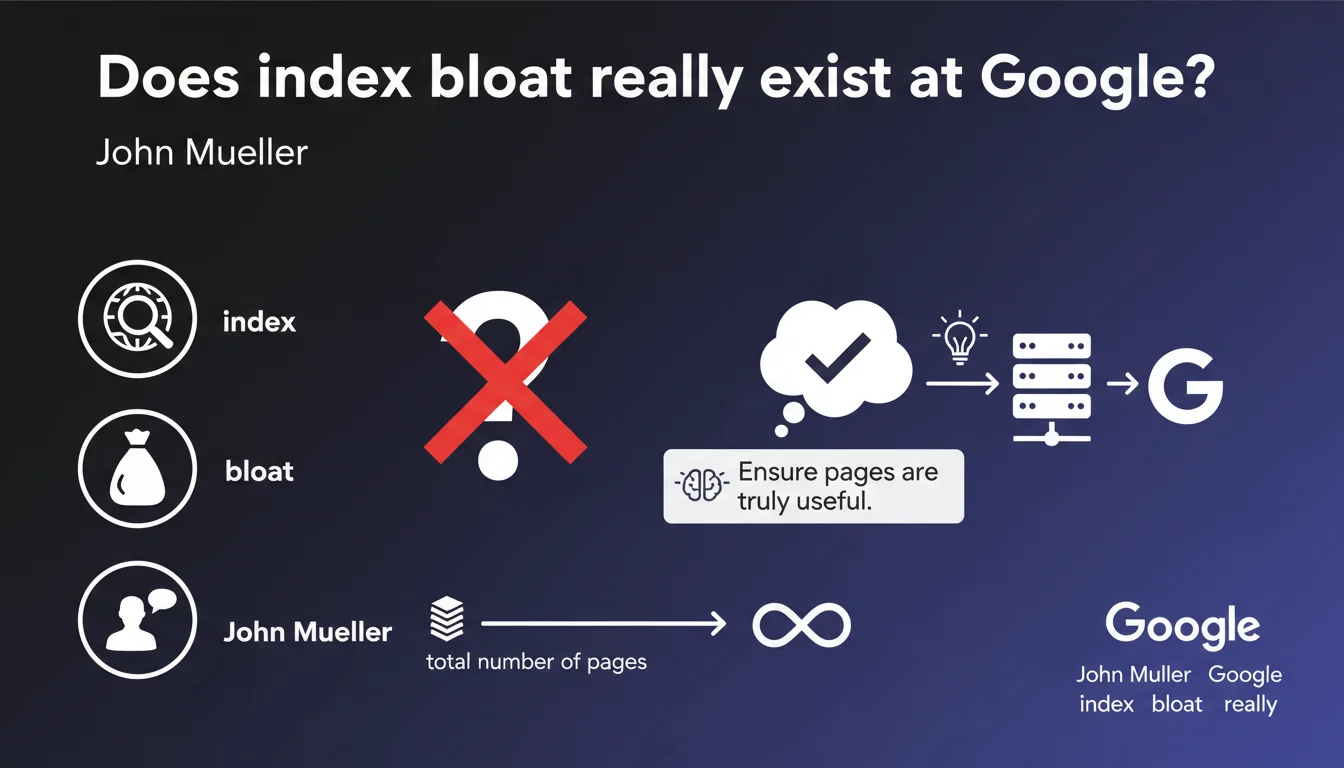
Google claims it has no index bloat mechanism that would artificially limit the number of indexed pages per site. The total volume of pages is not a criterion in itself — only their actual usefulness matters. Focus on quality rather than imaginary quotas.
What you need to understand
What exactly is index bloat?
Index bloat refers to the belief that a site with too many low-quality pages would see its overall indexation penalized. The underlying idea: Google would impose an implicit quota per domain, beyond which additional pages would dilute the visibility of the entire site.
This theory has circulated for years in the SEO community. It suggests that a site bloated with thin or duplicate content would suffer a form of global penalty, even on its quality pages.
What exactly does Mueller say about this topic?
John Mueller dismisses this concept outright: Google has no mechanism that would artificially limit the number of indexable pages per domain. Total volume is not a decisive criterion in the algorithm.
This does not mean you can index anything without consequence. Mueller is clear: ensure that the pages you submit for indexation are truly useful. That's the nuance.
Does crawl budget come into play?
Crawl budget remains a technical reality — Google cannot crawl an infinite number of pages per unit of time. But this is different from index bloat: crawl budget concerns the frequency and capacity for discovery, not a global indexation ceiling.
If your site has 10,000 useless pages, Google will eventually discover them... but will waste crawl time that could have been spent on your strategic content. The problem is therefore not a quota, but crawl efficiency.
- Google does not set arbitrary limits on the number of pages indexed per domain
- Volume is not a criterion: only the quality and usefulness of pages matter
- Crawl budget remains a real constraint, distinct from the fantasized index bloat
- Useless pages waste crawl time without adding value
SEO Expert opinion
Is this statement consistent with real-world observations?
Yes and no. On one hand, we regularly observe sites with hundreds of thousands of pages performing very well — no sign of an absolute ceiling. E-commerce giants and classified ad sites are living proof.
On the other hand, SEO practitioners observe significant improvements after deindexing weak pages. Is this a quota effect, or simply better crawl budget allocation and clearer signal definition for Google? Probably the latter. [To verify]: the actual effect remains difficult to isolate in the field.
What nuances should be added to this statement?
Mueller says Google has no index bloat mechanism — fair enough. But he does not say that having thousands of useless pages is without consequence. Crucial distinction.
A site that indexes 50,000 auto-generated pages with no added value sends a disastrous quality signal. Even without a strict quota, Google can interpret this volume as spam or thin content. The result? A loss of trust overall that impacts the entire domain.
Moreover, the notion of actual usefulness remains vague. Useful for whom? For the user? For Google? Mueller does not specify objective criteria. This evasiveness leaves the door open to all interpretations. [To verify]
In what cases does this rule not fully apply?
Niche sites with few high-value pages obviously have nothing to fear. But problems arise on large catalogs — e-commerce, real estate, classifieds.
In these contexts, even without a strict quota, the accumulation of empty pages (products permanently out of stock, expired listings, variants without inventory) creates massive friction. Google must sort, evaluate, decide what to keep. If you do not facilitate this work, you sabotage your own visibility.
Practical impact and recommendations
What should you do concretely on your site?
First action: audit your current index. List the indexed pages via Google Search Console, cross-reference with your site architecture. Identify pages that add no value — thin content, technical pages, internal search results, unnecessary filters.
Then decide for each category: deindexation (noindex), outright deletion, or content improvement. Keep indexed only what has a reason to exist for a user or for Google.
What mistakes should you avoid at all costs?
Classic mistake: believing that indexing everything that exists boosts your visibility. Wrong. Indexing empty pages, redundant variants, or auto-generated content with no added value pollutes your site.
Another trap: ignoring crawl budget under the pretext that there is no quota. The time Google spends on your useless pages, it is not spending on your strategic content. That is a waste.
How do you verify that your site complies with the recommendations?
Use Google Search Console to analyze indexed pages vs crawled pages. If you see a significant gap, investigate. Why is Google crawling pages you do not want indexed?
Also check server response time and the number of pages crawled per day. If Google is crawling slowly while you have fresh content to offer, that is a sign of inefficiency.
- Audit your current index via Google Search Console and isolate pages with no value
- Deindex or delete thin, redundant, or technical content
- Improve the editorial quality of pages kept in the index
- Optimize crawl budget by blocking unnecessary URLs via robots.txt or noindex
- Regularly monitor crawl and indexation metrics
- Prioritize semantic depth over raw page quantity
The absence of an index bloat mechanism at Google does not exempt you from rigorous index hygiene. Focus on the actual usefulness of each indexed page, optimize your crawl budget, and monitor your metrics closely.
These optimizations require specialized technical and editorial expertise. If your site has several thousand pages or if you lack internal resources, working with a specialized SEO agency can save you valuable time and avoid costly mistakes.
❓ Frequently Asked Questions
Google limite-t-il vraiment le nombre de pages indexées par site ?
Si l'index bloat n'existe pas, pourquoi désindexer des pages faibles améliore-t-il souvent les performances ?
Le crawl budget et l'index bloat sont-ils la même chose ?
Faut-il désindexer les pages de filtres ou de résultats de recherche interne ?
Comment savoir si mon site gaspille du crawl budget ?
🎥 From the same video 18
Other SEO insights extracted from this same Google Search Central video · published on 07/06/2023
🎥 Watch the full video on YouTube →
💬 Comments (0)
Be the first to comment.